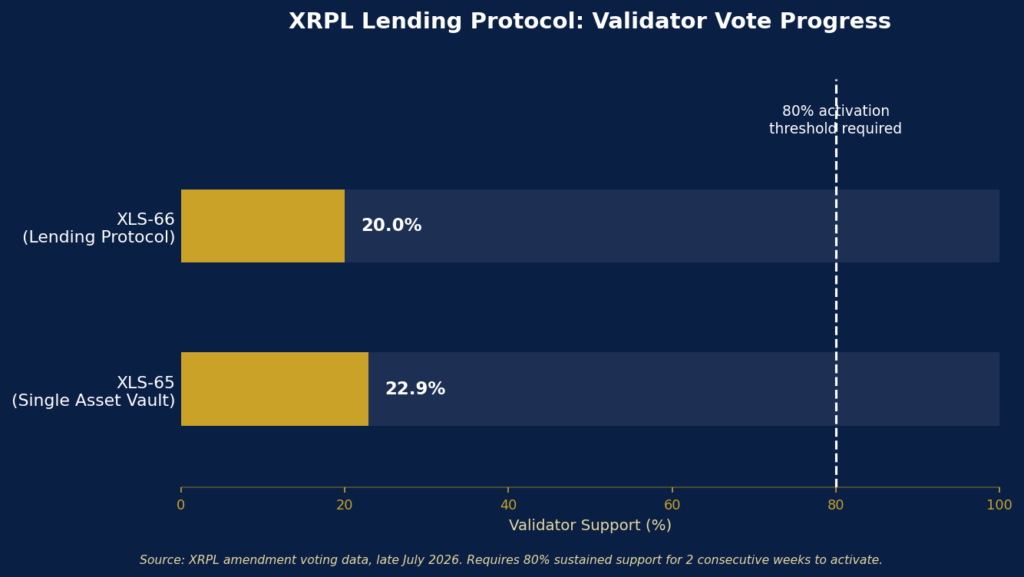
The XRPL lending protocol is one of the most consequential upgrades proposed for the XRP Ledger this year, and right now it’s stuck. Two linked amendments — XLS-65 and XLS-66 — have been open for validator voting on mainnet since June 30, 2026, and as of late July, support sits at roughly 20% of the network’s validators. Activation requires 80% sustained support for two consecutive weeks. The gap between where the vote stands and where it needs to be is the real story institutions tracking the XRPL lending protocol should be watching.
What the XRPL Lending Protocol Actually Does
Strip away the ticker symbols and the XRPL lending protocol is a fairly simple idea: bring structured, fixed-term credit directly onto the XRP Ledger, rather than leaving lending to third-party applications built on top of it. XLS-65 defines a Single Asset Vault, a standardized container that pools deposits from multiple participants and issues shares tracking each depositor’s stake. XLS-66 builds the lending logic on top of that vault — loan origination, interest accrual, amortized repayment, and default handling, all recorded on-ledger through dedicated transaction types.
Crucially, the protocol keeps credit underwriting off-chain. Banks and financial institutions using the XRPL lending protocol would still run their own credit checks, legal review, and risk assessment through existing compliance workflows — the ledger only handles execution once terms are agreed. That design choice matters because it lets the protocol plug into how regulated lenders already operate, rather than asking them to adopt an entirely new risk model.
Mechanically, XLS-66 introduces three dedicated transaction types to manage the loan lifecycle: LoanSet to originate a loan under agreed terms, LoanPay to process interest and principal payments, and LoanDelete to close out a completed or defaulted loan. Every step is recorded directly on the ledger, giving lenders and borrowers a transparent, auditable settlement trail without needing a separate off-ledger system to track loan status.
How This Differs From Typical DeFi Lending
Readers familiar with decentralized finance on other chains might assume the XRPL lending protocol works like Aave or Compound, where anyone can supply crypto as overcollateralized backing and borrow against it algorithmically. It doesn’t — and that gap between the XRPL lending protocol and typical DeFi lending is the whole point of its design. This is fixed-term, underwritten credit extended to credentialed counterparties who pass through XRPL’s existing permissioned domains and credential verification systems — closer to a traditional term loan than an open, permissionless lending pool.
That distinction is deliberate. The compliance architecture runs through mechanisms XRPL already supports: permissioned domains that restrict participation to approved counterparties, credential verification tied to real-world identity checks, and clawback and freeze functionality that regulated institutions require for legal and risk-management reasons. It’s a design built specifically for banks and payment firms operating under existing securities and lending law, not for anonymous retail yield farming.
How XRPL Amendment Voting Actually Works
The XRP Ledger doesn’t add new features through a company decision or a single vote at a point in time. Amendments like those behind the XRPL lending protocol activate only when validators — the independent servers that maintain network consensus — signal sustained support. Specifically, more than 80% of trusted validators must vote in favor continuously for two full weeks before the change goes live on mainnet.
That threshold is intentionally high. It’s designed to prevent contested or rushed changes from altering the ledger’s behavior without broad agreement across the validator community, which includes exchanges, businesses, and independent operators rather than a single centralized authority.
This is worth contrasting with how other blockchains add features. Many networks rely on a smaller set of core developers or a foundation to push upgrades through with far less friction. XRPL’s approach is slower by design, which means the XRPL lending protocol timeline says less about the quality of the underlying code and more about how conservatively the validator set treats any change that introduces genuinely new financial primitives to the ledger.
Why the Vote Is Stuck Near 20%
As of the most recent tracking, XLS-65 held support from roughly 7 to 8 of the network’s 34-35 validators — in the 20-23% range — while XLS-66 tracked similarly. Both figures sit well below the 80% threshold, and there’s no fixed deadline forcing a resolution. Validators can leave amendments in this holding pattern indefinitely.
The most likely explanation isn’t outright opposition. Given the depth of formal verification, security audits, and attackathon testing RippleX has already put the XRPL lending protocol through — including bounties of up to $200,000 for anyone who finds a design flaw — this reads more like validators taking a cautious, wait-and-see posture on a genuinely new category of on-ledger functionality than active resistance. Validator operators, particularly those running infrastructure for exchanges or institutional clients, tend to move deliberately on amendments that introduce entirely new transaction types rather than incremental tweaks to existing ones.
That caution has a track record on XRPL. Major amendments introducing new capabilities — rather than small bug fixes — have historically taken months of gradual validator sign-on before crossing the 80% line, even when the underlying code has already passed audits. The XRPL lending protocol appears to be following that same slow-build pattern rather than an unusually contested one.
One early sign of developer confidence, regardless of the validator timeline, is SOIL — a project that has publicly stated its intention to become the first application built on top of the XRPL lending protocol and its Single Asset Vault framework. SOIL’s team has already signaled support for activating the amendments as soon as possible, and is building against the devnet implementation in the meantime. A functioning application ready to launch the moment mainnet activation occurs would meaningfully shorten the gap between validator approval and real institutional usage.
Why This Matters More Than a Typical Amendment Vote
Most XRPL amendments are technical housekeeping that pass with little public attention. The XRPL lending protocol is different because it changes what the ledger is fundamentally used for. XRPL has moved through phases of representing value, moving value, and trading value — RippleX’s own framing for this milestone is that lending represents the next phase: financing value.
That distinction matters for how institutions think about XRP and RLUSD as productive assets rather than static holdings. Under the current design, RLUSD is positioned as a primary vault asset within the lending structure, which would let payment providers and treasury teams generate yield on stablecoin holdings that currently just sit idle, and it connects directly to the tokenized asset activity we’ve been tracking — including Ondo Finance’s cross-border settlement of tokenized US Treasuries on XRPL back in May.
RLUSD’s role here is worth spelling out. According to CoinGecko data, RLUSD has grown to roughly a $1.5 billion market cap since its late-2024 launch, giving the XRPL lending protocol a liquid, dollar-denominated base asset with meaningful existing supply from day one of activation. That matters because a lending market is only as useful as the liquidity available to fund it — a protocol with strong technical design but no ready capital base would take considerably longer to gain real traction than one that already has a stablecoin with billions in circulation positioned to fund its vaults.
How This Connects to the Broader Institutional Picture
This isn’t happening in isolation. Our recent coverage of Ripple Mint and the RLUSD institutional push covered how RLUSD is expanding as a settlement and payments asset; the XRPL lending protocol would be the next logical layer on top of that infrastructure, turning stablecoin liquidity into an interest-bearing product rather than a pure medium of exchange.
It also sits alongside the regulatory picture from our piece on the CLARITY Act’s impact on XRP. A durable federal framework for XRP’s legal status would make it considerably easier for regulated banks to participate directly in on-chain lending vaults, rather than relying solely on the interpretive commodity classification currently in place. The two developments — regulatory clarity and native credit infrastructure — reinforce each other rather than existing as separate stories.
And it connects to a third thread we’ve tracked: the growing roster of disclosed institutional XRP ETF holders. ETF exposure and native on-chain lending serve different institutional needs — one offers regulated market exposure without custody responsibility, the other offers a yield-generating use case for firms that already hold XRP or RLUSD directly. A bank disclosed as an ETF holder today isn’t necessarily a candidate to participate in lending vaults tomorrow, but the two channels together paint a picture of an asset accumulating multiple, distinct institutional use cases rather than a single narrow one.
What Activation Would Actually Change
It’s worth being concrete about what changes the day the XRPL lending protocol crosses the 80% threshold, versus what doesn’t. On activation, eligible institutions gain the technical ability to originate fixed-term loans, pool assets into vaults, and settle interest and repayment schedules natively on XRPL. What doesn’t change automatically is adoption — a live amendment is infrastructure, not demand. Vault usage would still depend on whether banks, payment firms, and treasury desks choose to build products on top of it, which typically takes additional months even after a technical capability goes live.
That’s a meaningful distinction for anyone tracking this as an investment thesis rather than a technical one. The XRPL lending protocol activating is a necessary condition for on-chain XRP credit markets to exist — it is not, by itself, a guarantee that meaningful capital will flow into them immediately.
What to Watch Next
There’s no scheduled date by which the XRPL lending protocol vote must resolve, so patience is the realistic posture here. A few concrete signals are worth tracking: whether validator support climbs meaningfully above the current 20% range in the coming weeks, whether any major exchange-affiliated validators publicly commit to a “yes” vote, and whether SOIL — the project positioning itself as the first application built on this framework — launches functioning products on devnet ahead of any mainnet activation.
If the amendments do eventually clear the 80% threshold, the two-week sustained requirement means there would still be a predictable lag between crossing that line and the feature actually going live, giving institutions time to prepare rather than facing a surprise activation. For readers tracking this alongside other 2026 XRP catalysts, the XRPL lending protocol is a slower-moving story than a Senate vote or an ETF flow report — but it’s arguably a more structural one, since it would change what the ledger itself is capable of rather than simply how existing capabilities are packaged and regulated.
For readers who want to track validator voting progress and XRP price action together in real time, an exchange like Bybit can offer a faster read than waiting for the next amendment status update.
Disclosure: This post contains an affiliate link. If you choose to open an account through it, this site may earn a commission at no extra cost to you.