If you’re trying to gauge the CLARITY Act XRP impact this week, the honest answer is: still pending, and more contested than the headlines suggest. On July 28, 2026, Senate leadership shelved a planned floor vote on the Digital Asset Market Clarity Act, pushing it behind a Russia sanctions bill and a batch of nominations. For a token whose legal status has swung between court rulings and regulatory interpretations for years, that delay is not a footnote — it’s the whole story right now. Understanding the CLARITY Act XRP impact means separating this week’s scheduling noise from the underlying legislative math.
A Brief History: How XRP Got Here
To understand why one Senate bill carries so much weight, it helps to remember how unsettled XRP’s legal status has been. A 2023 federal court ruling found that XRP sold to retail buyers on public exchanges did not, by itself, constitute a securities transaction — a win for Ripple, but a narrow one that left plenty of open questions about institutional sales and secondary markets.
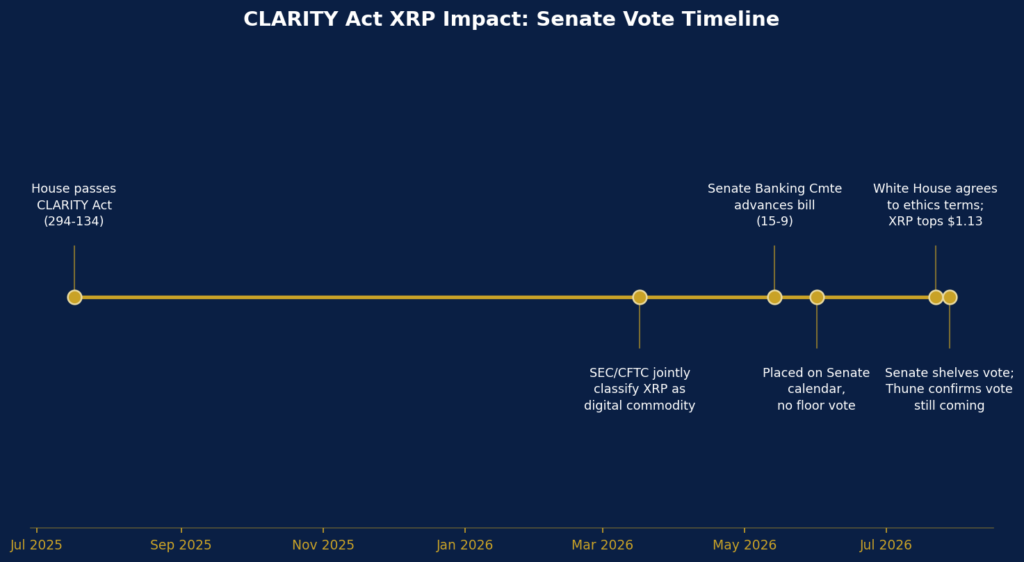
That ambiguity persisted for years until March 17, 2026, when the SEC and CFTC jointly classified XRP as a digital commodity. It was a meaningful step, but it came through interpretive guidance rather than legislation — meaning a future set of regulators, under a different administration or agency leadership, could revisit or narrow that stance without Congress ever voting on it. That gap between “regulators currently agree” and “the law says so” is exactly the question at the heart of the CLARITY Act XRP impact debate.
What Happened This Week
The CLARITY Act XRP impact story had real momentum just days earlier. On July 22, the White House agreed to ethics provisions that Senate Democrats had been demanding, restricting crypto-related business activity by senior officials, including the president. XRP jumped past $1.13 on the news, and commentary framed the bill as “one clause away” from a floor vote. That optimism ran into Senate scheduling reality less than a week later.
Majority Leader John Thune has publicly confirmed that a vote will still happen before the August recess, even as Russia sanctions and confirmation battles take priority on the floor calendar, according to reporting from DailyCoin. That leaves a narrow window — days, not weeks — for the bill to actually reach the floor before Congress leaves town, and for the CLARITY Act XRP impact question to move from theoretical to concrete.
Why This Matters More for XRP Than Most Tokens
XRP occupies a specific position in this debate, which is why the CLARITY Act XRP impact question gets asked far more often than it would for most other tokens. In March 2026, the SEC and CFTC jointly classified XRP as a digital commodity, following years of litigation. That classification currently rests on regulatory interpretation, not statute — which means a future set of regulators could simply reverse it. The CLARITY Act would convert that interpretation into permanent federal law.
For institutional allocators — pension funds, asset managers, and bank trust desks — that distinction is not abstract. An interpretive stance can shift with the political wind; a statute requires new legislation to undo. This is the core reason the CLARITY Act XRP impact gets discussed in institutional research far more than it does for tokens without XRP’s litigation history.
The Vote Math Behind the Delay
The mechanics behind the delay explain a lot about the CLARITY Act XRP impact timeline. The bill cleared the House 294-134 back in July 2025, then passed the Senate Banking Committee 15-9 in May 2026. Since June 1, it has sat on the Senate’s general calendar without a floor vote. Passage requires 60 votes.
Republicans now hold 52 seats, following the death of Senator Lindsey Graham on July 12, and are expected to lose at least two of their own members — Senators Josh Hawley and Rand Paul — on substantive grounds, meaning roughly 8 or more Democratic votes are needed, with only two, Ruben Gallego and Angela Alsobrooks, reliably secured so far, per analysis from Disruption Banking. Senator Mitch McConnell’s continued absence from votes tightens that math further.
Prediction markets have tracked this uncertainty closely, and their trajectory is itself a real-time gauge of the CLARITY Act XRP impact on institutional sentiment. Odds of 2026 passage on Polymarket have been on a steady decline rather than a back-and-forth swing: from a spring high near 82% in February, down to the 40-50% range by June, then falling further to around 37% after Thune told reporters on July 24 that he did not expect passage before the recess. As of this week, odds sit in the low-to-mid 30s.
Two structural issues explain most of the back-and-forth behind the CLARITY Act XRP impact story. First, the Senate Banking and Agriculture committees produced separate drafts with different approaches to stablecoin yield rules and how decentralized finance protocols should be treated, and no floor vote can proceed until those texts are reconciled into one bill. Second, an ethics dispute over restrictions on crypto-related business activity by senior federal officials — including provisions touching the president directly — held up negotiations for months before the White House agreed to terms on July 22.
That ethics breakthrough is what pushed XRP past $1.13 and generated the “one clause away” narrative that circulated last week. It’s also why this week’s scheduling delay landed as a genuine surprise rather than an expected outcome: the substantive disagreements had largely been resolved, and what remains is simply competition for limited floor time against higher-priority items like Russia sanctions and judicial confirmations.
What Passage Would Actually Change for Institutions
It’s worth being precise about the CLARITY Act XRP impact — what the bill does and doesn’t do. It would not create a brand-new legal status for XRP from scratch — the digital commodity classification already exists. What it would do is convert that classification from an interpretive stance, which any future SEC or CFTC leadership could revisit, into a durable statutory framework that requires an act of Congress to unwind.
For compliance and legal teams at banks, asset managers, and custodians, that distinction determines how much institutional infrastructure gets built on top of an asset. Firms are generally far more willing to commit long-term resources — custody arrangements, trading desks, structured products — to an asset whose legal footing can’t be quietly reversed by the next set of regulators. This is the practical, unglamorous mechanism through which the CLARITY Act XRP impact would most likely show up first: not in a single day’s price move, but in a gradual increase in institutional infrastructure commitments over the following year.
What a Failed or Delayed Vote Would Look Like
The counterfactual matters just as much for assessing the CLARITY Act XRP impact. If the Senate misses the August recess window entirely, the bill doesn’t automatically die — bills can carry over within a Congress — but the practical odds of action drop sharply. September’s floor calendar is already expected to be crowded, and any bill without a specific forcing mechanism tends to lose priority the longer it sits.
In that scenario, XRP’s legal status would remain exactly where it is today: commodity treatment by regulatory interpretation, not statute. That’s a meaningfully better position than XRP held before March 2026, but it leaves the door open to reversal under a future administration less favorably disposed toward digital assets — the specific risk institutional counsel has flagged repeatedly in commentary on this bill.
The CLARITY Act XRP Impact on Institutional Positioning
For readers tracking XRP as an institutional asset rather than a short-term trade, the CLARITY Act XRP impact shows up less in daily price action and more in how allocators frame risk. A permanent statute removes the single largest legal overhang cited in institutional research on XRP exposure — the possibility that a future SEC could simply reinterpret the 2026 commodity classification.
That’s also why the bill’s delay doesn’t erase the underlying case for XRP’s institutional narrative. As we covered in our breakdown of XRP ETF institutional adoption, spot ETF inflows and the broader RLUSD infrastructure buildout — including the Ripple Mint institutional push — have continued to advance independently of where this bill sits on the calendar. Legislative clarity would reinforce that trend rather than create it from scratch.
What Could Still Change the Timeline
A handful of concrete developments would move the CLARITY Act XRP impact timeline forward or push it into 2027:
- A merged Banking–Agriculture Committee text. No floor vote can happen until the two committees reconcile competing provisions on stablecoin yield and DeFi treatment.
- Two to seven additional Democratic votes declared publicly. The gap between current commitments and the 60-vote threshold is the single biggest open variable.
- A confirmed floor calendar slot before August recess. Thune’s public confirmation is a signal of intent, not a guaranteed timeline — sanctions bills and nominations can still eat available floor time.
Missing the August recess doesn’t necessarily kill the bill, but it does push any vote into a September session already crowded with other priorities, and a failure to act in 2026 at all risks pushing comprehensive crypto market-structure legislation years further out.
How This Compares to Other Jurisdictions
The U.S. isn’t the only market working through crypto market-structure rules this year, and the contrast is instructive. Ripple has already secured a full Crypto Asset Service Provider license under the EU’s MiCA framework, allowing it to offer regulated services across the European Economic Area without waiting on a single piece of pending legislation. That gives Ripple’s institutional stablecoin and payments business a functioning regulatory home in Europe regardless of what happens in the Senate.
The U.S. situation is different because XRP’s commodity status and Ripple’s corporate licensing are separate questions — and it’s precisely why the CLARITY Act XRP impact is a distinctly U.S. legal question rather than a global one. A European operating license doesn’t resolve how XRP itself is treated under U.S. federal law, which is precisely the gap the CLARITY Act targets. For institutional allocators weighing exposure across jurisdictions, that means Europe currently offers more settled ground for Ripple’s business operations, while the U.S. remains the more consequential — and more contested — market for XRP’s legal classification specifically.
How This Fits the Broader 2026 Pattern
This delay lines up with a pattern we’ve flagged before: XRP tends to move on catalysts, and stalls when they age without resolution. Our recent look at XRP and altcoin underperformance in 2026 noted that the CLARITY Act was one of the few remaining fresh catalysts capable of reigniting institutional interest independent of a broader market rotation, and this week is a real-time test of the CLARITY Act XRP impact thesis. This week’s delay is a live example of that dynamic — genuine legislative progress, immediately offset by a scheduling setback that keeps the catalyst pending rather than delivered.
A Note on Positioning Around the Vote
Legislative timelines are notoriously hard to trade around, and this one has already slipped multiple times through 2026. Treat any specific date — the August recess, a particular week in September — as a soft target rather than a certainty, and size any short-term positioning accordingly. The more durable signal is the direction of travel: substantive disputes over ethics and stablecoin rules have largely been resolved, even if scheduling keeps getting pushed back.
For longer-term institutional watchers, the more useful exercise is tracking the underlying vote count directly — how many Democratic senators have publicly committed — rather than reacting to each new headline about calendar delays, which tend to move price more than they move the actual legislative math.
The Bottom Line on CLARITY Act XRP Impact
Nothing about this week’s delay changes the underlying legal or institutional case for XRP — it just extends the timeline for converting a reversible regulatory interpretation into permanent law. The CLARITY Act XRP impact remains one of the more consequential open questions in crypto policy for 2026, and it will most likely be resolved, one way or another, in the next several weeks rather than dragging on indefinitely.
For readers who want the clearest read on how markets are pricing this in real time, watching XRP price action around Senate calendar updates directly on an exchange like Bybit can offer a faster signal than waiting for the next headline cycle.
Disclosure: This post contains an affiliate link. If you choose to open an account through it, this site may earn a commission at no extra cost to you.