Institutional interest in XRP is entering a new phase in the summer of 2026, and the numbers behind XRP institutional adoption tell a clearer story than the day-to-day price chart. While XRP has spent much of July consolidating between roughly $1.09 and $1.15, the underlying fundamentals point to steady institutional engagement rather than retreat. Ripple’s stablecoin business, regulatory progress in Washington and Brussels, and continued flows into spot exchange-traded funds are combining to reshape how banks, asset managers, and payment companies view the asset.
This article breaks down the specific developments fueling XRP institutional adoption right now, why they matter more than short-term price swings, and what investors watching this trend should keep in mind heading into the fourth quarter. None of this is investment advice, but understanding where the institutional money is actually flowing can help explain why the XRP narrative looks so different depending on whether you are reading a price chart or a regulatory filing.
RLUSD and Ripple Mint Are Central to XRP Institutional Adoption
One of the clearest signals of XRP institutional adoption this month comes from Ripple’s stablecoin, RLUSD, and the newly launched Ripple Mint platform. Ripple Mint lets institutional clients mint and manage RLUSD directly, giving banks and payment firms a regulated on-ramp for using the XRP Ledger in day-to-day settlement. RLUSD circulation has grown to roughly $1.51 billion, up from a much smaller base earlier in the year, and reserve assets backing the token now sit slightly above circulation at around $1.62 billion.
That reserve structure is backed by cash, cash equivalents, and short-term US Treasuries, and it is verified through regular attestations from a New York State Department of Financial Services-regulated trust company. This level of transparency is exactly what institutional treasury teams look for before committing meaningful capital, and it helps explain why RLUSD has become one of the more closely watched pieces of the broader XRP institutional adoption story this year.
Ripple has been explicit that XRP and RLUSD are designed to work together rather than compete for the same use case, and this pairing is a core part of the current XRP institutional adoption cycle. XRP supplies bridge liquidity across currency pairs, while RLUSD functions as the regulated settlement asset institutions actually hold on their balance sheets. This division of labor matters because it lets risk-averse institutions gain exposure to the XRP Ledger’s settlement speed without taking on the price volatility of XRP itself.
The CLARITY Act and XRP Institutional Adoption
Regulation has historically been the biggest obstacle to XRP institutional adoption in the United States, and that picture continues to shift. The CLARITY Act, proposed federal legislation that would classify XRP as a commodity under CFTC oversight rather than a security, was awaiting possible Senate floor action before the August congressional recess as of late July 2026. A commodity classification would remove much of the legal ambiguity that has kept some US institutions on the sidelines since the SEC’s original case against Ripple.
That case, decided in 2023 by a federal judge in the Southern District of New York, found that XRP itself is not inherently a security, though the manner in which it was sold in certain contexts could constitute one. That nuanced ruling left compliance teams at larger banks and asset managers with lingering questions about how to treat the token internally, even after the immediate legal fight wound down.
A clean commodity classification through federal legislation would resolve that ambiguity in a way a single court case never fully could, since it would apply uniformly across regulators rather than being interpreted case by case. Passage before the August recess is not guaranteed, but even the bill reaching a floor vote would mark meaningful progress compared with the regulatory limbo XRP faced just a few years ago.
Ripple has also picked up ground overseas, which adds another dimension to XRP institutional adoption outside the US. The company received a full Crypto Asset Service Provider license covering the European Economic Area, allowing it to offer regulated services across the EU under the MiCA framework. Combined with potential US commodity status, this dual-track regulatory progress is one of the strongest tailwinds behind XRP institutional adoption today, since global institutions typically need clarity in multiple major jurisdictions before allocating meaningfully to a digital asset.
The EU’s MiCA framework, which came fully into force across the bloc earlier in 2026, has already pushed some smaller exchanges to exit the European market rather than meet its compliance requirements. Ripple securing a full license under that same framework, rather than scaling back, signals a level of regulatory confidence that stands out against that broader industry backdrop and gives European banks a compliant counterparty to work with.
ETF Inflows Reflect Ongoing XRP Institutional Adoption
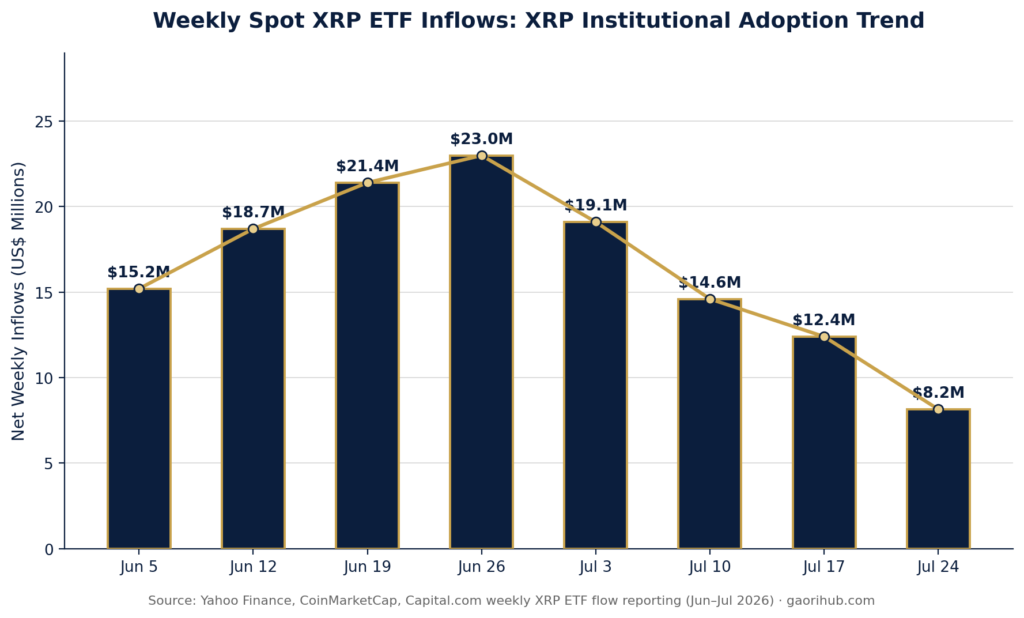
Spot XRP ETFs launched in the US since late 2025 have become one of the most direct, measurable channels for tracking XRP institutional adoption. Seven spot XRP ETFs are now trading, with cumulative net inflows reaching roughly $1.5 billion by late June 2026 after eight consecutive weeks of positive flows. Inflows moderated somewhat in July, slowing to roughly $8 million to $12 million in some weekly readings, but the fact that flows have stayed net positive through a period of price weakness is a meaningful data point for XRP institutional adoption watchers.
Providers including Bitwise, Franklin Templeton, and Canary Capital have all built out XRP-focused products, and CME’s XRP futures market has reportedly surpassed tens of billions of dollars in cumulative notional volume in its first year. Taken together, these figures suggest that XRP institutional adoption is no longer a speculative narrative confined to retail forums. It now shows up in regulated, auditable investment vehicles that traditional allocators can access through ordinary brokerage accounts.
On-chain cost-basis data adds another layer to this picture. Heatmaps tracking where XRP supply was last acquired show large clusters of coins concentrated in the $1.18 to $1.22 range, levels that have repeatedly capped recent bounces. Reading ETF flows alongside this kind of on-chain data gives a more complete view of XRP institutional adoption than price alone, since it shows both where money has entered through regulated products and where existing holders are positioned to react as price approaches key technical levels.
[INSERT CHART HERE: xrp-institutional-adoption-etf-inflows.png — Alt text: “XRP institutional adoption ETF inflow trends chart 2026”]
Price Action Hasn’t Caught Up With XRP Institutional Adoption Yet
One of the more interesting dynamics in the current market is the gap between fundamentals and price, which is common in an early-stage XRP institutional adoption cycle. XRP has traded in a consolidation range near $1.10 to $1.15 for much of late July, with the 200-day moving average around $1.09 acting as a key technical line. Analysts have pointed out that retail search interest and short-term momentum indicators have weakened even as the institutional side of the story, RLUSD growth, ETF flows, and regulatory progress, keeps improving.
Some analysts, including those at Standard Chartered, revised long-term XRP price targets downward earlier in the year while maintaining more bullish multi-year forecasts. The takeaway for anyone tracking XRP institutional adoption is that near-term price action and long-term institutional positioning can move on very different timelines, and treating a single quarter’s chart as proof one way or the other tends to miss the bigger structural shift underway.
Risks and Open Questions
No discussion of XRP institutional adoption would be complete without acknowledging the risks. ETF inflows can reverse quickly if broader risk sentiment sours, and the July slowdown in weekly inflows, down to roughly $8 million to $12 million from the $20 million-plus weeks seen earlier in the summer, is a reminder that institutional demand is not guaranteed to keep accelerating in a straight line. The Federal Reserve’s policy meetings remain a recurring source of volatility for the entire crypto market, XRP included.
Legislative risk also cuts both ways. The CLARITY Act still needs to clear the Senate floor and any reconciliation process before it becomes law, and there is no guarantee of the exact timeline or final language. Bitcoin’s own price trend matters too, since XRP has historically moved in tandem with broader market risk appetite even as its institutional-specific catalysts develop somewhat independently. Investors should weigh these open questions alongside the more encouraging structural developments described above.
What XRP Institutional Adoption Means for Investors
For long-term holders, the current phase of XRP institutional adoption offers a useful reframe: instead of watching daily price swings, it may be more productive to track the pace of RLUSD circulation growth, the cadence of new ETF inflow data, and legislative milestones like the CLARITY Act’s progress through Congress. These are the metrics institutions themselves are watching, and they tend to move more slowly and more predictably than retail sentiment.
For traders, the practical implication is that XRP institutional adoption and short-term price weakness can coexist for extended periods. Anyone actively trading this range should be especially mindful of position sizing given the historical volatility around regulatory headlines. Readers who want to see how the underlying XRP Ledger infrastructure is evolving alongside this institutional push can also look at recent developments in on-chain lending on the XRP Ledger, where new XRPL-native protocols are extending the ledger’s use cases well beyond simple settlement.
Bottom Line on XRP Institutional Adoption
Between RLUSD’s growth past $1.5 billion, Ripple’s EU licensing win, ongoing spot ETF inflows, and the CLARITY Act’s path through Congress, the case for XRP institutional adoption is arguably stronger today than the price chart alone suggests. Whether that translates into a near-term rally likely depends on broader risk appetite and the Federal Reserve’s policy path, but the structural pieces behind XRP institutional adoption, regulated products, transparent reserves, and clearer legal status, are falling into place one at a time.
Readers who want direct market exposure to XRP alongside these institutional developments can do so through a regulated exchange such as Bybit.
Disclosure: This post contains an affiliate link. If you sign up through it, gaorihub.com may earn a commission at no extra cost to you.
Sources: Capital.com XRP market coverage (July 27, 2026); FX Leaders Ripple Mint and RLUSD coverage (July 24, 2026); FX Leaders XRP ETF and technical setup coverage (July 27, 2026); Yahoo Finance XRP ETF inflow data (June 29, 2026).