If you want to know who the real XRP ETF holders are, the SEC’s own paperwork already tells you — you just have to know where to look. Every quarter, institutional investment managers overseeing more than $100 million in US securities must file a Form 13F with the SEC, disclosing their long positions in regulated products. Since spot XRP ETFs launched in the US in late 2025, those filings have quietly built a public roster of XRP ETF holders ranging from Wall Street banks to small regional advisory firms.
A Quick History of How XRP ETFs Got Here
Spot XRP ETFs are still a relatively recent addition to the US market, having launched in November 2025 after years of regulatory uncertainty over XRP’s legal status. Seven separate spot products now trade on US exchanges, issued by firms including Bitwise, Franklin Templeton, Grayscale, 21Shares, Canary Capital, and Volatility Shares, among others. Cumulative net inflows across these products have topped roughly $1.5 billion since launch, even as XRP’s own price has traded sideways to lower through much of 2026.
That combination — steady product-level inflows alongside soft price action — is itself part of why the identity of the underlying XRP ETF holders has become such a closely watched data point among institutional analysts. When flows and price diverge, the natural question is whether the money moving in is short-term speculative capital or longer-horizon institutional allocation. Quarterly 13F disclosures are one of the only public tools available to answer that question with actual names attached, rather than aggregate flow totals alone.
What a 13F Filing Actually Shows
Before naming names, it’s worth being precise about what these filings do and don’t reveal. A 13F is a snapshot of quarter-end positions, filed up to 45 days after the quarter closes. For 2026, that puts filing deadlines in mid-February, mid-May, mid-August, and mid-November, each covering the prior quarter’s holdings.
That lag matters. The XRP ETF holders named in a given filing may have already trimmed, added to, or fully exited their position by the time the public sees the disclosure. A 13F also doesn’t show cost basis, hedges, or whether the capital belongs to the firm itself or its clients. Treat every name on this list as a confirmed historical fact, not a live position.
There’s a second limitation worth flagging for anyone sizing up XRP ETF holders from this data. Form 13F only covers long positions in what the SEC classifies as Section 13(f) securities — a category that includes US-listed ETFs but excludes short positions, cash, and any digital assets held directly rather than through a regulated wrapper. A firm’s true crypto exposure could be considerably larger or smaller than what shows up in its 13F. The filing captures one specific channel through which institutions gain exposure, not the full picture of how they’re positioned.
The Big Names: Goldman Sachs, Morgan Stanley, UBS
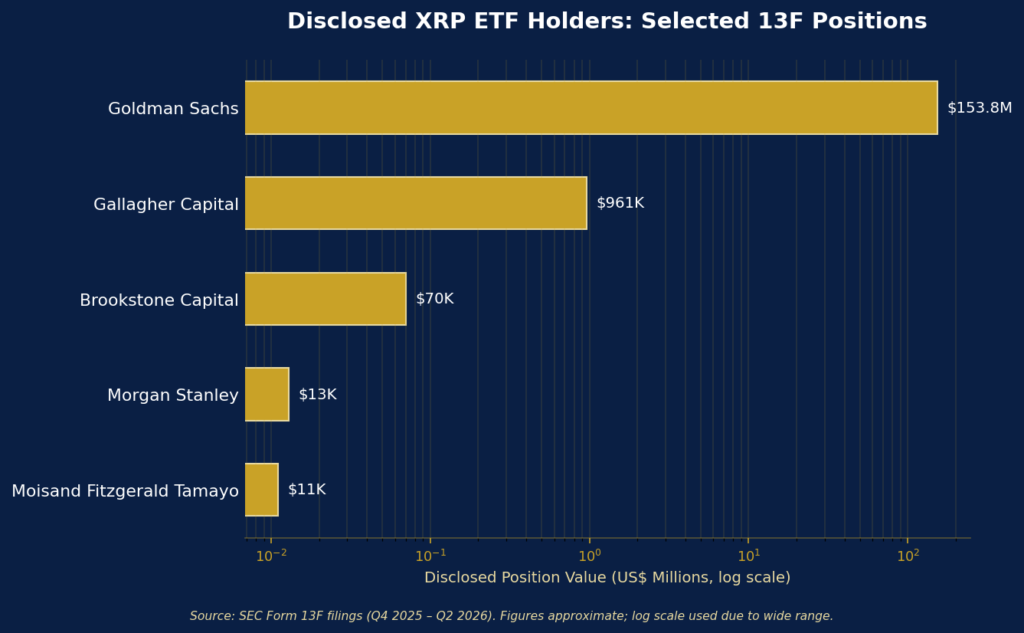
The most significant disclosure so far among XRP ETF holders came from Goldman Sachs, whose Q4 2025 13F revealed a $153.8 million position spread across four separate spot XRP ETFs — roughly $40 million in Bitwise’s fund, $38.5 million in the Franklin XRP Trust, $38 million in Grayscale’s XRP ETF, and $36 million in the 21Shares product. That made Goldman the largest disclosed institutional holder among the current roster of XRP ETF holders in the United States.
Morgan Stanley and UBS followed with smaller but still notable positions. Morgan Stanley’s filing showed a position in the Volatility Shares XRP ETF alongside a separate Grayscale holding, while UBS disclosed 197,369 shares of the Volatility Shares XRP ETF and a smaller stake in the Grayscale XRP Trust. Bank of America has also reported allocations, according to multiple 13F trackers. None of these positions are large relative to the banks’ overall balance sheets, but their mere presence in the filings is the story — global systemically important banks do not typically appear in a crypto-linked product’s shareholder registry by accident.
It’s worth being clear about scale here, since dollar figures alone can mislead. Goldman Sachs manages well over a trillion dollars in client and firm assets; a $153.8 million XRP ETF position represents a rounding error on that scale, and is almost certainly a mix of client-directed allocations, trading-desk inventory, and possibly hedging activity rather than a single conviction bet on XRP’s future. The same caveat applies to Morgan Stanley, UBS, and Bank of America. These filings confirm exposure exists among the major XRP ETF holders on record — they don’t confirm strategic conviction at the institutional level.
The Long Tail: Smaller RIAs Are Showing Up Too
What’s arguably more interesting than the big-bank disclosures is how far down the list of XRP ETF holders this trend now reaches, and how quickly that list is growing each quarter. Q2 2026 filings, submitted around mid-July, added a batch of smaller registered investment advisors to the roster. Gallagher Capital Management disclosed 86,744 shares of the Canary XRP ETF, valued at roughly $961,000. Citadel reported a position in the same Canary fund. Brookstone Capital Management disclosed a stake worth just over $70,000.
Two smaller regional advisors filed even more modest positions: Moisand Fitzgerald Tamayo, a Florida-based RIA managing $1.35-1.4 billion in assets, disclosed 964 shares of the Franklin XRP ETF worth about $11,000, and Virginia-based Main Street Group filed a similar small allocation. These are not headline-making dollar figures, but that’s precisely the point — firms this size don’t typically take on regulatory and compliance overhead for a position unless there’s a considered reason behind it.
It’s also worth noting who these smaller firms actually are. Registered investment advisors like Moisand Fitzgerald Tamayo and Main Street Group typically manage diversified portfolios for individual clients — retirees, small business owners, and families working with a financial planner rather than a hedge fund. A regional RIA adding even a small XRP ETF allocation to client portfolios suggests the asset is being evaluated using the same due-diligence process applied to any other regulated security, not treated as a speculative side bet. It’s a small but telling detail in the broader picture of who XRP ETF holders actually are today.
Why the Small Filings Matter More Than the Big XRP ETF Holders
A $153.8 million Goldman Sachs position is easy to explain away as a large bank hedging exposure across products, or a trading desk facilitating client flow rather than expressing genuine conviction. A $11,000 position from a Florida RIA with $1.4 billion in total assets under management is harder to explain that way. At that scale, the position isn’t material to the firm’s balance sheet — it exists because someone at the firm made a deliberate decision to add XRP exposure to a client’s regulated portfolio.
That’s the more meaningful signal buried in this batch of XRP ETF holders: institutional adoption of XRP is not confined to a handful of large banks testing the waters. It has started spreading into the ordinary machinery of wealth management, where advisors managing pensions, trusts, and individual retirement accounts are choosing regulated ETF wrappers specifically to avoid the custody and compliance burden of holding XRP directly.
This pattern mirrors what happened with Bitcoin ETFs in their second and third year on the market, when the initial wave of large-bank disclosures gradually gave way to a much longer list of mid-sized RIAs and family offices. If XRP ETFs follow a similar adoption curve, the current roster of disclosed XRP ETF holders — a mix of a few major banks and a handful of small advisors — is likely closer to the beginning of that curve than the end of it.
How This Connects to the Bigger Institutional Picture
This pattern builds on ground we’ve covered before. Our earlier look at XRP ETF institutional adoption focused on the inflow and product side — which ETFs exist, how much capital has moved into them, and how that compares to Bitcoin and Ethereum products. The 13F data adds the missing piece: not just how much money has moved into XRP ETFs, but specifically which kinds of institutions are the XRP ETF holders behind those numbers.
It also connects to the regulatory picture we covered in our recent piece on the CLARITY Act’s impact on XRP. Part of the reason ETF wrappers appeal to compliance-conscious RIAs and banks in the first place is that they sidestep the exact legal ambiguity the CLARITY Act is meant to resolve. A regulated, SEC-registered ETF wrapper already offers institutions a workaround for XRP’s unsettled statutory status — which is also why many allocators may not be waiting on Congress before building positions.
Put differently, the current list of disclosed XRP ETF holders may already reflect institutions that have made a practical peace with regulatory uncertainty by using a wrapper that keeps them within existing securities law, rather than institutions waiting for Congress to resolve the underlying question. Passage of the CLARITY Act wouldn’t necessarily accelerate this specific channel of adoption; it would more likely open the door to direct custody arrangements that don’t currently show up in any 13F filing at all.
A Note on Reading Future Filings
Anyone following this data going forward should resist the urge to treat a single quarter’s list of XRP ETF holders as a trend by itself. Institutional position sizes fluctuate for reasons that have nothing to do with conviction about XRP specifically — rebalancing schedules, client redemptions, tax-loss harvesting near year-end, and routine portfolio maintenance can all shift a filed position without reflecting any change in view. The more reliable signal comes from watching the same XRP ETF holders across multiple consecutive quarters, and watching whether the total number of disclosed holders is trending up or down over time.
What to Watch in the Next Filing Cycle
The next batch of Q3 2026 13F filings is due by mid-November, covering positions as of September 30. Three things are worth tracking when that data lands: whether Goldman’s position has grown, shrunk, or stayed roughly flat; whether more regional RIAs join the list of disclosed XRP ETF holders; and whether any of the current XRP ETF holders have exited entirely, which would be a more meaningful signal than a filing showing a position for the first time.
Given the 45-day lag built into every filing, none of this offers a real-time read on institutional sentiment. But as a slow-moving, quarter-by-quarter record of who is willing to put their name next to XRP in a public SEC filing, it remains one of the more concrete pieces of evidence available for how deep institutional interest in XRP actually runs.
For readers who want to track XRP price action alongside these institutional disclosures in real time, an exchange like Bybit can offer a faster read than waiting for the next quarterly filing cycle.
Disclosure: This post contains an affiliate link. If you choose to open an account through it, this site may earn a commission at no extra cost to you.