XRPL Institutional Custody Just Got a Major Upgrade Proposal
The XRP Ledger community is weighing one of the most consequential proposals of 2026, and it has nothing to do with price. On August 5, a group of XRPL developers introduced a new standard called On-Chain Cosigner, designed to fix a long-standing weakness in how the network handles multi-signature transactions. For anyone tracking XRPL institutional custody developments, this proposal matters more than another price prediction ever could, because it addresses the exact friction point that has kept some banks and regulated funds cautious about using the ledger for asset custody.
This proposal also adds to a broader wave of XRP Ledger institutional upgrades already reshaping the network this year, from privacy features to tokenized settlement rails.
At its core, the update is about coordination. XRPL has supported multi-signature transactions for years, letting several parties jointly authorize a payment or asset transfer. But the actual process of collecting those signatures happens off-chain, through manual coordination between signers. If the person responsible for gathering approvals goes offline, loses data, or simply drops the ball, the entire transaction can stall indefinitely. Developers call this the “last mile” problem, and it has quietly limited how comfortable large institutions feel relying on XRPL for sensitive custody workflows.
The Off-Chain Bottleneck Holding Back XRPL Institutional Custody
To understand why this proposal is generating so much attention, it helps to look at how multisig currently works on most blockchains, XRPL included. A group of signers agrees that a transaction requires, say, three out of five approvals. Each signer produces their portion of the signature, but those signatures then need to be gathered together, usually through email, a shared document, or a third-party coordination tool, before the transaction can be submitted to the network.
That dependency creates exactly the kind of operational risk that compliance teams hate. Banks, custodians, and regulated funds typically require clear audit trails, segregation of duties, and predictable failure handling. When the signature-collection process happens outside the blockchain, none of those guarantees are native to the system. A missed email or an offline coordinator can delay a transaction with no on-chain record of why. For XRPL institutional custody use cases specifically, this has been treated as a structural weakness rather than a minor inconvenience.
How the On-Chain Cosigner Proposal Works for XRPL Institutional Custody
The proposal, authored by XRPL developers Shawn Xie, Zhiyuan Wang, Chenna Keshava B S, and Mayukha Vadari, takes a different approach to XRPL institutional custody. Instead of gathering signatures somewhere off the ledger, it stores the signing request directly on-chain as a native object called a TransactionProposal. Each signer submits their approval directly to the network, where it is validated in real time. There is no single coordinator whose failure can halt the process, because the ledger itself keeps track of who has signed and who has not.
Community member Vet, who has been vocal about the proposal, described the shift plainly: the update adds native on-chain coordination that is completely decentralized, removing the need for a trusted intermediary to shepherd signatures across email threads or private messaging. That framing captures why the proposal is being discussed as a milestone for XRPL institutional custody rather than just another technical tweak. It converts an informal, error-prone process into something the protocol itself can guarantee.
Deployment is not automatic. Like any XRPL amendment, the change will only go live if a supermajority of network validators votes to approve it, and that voting process takes time. Still, the fact that this proposal exists at all signals where the ledger’s core contributors think the biggest gaps in XRPL institutional custody remain, and why closing them has become a development priority.
Why XRPL Institutional Custody Adoption Depends on This Upgrade
It’s worth stepping back to ask why custody, specifically, is the bottleneck worth solving right now. Institutions exploring blockchain rails are not primarily worried about transaction speed or fees; XRPL already settles in a few seconds at a fraction of traditional costs. What holds many of them back is confidence that asset custody can meet the same operational standards as their existing infrastructure, with clear approval chains and no single point of failure.
On-Chain Cosigner directly targets that concern. A custodian holding assets on behalf of clients can structure multisig approvals so that every step of the authorization process is recorded natively on the ledger, with no off-chain handoff that auditors have to reconstruct after the fact. For a compliance officer evaluating whether to greenlight XRPL institutional custody arrangements, that difference is not cosmetic. It changes what can be demonstrated to regulators and internal risk committees.
The timing lines up with broader momentum. Ripple has been actively expanding its regulatory footprint, including a recently obtained Crypto Asset Service Provider license from Luxembourg that opens the door for European institutions to integrate with the ledger more directly. Combined with a proposal aimed squarely at custody-grade coordination, the pieces are falling into place for XRPL institutional custody products that look and behave more like what traditional finance already expects.
Part of a Broader Institutional Push: XRPL 3.3.0
On-Chain Cosigner is not arriving in isolation. It is expected to complement the upcoming xrpld 3.3.0 release, a bundle of five protocol amendments that RippleX has been previewing since late July. According to RippleX’s head of product, Jazzi Cooper, the release focuses on making assets that are already issued on XRPL more usable in everyday financial activity, including global transfers, trading, collateralizing, and settlement.
The bundle reportedly includes zero-knowledge-powered privacy features for tokenized assets, atomic batch settlement, and role-based access controls built specifically with institutional users in mind. Batch transactions, in particular, are designed to work alongside the multisig proposal, letting institutions bundle multiple actions into a single, auditable unit rather than processing them one at a time. Taken together, the direction is unmistakable: XRPL institutional custody is becoming a design priority for the protocol’s core development, not an afterthought bolted on by third parties.
A native XRPL lending protocol is also in the pipeline, allowing on-chain borrowing and lending of XRP and RLUSD directly on the ledger. None of these features exist purely for retail convenience. They are aimed at the specific operational needs of banks, custodians, and asset managers who need programmable, auditable financial infrastructure before they will commit meaningful volume to XRPL institutional custody arrangements.
Market Context: Growing Institutional Interest in the XRP Ledger
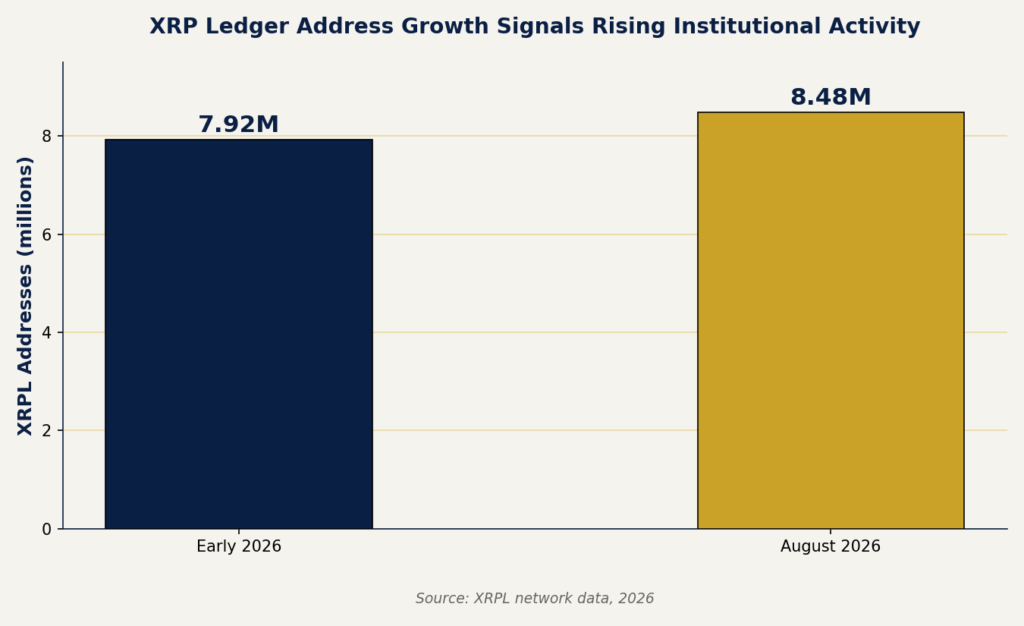
Interest in XRPL institutional custody is not developing in a vacuum. The proposal is landing at a moment when XRPL’s underlying usage metrics are already climbing. Network address counts rose from roughly 7.92 million to 8.48 million during 2026, with transaction volume more than doubling in early August alone. That growth has coincided with a wave of institutional announcements, including Ripple’s strategic investments in Zilo and Licuido to expand capital markets infrastructure connected to the ledger, and a tokenized share class of Aviva’s US Dollar Liquidity Fund launching on XRPL.
Ripple President Monica Long summarized the shift in early August, describing a rapid transition from bank pilots toward production-grade activity across the ecosystem, a description that applies just as well to XRPL institutional custody as it does to tokenized funds. Separate infrastructure projects are also underway to connect XRP and RLUSD liquidity with tokenized U.S. Treasury products, using audited reserves and regulated custody controls.
None of this activity depends on the multisig proposal passing, but it does explain why XRPL institutional custody has become such a focal point for developers right now. The rails for tokenized, institution-grade finance are being built in parallel, and custody coordination is one of the last structural gaps. It also mirrors the broader trend in XRP institutional adoption across custody, lending, and settlement infrastructure this year.
XRP’s own price action has stayed comparatively quiet through this period, trading in a tight range near the $1 support level that traders have been watching closely. That disconnect between subdued price movement and accelerating infrastructure development is fairly typical for XRPL; the ledger’s institutional roadmap tends to move on its own timeline, independent of short-term market sentiment.
Risks and What Comes Next
None of this is guaranteed to ship on the proposed timeline for XRPL institutional custody. XRPL amendments require validator approval through a formal voting process, and proposals with this much architectural weight tend to draw extended technical review before validators commit. It is entirely possible the mechanism gets revised, delayed, or bundled differently before activation. Anyone evaluating XRPL institutional custody prospects based on this proposal should treat it as a strong signal of direction rather than a finished product.
There is also the question of adoption beyond the protocol layer. Even once On-Chain Cosigner is technically available, custodians and financial institutions will need to build their own operational processes around it, get internal compliance sign-off, and in many cases wait for regulatory clarity in their home jurisdictions. Technical capability and institutional readiness do not always move at the same pace.
Validator operators have been encouraged to review the proposal’s technical documentation as it becomes available, with further implementation guides and security reviews expected in the coming weeks. Ripple’s Swell conference later this year is widely expected to bring additional announcements tied to XRPL institutional custody and the broader institutional push, so it’s worth watching that event for confirmation of how far the multisig upgrade and the related XRPL 3.3.0 features hXRP trading pairsave progressed.
Final Thoughts
The On-Chain Cosigner proposal is a reminder that some of the most important developments in crypto infrastructure happen away from price charts entirely. By moving multisig coordination fully on-chain, XRPL is directly addressing one of the clearest remaining obstacles to institutional-grade custody, and doing so in a way that could make the ledger meaningfully more attractive to banks, custodians, and regulated funds evaluating blockchain rails. Whether or not validators approve the exact mechanism as proposed, the direction of travel for XRPL institutional custody infrastructure is becoming difficult to ignore.
For traders who prefer to act on XRP’s price action rather than its infrastructure roadmap, a reliable exchange with deep liquidity still matters. Those exploring spot or margin positions around XRP’s current range can find that setup on Bybit, one of the exchanges offering XRP trading pairs alongside broader market tools. As always, this is not financial advice, and any trading decision should account for your own risk tolerance.