The XRP Ledger institutional upgrade is finally moving from proposal to protocol. RippleX has confirmed that xrpld v3.3.0 is set for release, bundling five amendments aimed squarely at banks, asset issuers, and enterprise users of the XRP Ledger. Unlike prior updates that focused on retail-facing speed or fee tweaks, this release is built around the operational needs of institutions: batching transactions, delegating limited account access, and keeping sensitive balances private while still satisfying auditors.
For anyone tracking XRP as infrastructure rather than a short-term trade, the XRP Ledger institutional upgrade is one of the more consequential technical stories of the year. It arrives alongside an unrelated but complementary community proposal for on-chain multisig coordination, meaning the ledger’s custody and compliance tooling is advancing on two fronts at once.
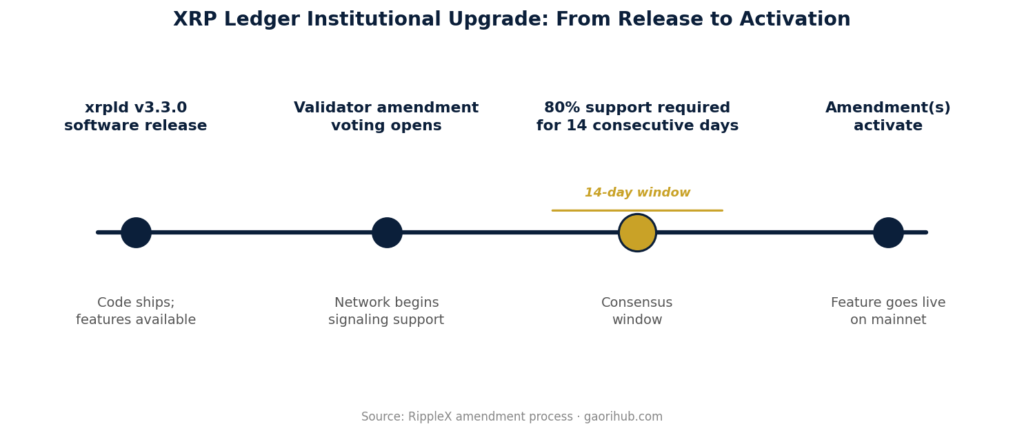
The XRP Ledger Institutional Upgrade Explained
RippleX Head of Product Jazzi Cooper framed the release as the next logical step after tokenization proved viable on-chain. The network has already demonstrated it can issue and settle tokenized assets at scale; the XRP Ledger institutional upgrade is meant to make those assets usable in the way institutions actually operate — transferred, collateralized, traded, and settled without manual bottlenecks. Two of the five amendments are returning features, restored after earlier versions were pulled during security audits that flagged critical issues, which says something about how carefully this rollout has been vetted before shipping.
That vetting process matters because institutional counterparties do not adopt infrastructure on marketing promises. Compliance teams need predictable behavior, auditable trails, and a credible security review history before they will route real balance sheets through a public ledger. According to reporting from <a href=”https://crypto.news/xrp-ledger-v3-3-0-brings-five-institutional-features/”>crypto.news</a>, RippleX has described privacy as often being a prerequisite for institutions to use public blockchain infrastructure at all, rather than a nice-to-have feature layered on top. The XRP Ledger institutional upgrade is explicitly positioned to answer that bar, rather than to chase a retail feature checklist.
Five Protocol Amendments Driving the XRP Ledger Institutional Upgrade
The v3.3.0 package bundles five amendments, each targeting a distinct friction point institutions have raised about using the XRP Ledger at scale:
- Batch Transactions — combine up to eight transactions into a single atomic package
- Permission Delegation — grant employees or third parties limited account access without exposing full wallet control
- Confidential MPT — conceal Multi-Purpose Token balances and transfer amounts from public view
- Dynamic MPT — allow issuers to adjust token settings after issuance instead of locking parameters permanently
- Sponsored Fees — let a third party cover transaction costs, reducing friction for end users
None of these amendments activate the moment the software ships. Each has to clear the ledger’s amendment voting process first, which is a deliberate design choice that keeps any single stakeholder from forcing a change onto the network. Coverage from <a href=”https://www.kucoin.com/blog/hk-xrp-ledger-v3-3-0-upgrade-what-to-know-about-the-upcoming-release-and-new-features”>KuCoin’s research desk</a> frames the five features as directly tailoring the network’s infrastructure for institutional adoption and real-world asset tokenization, rather than as isolated developer tools.
Batch Transactions and Permission Delegation for Enterprise Wallets
Batch Transactions solves a specific institutional pain point: multi-step settlement. Today, if a transfer, a currency conversion, and a fee payment all need to happen together, each step is a separate transaction with its own failure risk. Under the XRP Ledger institutional upgrade, up to eight of those steps can be bundled so they either all succeed or all fail together, which removes the partial-execution risk that compliance and treasury teams flag as a blocker for automation.
Permission Delegation addresses a different problem: operational access without custody risk. A bank running treasury operations rarely wants a single private key controlling everything an operations team touches. Delegated permissions let an institution assign narrow, revocable authority — approve payments up to a limit, or submit specific transaction types — without ever exposing the underlying account’s full signing power to a junior employee or an external vendor. Together, these two amendments form the operational backbone of the XRP Ledger institutional upgrade: fewer manual steps, and access control that maps onto how real organizations are structured.
Confidential and Dynamic MPTs: Privacy Without Losing Compliance
Confidential MPT is arguably the most structurally important piece of the XRP Ledger institutional upgrade, because it targets the single biggest objection banks raise about public blockchains: everyone can see everyone else’s balances and flows. Using elliptic-curve encryption and zero-knowledge proofs, Confidential MPT hides token balances and transfer amounts from the public ledger while still allowing a designated party — an auditor, a regulator, a compliance officer — to verify the data when required. It does not touch XRP balances, NFTs, or standard IOUs; the scope is deliberately narrow, targeting the tokenized-asset use case where commercial confidentiality actually matters.
Dynamic MPT solves a quieter but equally practical problem. Once an issuer creates a Multi-Purpose Token today, its settings are effectively fixed. Real-world financial products change — fee structures shift, transfer restrictions are updated, compliance requirements evolve.
Dynamic MPT lets issuers adjust those parameters after the fact instead of having to deprecate and reissue an entire token class, which is closer to how traditional fund administrators actually manage products over time. Between the two, this pairing gives the XRP Ledger institutional upgrade a privacy layer that regulators can still see through when they need to, which is the balance institutional users have been asking XRPL to strike for some time.
On-Chain Multisig: Closing a Custody Gap the XRP Ledger Institutional Upgrade Doesn’t Cover
Separately from the v3.3.0 package, XRPL community developers have submitted an “On-Chain Cosigner” proposal that tackles a gap the formal amendments don’t touch: multisignature coordination. The ledger has supported multisig transactions for years, but the coordination step — collecting signatures from multiple authorized parties — still happens off-chain, through manual distribution or third-party tooling that can fail or introduce a single point of trust. As one XRPL community contributor put it in reporting from <a href=”https://u.today/xrp-ledger-eyes-major-multisig-upgrade-targeting-institutional-custody”>U.Today</a>, most chains, including XRPL today, require signers to coordinate off-chain, and this proposal would make that coordination native and fully decentralized on-chain instead.
The new proposal would move that coordination fully on-chain, letting proposals and signatures live directly on the ledger so any authorized signer can complete a transaction without a separate off-chain assembly process. For institutional custody setups — where a treasury transaction might legitimately require sign-off from three or four separate approvers — that is a meaningful reduction in operational fragility.
It is also a sign that the XRP Ledger institutional upgrade extends beyond what RippleX has formally packaged into v3.3.0. If adopted, the on-chain cosigner model would complement the batch and delegation amendments by removing one of the last manual steps left in institutional-grade account management, closing a gap that custody providers have flagged for years but that no single amendment had directly addressed until now.
Validator Consensus and Realistic Timeline
None of this happens overnight. Every XRP Ledger amendment — including all five in the v3.3.0 package — requires at least 80% continuous support from the network’s trusted validators over a 14-day window before it activates. That threshold exists precisely to prevent a rushed or contested change from taking effect, and it means the practical rollout of the XRP Ledger institutional upgrade will be measured in weeks, not days, even after the software itself ships.
It is also worth being precise about sequencing: the xrpld v3.3.0 release and the amendment activation are two separate events. Shipping the code makes the features available for validators to support; it does not turn them on.
Anyone evaluating the near-term business case for using these features should plan around the full validator window, not the announcement date. <a href=”https://www.cryptopolitan.com/xrp-ledger-set-for-major-v3-3-0-upgrade/”>Cryptopolitan’s coverage</a> of the release makes the same point — the update is designed to make the ledger more attractive to institutions, but every change still has to clear the same amendment voting process XRPL has always used, with no shortcuts for institutional-focused features. Past amendments have cleared that bar in as little as two weeks and, in more contested cases, taken several months, so the XRP Ledger institutional upgrade timeline is worth watching rather than assuming.
What the XRP Ledger Institutional Upgrade Means for XRP Long-Term
Context matters here. This upgrade doesn’t exist in isolation — it builds directly on infrastructure already live on the network. <a href=”https://gaorihub.com/xrpl-lending-protocol/”>XRPL’s institutional lending protocol</a> already gave the network fixed-term, underwritten credit primitives built for professional lenders rather than pooled DeFi yield chasers. <a href=”https://gaorihub.com/ripple-mint-rlusd-xrp-support/”>Ripple’s RLUSD infrastructure</a> gave it a compliant stablecoin rail.
Confidential and Dynamic MPT extend that same institutional logic to the broader universe of tokenized assets — funds, bonds, structured products — that need privacy and flexibility the original MPT standard didn’t offer. Taken together, the lending protocol, RLUSD, and the XRP Ledger institutional upgrade read less like three separate headlines and more like one continuous infrastructure build-out aimed at a single audience: regulated financial institutions evaluating XRPL as settlement infrastructure.
None of this is a short-term price catalyst, and it shouldn’t be read as one. Near-term XRP price forecasts remain wide, with AI-model consensus and analyst ranges clustering XRP between roughly $1.05 and $1.25 for the month, and infrastructure upgrades rarely move price on their own.
What the XRP Ledger institutional upgrade actually changes is the addressable use case: it gives banks and asset issuers fewer technical excuses not to build on the ledger, which is a slower, more structural kind of bullish case than a chart pattern. Whether that translates into measurable enterprise adoption will depend on how many of the five amendments actually clear the 80% validator threshold, and how quickly issuers build products on top of Confidential and Dynamic MPT once they do.
Institutions evaluating the XRP Ledger institutional upgrade are underwriting infrastructure risk, not trading a headline — due diligence on validator activation status and audited amendment code should come before any allocation decision, on-chain or otherwise. Traders who want exposure to XRP while this plays out can review current market access through Bybit’s exchange platform. This article is for informational purposes only and is not financial advice; the referral link above is an affiliate link, and cryptocurrency trading carries substantial risk of loss.