For years, XRP sat on the sidelines of the exchange-traded fund conversation while Bitcoin and Ethereum absorbed the bulk of institutional attention. That gap has closed faster than most analysts expected. XRP ETF institutional adoption is no longer a theoretical narrative — it is a measurable, fast-growing allocation trend that asset managers, RIAs, and treasury desks are now underwriting into their 2026 portfolio strategies.
This shift did not happen in isolation. It followed a resolution of long-standing legal uncertainty, a new regulatory listing framework, and a wave of infrastructure upgrades to the XRP Ledger (XRPL) itself. For institutional investors evaluating whether XRP deserves a permanent line item in a diversified digital asset allocation, understanding the mechanics behind this XRP ETF institutional adoption wave is essential.
The Numbers Behind the XRP ETF Institutional Adoption Wave
The pace of capital entering XRP ETFs has surprised even bullish observers. According to Ripple’s official recap of the ETF launch, U.S. spot XRP ETFs did not post a single net outflow day in their first month of trading — an unusually clean start for a newly listed commodity-based product.
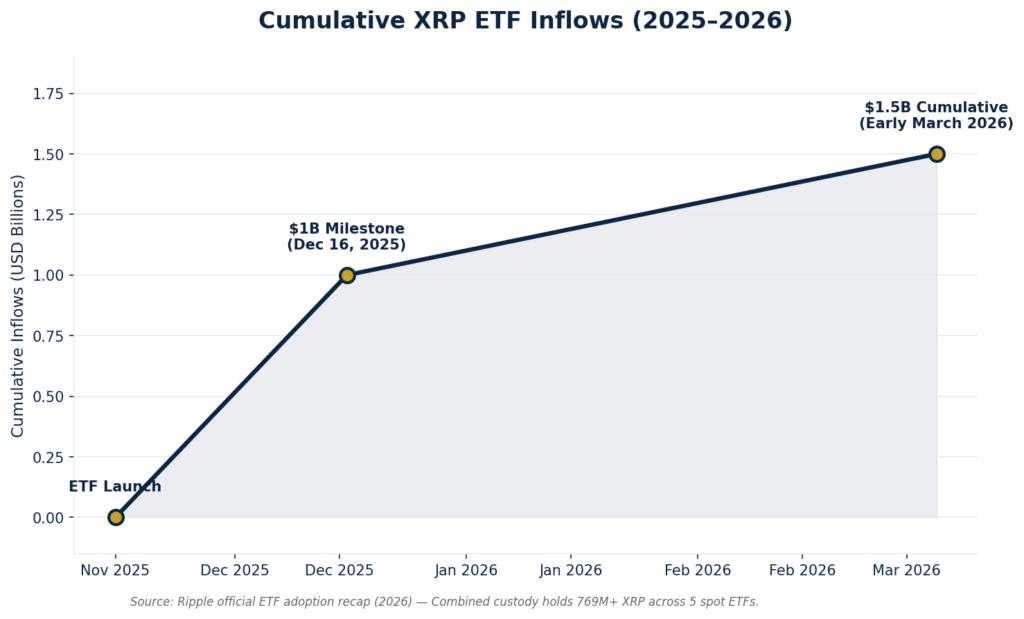
Cumulative inflows crossed the $1 billion mark by mid-December 2025, making XRP the fastest digital asset to reach that milestone since Ethereum’s ETF debut. Momentum carried into the new year: by early March 2026, cumulative inflows exceeded $1.5 billion across five spot XRP ETFs, with more than 769 million XRP tokens held in combined custody arrangements.
That custody detail matters more than it might first appear. Every ETF share sold to an institutional buyer corresponds to XRP held under a regulated custodian — which means ETF growth is, indirectly, a stress test of the same custody infrastructure institutional desks have been building out independently.
Readers evaluating self-custody versus custodial models for direct XRP holdings may find it useful to compare against our institutional-grade XRP custody guide, which covers cold storage and multisig protocols for firms that hold XRP outside of an ETF wrapper.
Why Institutions Are Moving Now: The Regulatory Unlock Behind XRP ETF Institutional Adoption
The catalyst for this capital shift traces back to a structural change in how digital asset ETPs get approved. Historically, a spot crypto ETF filing could take up to 240 days to clear individual SEC review.
By mid-2025, new generic listing standards for commodity-based cryptocurrency ETPs compressed that historically lengthy review process significantly, removing much of the regulatory friction that had kept institutional capital on the sidelines.
Ripple executives have been vocal about what this unlock means at scale. Ripple President Monica Long has projected that roughly half of Fortune 500 companies will have formal digital asset strategies or hold crypto directly on their balance sheets by the end of 2026, and she has forecast that between 5% and 10% of capital markets settlement activity could move onchain as custodian banks and clearing houses adopt tokenization.
Those are aggressive targets, but Ripple has tied them to concrete deal flow rather than pure speculation — including a major asset manager’s move to bring traditional fund structures onchain via the XRPL, as detailed in Ripple’s institutional adoption commentary.
Real-World Asset Tokenization Is Reinforcing the ETF Thesis
XRP ETF institutional adoption does not exist in a vacuum — it is being reinforced by parallel infrastructure work on the ledger itself. One of the more consequential technical developments is the proposed XLS-0096 standard.
As outlined in recent technical coverage, this standard introduces Confidential Multi-Purpose Tokens, embedding encryption and zero-knowledge proofs directly into the token standard so that individual wallet balances and transfer amounts stay hidden from public block explorers. Crucially, the design still lets validators mathematically confirm that total supply rules are being followed without decrypting individual balances, and issuers retain the ability to freeze assets for compliance purposes.
For institutions, this “selective disclosure” model solves a problem that has quietly blocked broader real-world asset (RWA) tokenization on public ledgers: the tension between transparency requirements for network integrity and the confidentiality obligations firms owe their clients. A bond desk tokenizing a fund structure cannot operate on a ledger where competitors can see every position in real time — XLS-0096 is a direct answer to that constraint.
Alongside this, permissioned decentralized exchanges went live on the XRPL earlier in 2026, completing a piece of infrastructure Ripple has described as the final requirement for institutional payment flows, alongside existing digital identity credentials and permissioned domains. Together, these upgrades are designed to let regulated entities transact on a public ledger while still meeting KYC, AML, and disclosure obligations — a prerequisite most institutional risk committees treat as non-negotiable before allocating capital.
RLUSD’s Role in the Broader Institutional Stack
A stablecoin is rarely the headline of an ETF story, but RLUSD has become an important supporting piece of the institutional adoption thesis. RLUSD is being used across payment flows, treasury management functions, and as collateral within Ripple Prime, effectively acting as the working-capital layer that sits alongside XRP itself.
XRP Ledger’s Q1 2026 results showed strong growth in stablecoins, tokenized assets, payment activity, and institutional infrastructure, even as speculative trading cooled — a pattern institutional allocators tend to read as a healthier, less speculative growth signal than a pure price rally.
This matters for how firms think about portfolio construction. An allocation built purely around XRP’s price trajectory is a directional bet. An allocation that also accounts for RLUSD’s treasury utility and the ETF’s custody-backed structure is closer to an infrastructure bet — a distinction many risk committees weigh heavily.
For a deeper framework on balancing directional exposure against structural, utility-driven exposure, see our guide to XRP liquidity and portfolio risk management.
Portfolio Allocation Considerations for Institutional Investors
Firms evaluating XRP ETF institutional adoption as part of a broader digital asset sleeve are generally weighing three factors:
- Custody and counterparty risk. ETF exposure removes the operational burden of private key management, but it introduces custodian concentration risk — worth stress-testing against direct custody alternatives.
- Liquidity depth relative to mandate size. With combined ETF custody now holding several hundred million XRP tokens, liquidity has improved materially, though allocators managing large positions should still model slippage against actual daily volume rather than headline market cap.
- Utility-based valuation versus speculative multiples. One utility-based model ties XRP’s potential value to the share of SWIFT’s transaction volume it could realistically capture, implying meaningfully higher valuations if adoption targets near 14% of SWIFT volume are met.
None of this eliminates volatility. Even amid a heavy institutional marketing push in 2026 centered on XRPL infrastructure, real-world tokenization, and compliant DeFi, XRP’s price has not always moved in step with the institutional narrative.
This underscores a real debate within the holder base about whether Ripple’s partnerships are generating native XRPL demand or simply settling on adjacent infrastructure. Institutional investors should treat XRP ETF institutional adoption data as a signal of structural demand, not a guarantee of near-term price performance.
ETF Exposure vs. Direct XRP Holdings: Which Structure Fits the Mandate?
Not every institution should default to the ETF wrapper simply because it is the most liquid on-ramp available. The right structure depends heavily on mandate, reporting requirements, and internal operational capacity.
ETF exposure tends to fit best when:
- The mandate requires exposure through a regulated, exchange-listed security rather than direct digital asset custody.
- Compliance and audit teams need standardized reporting that mirrors existing equity and commodity ETF processes.
- The firm wants exposure without building internal wallet infrastructure, key-management protocols, or blockchain-specific operational expertise.
Direct XRP holdings, by contrast, tend to make more sense when:
- The firm plans to actively participate in XRPL-native activity — such as providing liquidity, using permissioned DEX functionality, or holding RLUSD as a treasury instrument — none of which an ETF wrapper provides.
- Cost basis and tax treatment favor direct ownership over fund-level expense ratios, particularly for long-duration holds.
- The firm already has, or is willing to build, institutional-grade custody infrastructure and prefers to avoid the counterparty layer introduced by a fund sponsor and its custodian.
A growing number of institutions are landing on a hybrid approach: ETF exposure for the liquid, easily rebalanced core position, paired with a smaller direct holding for firms that want optionality to participate in XRPL-native yield or governance activity as it matures. This mirrors a pattern seen in early institutional Bitcoin and Ethereum adoption, where ETF flows preceded — rather than replaced — direct custody build-outs.
Risks Institutional Allocators Should Not Overlook
No allocation thesis is complete without a clear-eyed look at downside scenarios:
- Regulatory reversal risk. Listing standards can be revisited by future SEC leadership; firms should model exposure under a less favorable regulatory regime.
- Concentration in custodial infrastructure. With hundreds of millions of tokens held across a small number of ETF custodians, a custodial failure or security incident would have outsized market impact.
- Narrative-versus-usage divergence. As noted above, institutional partnerships do not automatically translate into on-chain XRP demand, and allocators should track actual network usage metrics rather than partnership announcements alone.
Conclusion: XRP ETF Institutional Adoption Is a Structural Shift, Not a Speculative Spike
XRP ETF institutional adoption in 2026 is being driven by a convergence of factors that rarely align simultaneously: a resolved regulatory overhang, a faster ETP listing pathway, meaningful custody infrastructure already holding hundreds of millions of tokens, and ledger-level upgrades purpose-built for regulated participants.
For institutional investors, the relevant question is no longer whether XRP belongs in a digital asset allocation conversation, but how large a position the underlying custody, liquidity, and regulatory infrastructure can now responsibly support. As with any emerging asset class exposure, position sizing should be grounded in liquidity modeling and custody due diligence rather than headline inflow figures alone.