Institutional allocators have spent years watching XRPL institutional lending stay conceptual while decentralized finance chased short-term yield. That changed on August 20, 2026, when Ripple, Clearpool, and Cicada Partners announced a joint effort to bring XRPL institutional lending onto the XRP Ledger through a regulated, RLUSD-denominated credit fund. The initiative targets fintechs, payment companies, and crypto service providers that need working capital, and it marks one of the clearest signals yet that XRPL is being positioned as a full financial infrastructure layer rather than a payments-only network.
[[IMAGE: XRPL institutional lending DeFi yield source breakdown chart]]
What Is XRPL Institutional Lending, and Who Is Building It
The new XRPL institutional lending initiative splits responsibility across three firms, each with a distinct role. Clearpool, which has facilitated more than $930 million in institutional loans since 2021, is building the technical credit infrastructure. Cicada Partners, an underwriter with more than $860 million in credit experience, will act as both general partner of the fund and manager of the individual credit pools, handling borrower sourcing, loan terms, covenants, and ongoing monitoring. Ripple is joining as a limited partner, investing capital on the same terms as other institutional co-investors rather than acting as a guarantor or backstop for the fund.
This structure matters for XRPL institutional lending because it separates infrastructure, underwriting, and capital into distinct, accountable roles instead of bundling them into a single opaque product. No single firm could deliver the full stack alone. Clearpool provides the technical rails, Cicada provides credit expertise and a borrower pipeline, and Ripple provides capital and settlement infrastructure on top of the ledger itself.
Borrowers are expected to be fintech firms, payment processors, and crypto-related businesses that already hold stablecoin balances for treasury operations and need short-term working capital rather than speculative leverage. That borrower profile is deliberate. The partners want XRPL institutional lending to be judged against traditional credit underwriting standards, not against the yield farming strategies that have historically dominated on-chain lending.
The XLS-66 Lending Protocol and XLS-65 Single Asset Vaults
The technical foundation of XRPL institutional lending rests on two proposed ledger-level features: the XLS-66 Lending Protocol and the XLS-65 Single Asset Vault architecture. Rather than relying on third-party smart contracts, these amendments would let loan issuance, repayments, and liquidity-provider accounting run natively on the XRP Ledger itself. That native design is central to how Ripple, Clearpool, and Cicada describe the appeal of XRPL institutional lending to regulated firms: fewer external dependencies and a smaller attack surface than a typical DeFi lending pool.
Single Asset Vaults support a curator-driven model, meaning independent risk managers can operate isolated credit markets with their own predefined parameters rather than pooling all capital into a single undifferentiated fund. This isolation matters for institutional allocators, since a default or credit event in one curated pool does not automatically spread risk into every other pool sharing the same underlying infrastructure.
Clearpool is currently testing the integration on XRPL’s Devnet, with a technical demonstration planned to walk through the complete lending cycle, from pool creation through borrowing and repayment. Neither amendment has activated on mainnet yet.
Like all XRPL amendments, XLS-66 and XLS-65 require support from at least 80% of trusted validators for two consecutive weeks before they can take effect, so the timeline for a live XRPL institutional lending product still depends on that governance process. Both features were previously withdrawn once during earlier development cycles after security researchers flagged issues, and the current versions represent revised proposals now back in front of validators.
RLUSD as the Credit Asset Behind the Fund
Every loan issued through this XRPL institutional lending structure will be denominated in RLUSD, Ripple’s dollar-backed stablecoin. RLUSD operates under New York Department of Financial Services oversight and is custodied by BNY, a combination the partners say strengthens the product’s appeal to regulated institutional allocators who need a compliant dollar asset rather than an unregulated stablecoin. Borrowers would draw RLUSD for working capital, while XRP continues to handle the underlying settlement mechanics, including transaction fees and ledger reserves.
The partners frame this loop as a structural difference from typical DeFi lending. Borrowing and repaying in RLUSD through XRPL institutional lending pools creates a direct, recurring reason to hold and move the stablecoin on XRPL rather than on a competing chain, which the companies argue could meaningfully expand RLUSD’s role inside the broader ecosystem over time.
Built-In Compliance Tools for Regulated Participants
A recurring theme across every account of XRPL institutional lending is the emphasis on ledger-native compliance controls. The system is designed to use Permissioned Domains, Credentials, and Clawback functionality to restrict participation to verified accounts and give issuers a way to reverse funds when contractual or regulatory conditions require it. For institutional allocators accustomed to KYC and AML requirements in traditional credit markets, these features are meant to make XRPL institutional lending look less like permissionless DeFi and more like a familiar, gated financial product wrapped in blockchain settlement rails.
That gated design is also why Clearpool and Cicada describe the fund as targeting “real-world” credit rather than crypto-native speculation. Loans go to operating businesses with documented working-capital needs, not to leveraged trading positions, and credit performance is expected to be monitored on an ongoing basis by Cicada’s underwriting team throughout the life of each loan.
Clawback in particular is a feature that draws attention outside the XRPL community, since it gives an issuer the ability to reclaim tokens under predefined conditions rather than leaving every transfer irreversible. Inside a lending context, that capability can function as a contractual enforcement tool, letting a credit manager act on a default or covenant breach without relying entirely on off-chain legal remedies.
Combined with Permissioned Domains restricting pool access to verified participants, the compliance stack behind this structure is meant to resemble the controls a bank or regulated fund administrator would expect, not the open access typical of most public DeFi markets.
Why This Matters Beyond a Single Partnership
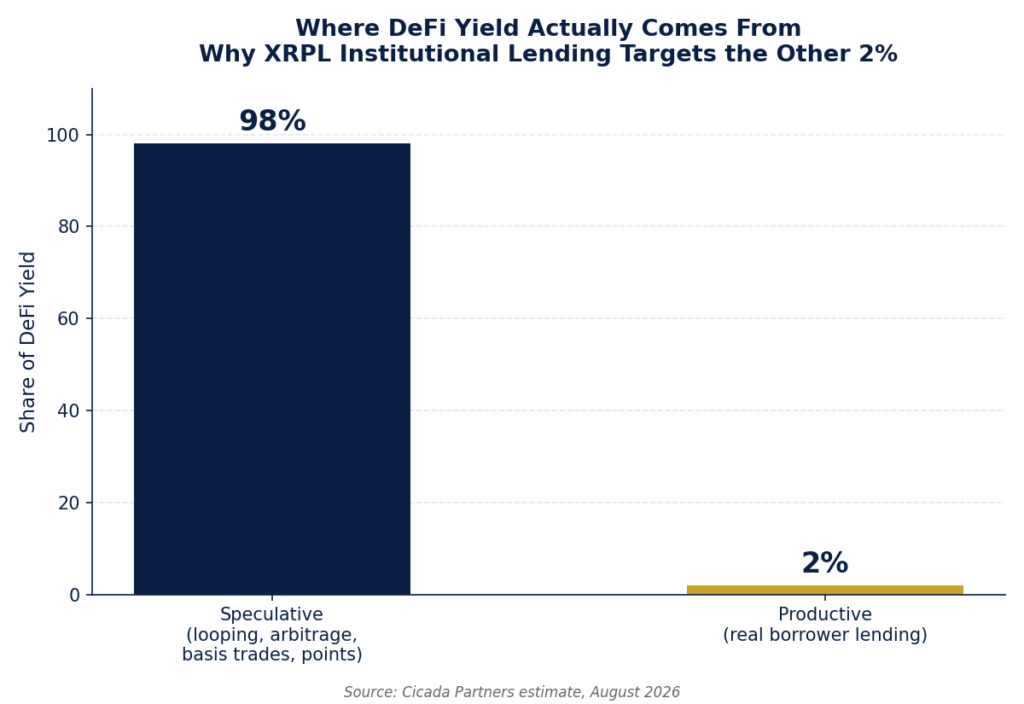
The case for XRPL institutional lending is partly a critique of existing decentralized finance yield. Cicada Partners has stated that roughly 98% of DeFi yield historically comes from mechanisms such as looping, arbitrage, basis trades, points programs, and liquidity mining rather than from genuine lending to productive businesses. Institutional allocators have largely stayed on the sidelines of DeFi credit because that yield source is difficult to underwrite and doesn’t map cleanly onto traditional risk frameworks.
XRPL institutional lending is pitched as a corrective to that gap. Stablecoin transaction volume topped $27 trillion over the past year, and tokenized private credit markets are now valued above $10 billion, according to figures cited by the partners. Connecting XRPL to that growing pool of tokenized credit demand, while keeping underwriting and yield tied to real borrower activity, is the core thesis behind bringing XRPL institutional lending to market.
If the model works as designed, lenders would earn returns from borrower interest payments rather than from internal crypto-market mechanics, which the partners argue is a more durable and explainable source of yield for institutional mandates. That framing reflects how Clearpool and Cicada describe their own product, and it has not been independently verified by outside auditors, so allocators should treat the yield-quality argument as a thesis to test rather than a settled fact.
The timing also lines up with other institutional moves around Ripple. Ripple Prime separately closed an upsized $275 million senior-notes offering in August 2026 to fund its clearing, financing, and prime brokerage operations, underscoring that the push into XRPL institutional lending is part of a broader build-out of institutional-grade financial services around the XRP Ledger rather than an isolated experiment.
How This Compares to Traditional DeFi Lending Pools
Permissionless lending protocols on other chains typically pool capital into a single shared market, where every lender is exposed to every borrower approved by the protocol’s risk parameters. XRPL institutional lending takes a different path by design. The curator model behind Single Asset Vaults lets Cicada Partners define borrower eligibility, loan covenants, and monitoring standards the way a traditional credit fund would, rather than relying on algorithmic risk scoring alone.
That difference is likely to matter most to compliance and risk teams at regulated institutions, who are often barred from participating in permissionless pools regardless of the underlying yield quality. By pairing ledger-level settlement with off-chain underwriting discipline, XRPL institutional lending aims to sit closer to a traditional private credit fund wrapped in blockchain infrastructure than to a typical DeFi money market. Whether that hybrid structure proves durable at scale is still an open question, since the model has not yet processed a single loan on XRPL mainnet.
What Institutional Investors Should Watch Next
XRPL institutional lending is not yet a live product, and that distinction matters for anyone evaluating the opportunity today. The XLS-66 and XLS-65 amendments remain in the validator voting process, Clearpool’s integration is still being tested on Devnet rather than mainnet, and no loans have been issued through the structure yet. Investors should treat current coverage as an early-stage development with a credible institutional backer rather than a confirmed, operating credit market.
Even so, the announcement fits a broader pattern of institutional infrastructure landing on XRPL in 2026, alongside tokenized fund custody, stablecoin expansion, and a national trust bank charter pursuit. Together, these developments continue to push XRPL institutional lending and related use cases beyond payments settlement and toward a fuller institutional finance stack.
Firms evaluating exposure to this ecosystem, whether through direct XRPL infrastructure or through crypto exchanges offering XRP markets, should track the amendment voting timeline closely, since mainnet activation is the gating event for the entire XRPL institutional lending thesis to move from proposal to production. Public statements from RippleX, Clearpool, and Cicada Partners so far describe a coordinated rollout, but validator approval ultimately sits outside any single company’s control, and history on XRPL shows that even well-specified amendments can take multiple voting cycles to clear the 80% threshold tokenized fund custody
For traders who want exposure to XRP while this institutional narrative develops, exchanges such as Bybit offer spot and derivatives markets for tracking XRP alongside XRPL ecosystem news. Disclosure: this article contains an affiliate link. We may earn a commission if you sign up through it, at no extra cost to you.
Conclusion
XRPL institutional lending is still in its earliest stage, gated by validator approval and Devnet testing, but the structure behind it is unusually well-specified for a pre-launch product. Clearpool supplies the infrastructure, Cicada supplies underwriting discipline, and Ripple supplies capital and settlement rails, with RLUSD and native compliance tools tying the whole system together. Whether XRPL institutional lending scales into a meaningful credit market will depend on amendment activation and real borrower demand, but the framework itself signals that XRPL’s institutional roadmap now extends well past payments and custody into productive, real-world credit.