Ripple National Trust Bank is quietly becoming one of the most consequential developments in the XRP Ledger ecosystem, even though it barely moves the daily price chart. While retail attention stays fixed on XRP’s swings near the $1 level, institutional desks are watching a slower, structural story: Ripple’s push to operate a federally chartered trust bank with a direct line into the U.S. payment system. For institutional readers evaluating XRPL exposure, understanding what Ripple National Trust Bank actually is — and what it is not — matters more than any single day’s price action.
[[IMAGE: chart showing Ripple National Trust Bank regulatory timeline from OCC conditional approval to Fed master account application]]
The Origins of Ripple National Trust Bank
Ripple National Trust Bank traces back to December 2025, when the Office of the Comptroller of the Currency granted conditional approval for Ripple to charter a federally supervised trust bank headquartered in New York. The approval arrived as part of a broader wave, with the OCC simultaneously advancing applications from BitGo, Fidelity Digital Assets, Paxos, and other digital asset firms seeking similar charters. Ripple CEO Brad Garlinghouse framed the milestone as proof that Ripple was willing to operate under the same regulatory rigor as legacy banks, rather than avoiding oversight the way critics of crypto often allege.
Conditional approval is not the same as a finished bank. Ripple National Trust Bank still needed to satisfy a list of OCC requirements before commencing full operations, and the charter itself only covers trust company activities — fiduciary services, custody, and safekeeping — not deposit-taking, checking accounts, or FDIC insurance. Institutional readers should treat Ripple National Trust Bank as a specialized custody and reserve-management entity, not a retail bank replacement for Ripple’s broader business.
Why the April 2026 OCC Rule Mattered
The conditional charter only became operationally meaningful once the OCC’s final rule on national trust bank activities took effect on April 1, 2026. Before that rule, national trust charters were confined to a narrow definition of fiduciary activities. The revised language replaced “fiduciary activities” with “operations of a trust company and activities related thereto,” explicitly opening the door to non-fiduciary services such as digital asset custody and stablecoin reserve management.
That single wording change is what allows Ripple National Trust Bank to actually custody RLUSD reserves and hold institutional client assets under direct federal supervision. Without the April rule, Ripple National Trust Bank would have remained a narrowly scoped custody license with limited relevance to Ripple’s payments infrastructure. With it, Ripple National Trust Bank can layer custody, reserve management, and eventually payment-related services onto a single federally chartered entity, giving institutional counterparties one regulated point of contact instead of a patchwork of state trust arrangements.
The Federal Reserve Master Account: The Bigger Prize
The OCC charter is only half of Ripple’s banking ambitions. Ripple has separately applied for a Federal Reserve master account, which would grant Ripple National Trust Bank direct access to Fedwire and the Fed’s core payment rails — the same infrastructure used by JPMorgan, Wells Fargo, and Bank of America. A master account would let Ripple National Trust Bank hold RLUSD reserves directly at the central bank, removing commercial-bank counterparty exposure entirely.
Approval is far from guaranteed. The Federal Reserve applies a tiered, risk-based review process, and precedent is not encouraging: Custodia Bank, a Wyoming-chartered special purpose depository institution, spent years pursuing a master account before being denied in 2023. Ripple National Trust Bank sits in a different political and regulatory environment than Custodia did, with the GENIUS Act and broader stablecoin legislation shifting Washington’s posture toward crypto-native banks. Still, as of the most recent public updates, the Fed has set no confirmed timeline for a decision on Ripple National Trust Bank’s application.
What Ripple National Trust Bank Means for RLUSD
The most direct beneficiary of Ripple National Trust Bank is RLUSD, Ripple’s dollar-backed stablecoin, rather than XRP itself. With a national trust bank managing reserves, RLUSD gains dual oversight — federal supervision through the OCC and state supervision through the New York Department of Financial Services. That dual-regulator structure is designed to set RLUSD apart from stablecoin issuers operating under lighter state-only trust charters, reinforcing Ripple’s compliance-first positioning as institutional capital allocators weigh which stablecoins meet their risk requirements.
If the Federal Reserve master account is eventually approved, RLUSD reserves could sit directly at the Fed rather than in commercial bank accounts, a structural upgrade that institutional stablecoin buyers tend to value highly. Ripple National Trust Bank would then function similarly to how large asset managers use Fed-adjacent custody arrangements for cash collateral — a detail that matters far more to treasury desks and compliance teams than to retail token holders.
Indirect, Not Direct, Implications for XRP
Institutional XRP holders should be precise about what Ripple National Trust Bank does and does not do for the token. The charter itself creates no mechanical demand for XRP — it does not require XRP holdings, and its custody functions apply primarily to RLUSD and institutional digital asset clients. Analysts covering the space have repeatedly noted that Ripple’s corporate wins tend to flow first to Ripple the company and to RLUSD, with XRP benefiting only indirectly and gradually, if at all.
The indirect case rests on legitimacy and infrastructure. A bank-grade Ripple, operating Ripple National Trust Bank under dual OCC and NYDFS oversight, strengthens the broader XRPL ecosystem’s credibility with institutions that were previously hesitant to touch a token with an unresolved regulatory history. As tokenized funds, custody solutions, and lending protocols continue launching on XRPL, a federally regulated Ripple National Trust Bank gives institutional counterparties one more reason to trust the surrounding infrastructure, even without a direct token-demand mechanism.
Key Facts at a Glance
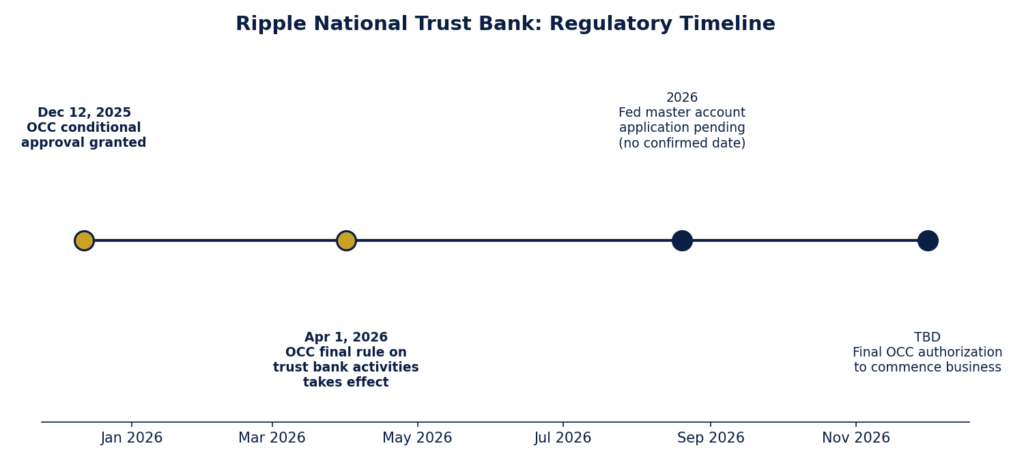
For institutional readers who need the regulatory picture in a single scan: the OCC granted conditional approval for the charter in December 2025; the OCC’s final rule expanding non-fiduciary trust activities took effect April 1, 2026; the Federal Reserve master account application remains pending with no confirmed decision date; and the charter covers custody, fiduciary services, and RLUSD reserve management rather than deposit-taking or FDIC-insured accounts.
Dual oversight runs through both the OCC at the federal level and the New York Department of Financial Services at the state level, a structure regulators and institutional compliance teams alike tend to view favorably. Each of these facts changes independently, so institutional readers tracking XRPL-adjacent regulatory developments should revisit this list periodically rather than treating any single data point as permanent.
How Ripple National Trust Bank Compares to Peer Charters
Ripple National Trust Bank is not unique in seeking this structure. The OCC’s December 2025 conditional approvals also covered BitGo Bank & Trust, Fidelity Digital Assets, Paxos Trust Company, and First National Digital Currency Bank, placing Ripple National Trust Bank alongside established custody and stablecoin infrastructure providers. Circle and Crypto.com have pursued comparable national trust structures as well, underscoring that federally chartered digital asset custody is becoming a competitive baseline rather than a differentiator on its own.
What distinguishes this charter within that group is the combination with an active Federal Reserve master account application and an existing, revenue-generating stablecoin in RLUSD. Competing trust charters without a comparable payments business may achieve custody status without the same potential upside from direct Fedwire access, which is why institutional observers treat the bank’s master account bid as the more consequential milestone to track.
A Timeline Institutional Desks Should Track
The path from application to full operation has moved in distinct stages, and each one carries a different signal for institutional readers. December 2025 brought the OCC’s conditional approval, a preliminary green light contingent on Ripple satisfying governance, capital, and compliance commitments. April 1, 2026 brought the final rule change that actually expanded what a national trust charter could do, converting the December approval from a narrow custody license into a broader operational framework.
What remains outstanding is final authorization to commence business under 12 U.S.C. 27(a), plus a decision on the Federal Reserve master account application, which the OCC noted Ripple had committed to pursuing as part of its original charter proposal. Neither step has a confirmed public date, which is precisely why institutional desks tend to treat this story as an ongoing filing to monitor rather than a resolved event to react to once.
Each of these milestones functions as a distinct, trackable event rather than a single announcement. Institutional readers monitoring regulatory filings, OCC press releases, and Federal Reserve account-access decisions get a clearer read on Ripple’s banking integration than readers waiting for one conclusive headline. Treating the rollout as a sequence — conditional charter, rule change, final authorization, master account decision — also helps separate genuine structural progress from routine news-cycle noise that tends to surround any Ripple regulatory story.
Risks and Open Questions
Several uncertainties remain before Ripple National Trust Bank reaches full operational maturity. Final OCC authorization to commence business is a separate step from conditional approval, and the bank must satisfy governance, capital, and compliance commitments made during the application process before that authorization is granted. The Federal Reserve master account outcome remains genuinely uncertain given the Custodia precedent, and industry groups such as the Bank Policy Institute have publicly raised concerns about extending Fed account access to crypto-native trust banks, signaling that traditional banking lobbies will continue contesting the decision well past any near-term ruling.
Timeline risk is also worth flagging for institutional planning purposes. Some estimates place full banking integration for the trust bank at twelve to thirty-six months out, meaning the structural benefits described above are unlikely to materialize as a near-term catalyst. Institutional readers tracking this story should treat it as a multi-quarter regulatory arc rather than a single announcement to trade around, and should size any related positioning accordingly rather than expecting a sudden re-rating tied to one filing update.
A further open question concerns scope creep versus mission discipline. National trust charters were historically narrow, and the April 2026 rule change that broadened permissible activities could itself face legal or political challenge if traditional banks continue lobbying against expanded digital-asset custody powers. Institutional readers should watch for any regulatory pushback on the rule itself, not just on individual charter applications, since a reversal at the rule level would affect every crypto-native trust bank approved under the current framework, not Ripple alone.
Takeaways for Institutional XRPL Watchers
Ripple National Trust Bank represents a genuine structural upgrade to Ripple’s regulatory standing, positioning the company as the first crypto-native firm with a realistic, if unconfirmed, path to direct Federal Reserve payment access. The near-term impact concentrates on RLUSD reserve custody and Ripple’s institutional credibility rather than on XRP demand mechanics. For institutional desks building XRPL exposure, this charter is best monitored as a compliance and infrastructure indicator — a signal of how deeply XRPL-adjacent business is integrating with the traditional U.S. banking system, even as the token’s own price continues to trade on separate market dynamics.
Institutional readers actively trading XRP around these regulatory catalysts often use exchanges with dedicated institutional order flow and margin infrastructure. Bybit’s institutional trading suite offers deep XRP liquidity for desks tracking developments like Ripple National Trust Bank’s Fed master account progress. This is an affiliate link; Gaori may earn a commission at no extra cost to you.