Institutional Guide to XRPL AMM Order Book Liquidity Architecture
As institutional adoption of decentralized finance (DeFi) accelerates, liquidity execution models have become a primary differentiator for enterprise blockchain networks. Traditional decentralized exchanges (DEXs) typically rely on Automated Market Makers alone, which can cause significant price slippage during large-volume block trades. The XRP Ledger solves this structural inefficiency through a unique hybrid execution engine that merges on-chain Limit Order Books with a native xrpl amm protocol.
Understanding the full impact of an xrpl amm requires examining how high-frequency trading desks, treasury funds, and institutional market makers execute capital deployment while managing slippage, impermanent loss, and regulatory compliance.
In this comprehensive technical analysis, we evaluate 3 fundamental benefits of an xrpl amm integrated with order book liquidity for institutional asset managers, treasuries, and trading desks.
1. Automated Continuous Order Routing and Slippage Reduction in XRPL AMM Engine
The defining feature of the XRP Ledger’s trading engine is its native, protocol-level order router designed specifically to optimize xrpl amm liquidity alongside traditional limit order books. When a market participant submits a trade, the ledger does not force execution through a single liquidity mechanism. Instead, it evaluates execution paths across both central limit order books and passive xrpl amm pools simultaneously to construct an optimal execution route.
| XRPL HYBRID ROUTING ENGINE |
+———————————————————————–+
| [ Institutional Trade Order ] |
| | |
| v |
| < Protocol Pathfinder Engine > |
| / \ |
| v v |
| [ Limit Order Book ] [ AMM Liquidity Pool ] |
| (Firm Pricing) (Algorithmic Yield) |
| \ / |
| v v |
| [ Optimal Combined Execution with Minimal Slippage ] |
+———————————————————————–+
Quantitative Slippage Optimization Model
Standard constant-product market makers (x * y = k) experience exponential slippage as transaction size increases relative to pool depth. On XRPL, the pathfinding algorithm splits large orders into micro-tranches, executing across available limit orders first, then filling remaining volume against the xrpl amm curve where pricing is more favorable.
By routing portions of order volume into resting limit orders on the CLOB, the effective price impact of an xrpl amm trade is significantly reduced compared to isolated constant-product pools.
Institutional Execution Dynamics
- Optimal Pathfinding: The network automatically splits orders at the consensus layer to consume liquidity from the cheapest available venue without needing off-chain aggregator smart contracts.
- Auto-Bridging Efficiency: Using XRP as a native bridge asset, the ledger transfers liquidity seamlessly between foreign asset pairs (e.g., USD to EUR via XRP) without requiring pre-funded multi-currency pools.
- Zero MEV Exploitation: Because transaction ordering on XRPL is deterministic and validated via consensus without a traditional mempool, institutional traders utilizing an xrpl amm are insulated from sandwich attacks, front-running, and Maximal Extractable Value (MEV) extraction.
For a deeper foundation on how institutional asset safety is structured before routing liquidity, see our detailed guide on Institutional XRP Custody & Security Infrastructure. Official ledger technical specifications can also be verified via the XRPL Official Documentation.
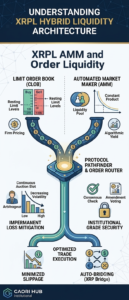
2. Dynamic Continuous Auction Mechanisms for Impermanent Loss Mitigation in XRPL AMM Pools
Impermanent loss (IL) remains one of the greatest structural barriers preventing risk-averse institutional treasuries from depositing balance sheet assets into public protocols. The architecture behind an xrpl amm addresses this by integrating a native continuous auction mechanism (the Auction Slot) designed specifically to monetize arbitrage opportunities for the benefit of liquidity providers (LPs).
Mechanics of the XRPL AMM Auction Slot
- Discounted Trading Access: Arbitrageurs bid for a 24-hour Auction Slot using the pool’s native LP tokens. Winning the slot grants the holder a heavily discounted trading fee (e.g., 0% instead of standard pool fees) on the xrpl amm.
- Deflationary Yield Burn: The LP tokens used to bid for the slot are returned to the pool or burned, directly increasing the equity ratio and pool share value for passive institutional LPs.
- Pre-Emptive Price Alignment: High-frequency arbitrageurs are financially incentivized to realign pool prices with external reference markets before extreme price divergence accumulates.
| AUCTION SLOT ARBITRAGE FLOW |
+———————————————————————–+
| [ External CEX Market Price Shift ] |
| | |
| v |
| [ Auction Slot Holder Bids LP Tokens ] –(Tokens Returned/Burned)–> [ LP Pool ]
| | |
| v |
| [ Executes 0% Fee Arbitrage Trade ] |
| | |
| v |
| [ Pool Price Re-aligned Instantly / Impermanent Loss Reduced ] |
+———————————————————————–+
Mathematical Impermanent Loss Containment
By converting external market volatility into structured fee revenue and token burns, an xrpl amm enables liquidity providers to capture market-neutral yield while significantly flattening the drawdown curve caused by impermanent loss.
To understand the specific mathematical modeling and hedging strategies used to mitigate continuous market divergence, read our complete breakdown on Managing Impermanent Loss in Native XRPL Liquidity Pools.
3. Institutional Governance Standards for XRPL AMM Protocol Architecture
Enterprise treasuries and regulated fund managers require predictable governance frameworks, auditability, and transparent rule sets. Unlike EVM-based decentralized exchanges that rely on complex, third-party smart contracts subject to re-entrancy bugs and logic exploits, xrpl amm features are embedded directly into the core consensus layer.
Enterprise Compliance Architecture
- Native Protocol Security: Liquidity pools and order books operate via native ledger primitives, completely eliminating smart contract vulnerability risk.
- Clawback & Freeze Controls: Issuing institutions retaining regulatory mandates can attach native compliance flags (such as Individual Freeze or Global Freeze) to tokenized assets without modifying underlying trading engine logic.
- Consensus Amendment Engine: Protocol upgrades to xrpl amm features require an 80% supermajority consensus among trusted validators sustained over a mandatory 14-day voting window.
Protocol Upgradability and Consensus Rules
To review how validator consensus shapes protocol updates and liquidity rules, consult our analysis on XRPL Decentralized Governance & Amendment Engine.
Furthermore, as tokenized real-world assets (RWAs) like treasury bills and private credit expand into public ledgers, this native hybrid execution model provides the necessary liquidity depth for institutional-scale redemption. Learn more in our overview of Real-World Asset Tokenization on XRPL.
Institutional Summary: Capital Efficiency Re-Engineered
By integrating an xrpl amm at the core consensus layer alongside traditional limit order books, the XRP Ledger delivers an enterprise-ready environment capable of handling high-volume institutional trading with low latency, deterministic execution, and predictable risk management parameters.
Institutional On-Ramp Notice: GaoriHub provides institutional research and strategic technical analysis for digital asset treasury management. Explore our full library of enterprise protocols to optimize your fund’s XRPL architecture.