Markdown
As institutional asset managers navigate the maturing digital asset landscape, capital efficiency and yield optimization have moved to the forefront of treasury operations. While decentralized finance (DeFi) was historically dominated by high-friction, smart-contract-heavy protocols, the evolution of the XRP Ledger (XRPL) has introduced a highly secure, protocol-level approach to institutional yield generation.

Understanding the mechanics of native **XRPL DeFi** functionality—specifically its protocol-native Automated Market Maker (AMM) features—is now essential for institutional allocators seeking risk-adjusted returns on enterprise digital asset holdings.

---

## The Architecture of Protocol-Native XRPL DeFi

Unlike legacy DeFi platforms that rely heavily on complex, third-party Turing-complete smart contracts, **XRPL DeFi** capabilities are baked directly into the ledger’s core protocol. This fundamental architectural distinction significantly alters the risk-reward profile for institutional market participants.
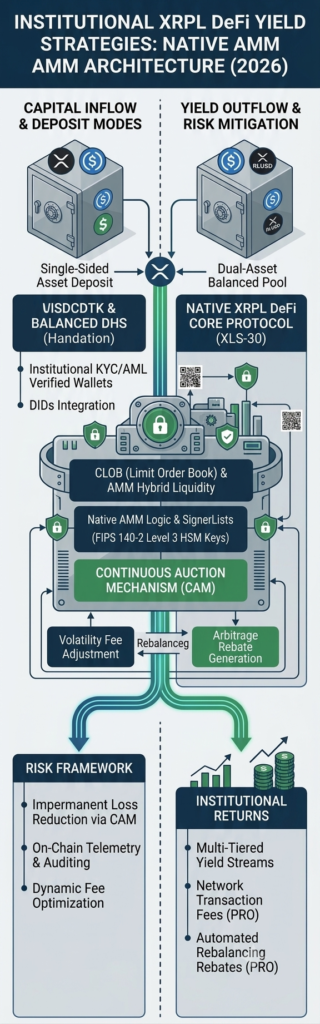
Furthermore, the architectural integration of protocol-level Automated Market Makers on the XRPL DeFi network ensures localized liquidity efficiency without introducing EVM-layer smart contract vulnerability risks. Institutional treasuries benefit directly from native settlement speed, deterministic transaction outcomes, and rigorous cryptographic verification standards, making multi-asset liquidity management seamless across high-volume trade executions.
+———————————————————————–+
| XRPL Native Protocol Layer |
| +————————+ +————————————-+ |
| | Native AMM Logic | | Built-In DEX Order Book | |
| | (XLS-30 Standard) | | (CLOB – Central Limit Order Book) | |
| +———–+————+ +——————+——————+ |
+————–|———————————-|———————+
v v
+———————————————————————–+
| Hybrid On-Chain Liquidity Pool |
+———————————————————————–+
### Key Technical Advantages for Enterprises

* **Reduced Smart Contract Exploit Risk:** Because AMM functionality is integrated natively within the XRPL code, institutional capital is not exposed to custom bytecode vulnerability vectors commonly seen in external smart contracts.
* **Continuous Auction Mechanism (CAM):** The XRPL AMM incorporates a novel continuous auction mechanism that allows arbitrageurs to bid for discounted trading fees, significantly reducing impermanent loss for liquidity providers.
* **Order Book & AMM Integration:** XRPL seamlessly blends its native Central Limit Order Book (CLOB) with AMM liquidity pools, ensuring optimal trade routing and minimal slippage for high-volume enterprise transactions.

For institutional treasuries prioritizing secure asset storage prior to deploying capital into yield pools, reviewing enterprise-grade storage architectures is highly recommended. You can review our comprehensive analysis on [Institutional-Grade XRP Custody](https://gaorihub.com/xrp-custody-cold-storage-guide/) to establish baseline cold storage protocols.

---

## Institutional Yield Generation Models

Deploying institutional capital into the **XRPL DeFi** ecosystem allows asset managers to unlock multi-tiered yield streams without relinquishing operational control.

### 1. Dual-Asset and Single-Asset Liquidity Provision
Institutions can supply liquidity to asset pairs (e.g., XRP/RLUSD or XRP/USDC) to earn a proportional share of continuous network transaction fees. Additionally, native single-sided deposit features allow treasuries to deposit a single asset while the ledger automatically rebalances the portfolio, minimizing transaction overhead.

### 2. Yield Optimization via Automated Arbitrage Rebates
Through the ledger's built-in auction slot mechanism, arbitrage traders pay a fee to capture price discrepancies. A major percentage of this fee is immediately returned to the pool's liquidity providers, creating a secondary layer of passive yield distinct from conventional trading volume fees.

---

## Mitigating Impermanent Loss & Liquidity Risks

Yield generation inherently involves risk exposure. For institutional fiduciary compliance, risk mitigation frameworks must be integrated directly into allocation algorithms.
              +-----------------------------------+
              |  Institutional Treasury Allocation |
              +-----------------+-----------------+
                                |
        +-----------------------+-----------------------+
        v                                               v
+———————–+ +———————–+
| Single-Asset Deposit | | Dual-Asset Balance |
| (Auto-Rebalanced Pool)| | (Correlated Peg Pools)|
+———–+———–+ +———–+———–+
| |
+———————–+———————–+
v
+———————————–+
| Continuous Auction Mechanism (CAM) |
| Impermanent Loss Reduction |
+—————–+—————–+
|
v
+———————————–+
| Institutional Risk-Adjusted Yield |
+———————————–+
### Risk Mitigation Best Practices

1. **Focus on Low-Volatility Correlated Asset Pairs:** Allocating funds to fiat-backed stablecoin pairs or highly liquid major assets substantially limits exposure to severe impermanent loss caused by price divergence.
2. **Dynamic Fee Adjustments:** The native **XRPL DeFi** framework dynamically adjusts pool trading fees based on real-time market volatility, protecting liquidity providers during periods of extreme price fluctuations.
3. **Continuous On-Chain Auditing:** Enterprise allocators should implement automated telemetry tools to monitor pool health, total value locked (TVL), and dynamic fee accruals in real time. Official ledger metrics can be tracked directly via standard open resources such as the [XRPL Official Documentation](https://xrpl.org/).

---

## Regulatory Compliance & KYC Integration

Enterprise adoption of decentralized liquidity solutions requires full compliance with global regulatory standards, including Anti-Money Laundering (AML) and Know Your Customer (KYC) mandates.

Permissioned liquidity pools built on XRPL allow institutional operators to enforce credential verification at the account level. By utilizing Decentralized Identifiers (DIDs) and zero-knowledge proof credentials, institutions can interact within liquid DeFi environments while ensuring all counterparty wallets meet rigorous institutional compliance standards.

---
Institutional Liquidity Provision & Yield Optimization Strategies
Expanding operational exposure within the XRPL DeFi ecosystem requires asset managers to maintain strict balance sheet equilibrium between yield optimization and asset security. When committing institutional capital to automated market makers, treasuries must execute programmatic liquidity rebalancing protocols to hedge against dynamic market volatility.

Automated Yield Compounding: On-chain liquidity pools continuously generate transaction fee rebates. Institutional treasuries should utilize automated smart-accounting workflows to compound earned yield back into primary liquidity pools, maximizing exponential capital efficiency.

Risk-Adjusted Capital Allocation: Rather than deploying whole treasury reserves into a single pair, allocators must establish strict cap limits (e.g., maximum 15% of digital asset portfolio) across high-liquidity pools such as XRP/RLUSD and XRP/USDC.

For broader portfolio risk management and asset balancing strategies, refer to our comprehensive institutional research on XRP Liquidity and Portfolio Risk Management. Additionally, technical specifications regarding native ledger parameters can be cross-referenced with the XRPL Dev Portal.

By enforcing rigorous liquidity parameters within XRPL DeFi operations, institutional treasuries achieve an optimal framework designed to yield sustainable risk-adjusted returns while safeguarding underlying principal reserves.

## Strategic Roadmap for Institutional Allocation

To successfully integrate **XRPL DeFi** yield strategies into enterprise treasury operations, asset managers should adhere to a structured four-phase implementation roadmap:

* **Phase 1 - Compliance & Authorization:** Verify institutional KYC/DID credentialing and establish legal framework mandates for on-chain liquidity deployment.
* **Phase 2 - Pilot Test Deployments:** Initiate low-cap single-sided liquidity deposits in primary asset pools to test automated fee generation and yield reporting workflows.
* **Phase 3 - Multi-Signature Vault Integration:** Connect liquidity pool interaction keys to multi-signature enterprise cold vaults to ensure strict multi-party custody control over yield-generating principal assets.
* **Phase 4 - Full Treasury Scaling:** Scale capital deployment across diversified, low-volatility liquidity pools with automated, real-time risk threshold monitoring.

Implementing structured **XRPL DeFi** protocols provides institutional treasuries with an optimal equilibrium between high capital efficiency, protocol-level security, and regulatory compliance.
Institutional Risk Management & Reference Protocols
To optimize multi-asset yield strategies while mitigating systemic protocol risks, institutional asset managers must maintain integrated risk parameters. For detailed analytical frameworks on cross-asset balancing and liquidity risk exposure, explore our published research on XRP Liquidity and Portfolio Risk Management. Furthermore, ongoing technical documentation and protocol updates can be independently verified through the official XRPL Developer Portal.