If you’ve been watching XRP and the broader altcoin market limp sideways while wondering when the rotation finally arrives, the data has a clear answer: this XRP altcoin underperformance is more structural than sentimental, and it hasn’t run its course yet.
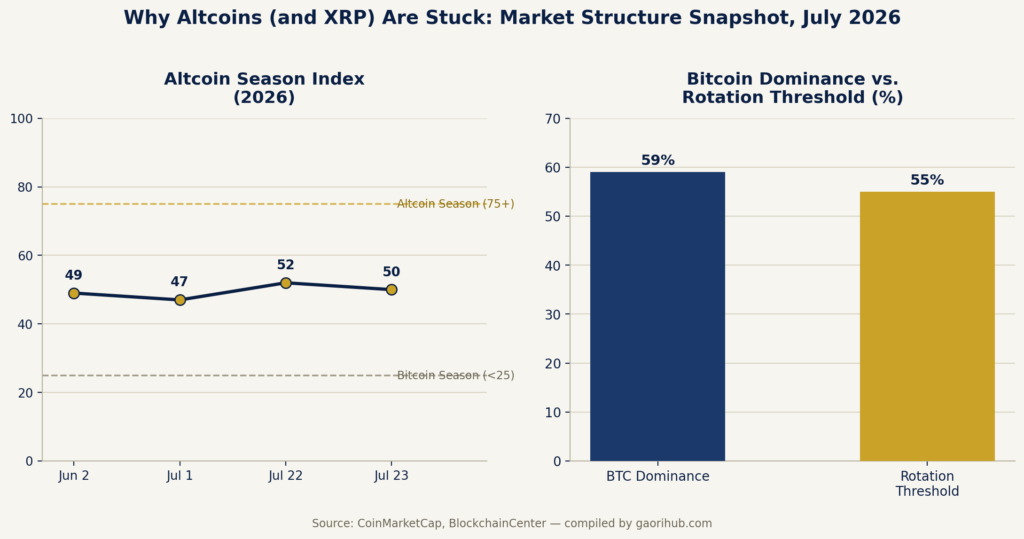
As of late July 2026, Bitcoin dominance sits at roughly 58-60% of total crypto market capitalization, and the CoinMarketCap Altcoin Season Index has been drifting in the high-40s to low-50s range — a reading of 50 signals a genuinely balanced market, nowhere near the 75-plus threshold that defines a confirmed altcoin season. For institutional XRP watchers and long-term holders, understanding why capital is stuck in this holding pattern matters more than chasing the next green candle.
Reason One: Capital Is Concentrated, Not Distributed
The Altcoin Season Index measures how many of the top 50-100 altcoins have outperformed Bitcoin over a trailing 90-day window. Index readings above 75 confirm a broad rotation; readings below 25 confirm Bitcoin dominance; anything in between is transitional. Since early June 2026, that index has bounced between roughly 47 and 52 — essentially a coin flip, not a trend.
What makes this cycle distinct from 2021’s “everything pumps” altseason is fragmentation. Analysts tracking the current period describe it as a market of selective strength rather than indiscriminate gains: a handful of tokens tied to specific catalysts — AI-crypto convergence plays, tokenized real-world assets, or company-specific news like a large strategic investment — have posted double-digit moves, while the majority of lower-liquidity altcoins continue drifting lower.
Tighter overall liquidity and an institutional preference for well-known, compliant assets mean that the kind of broad-based, thousands-of-tokens rally seen in past cycles is a much less likely outcome now than it was in 2021 — one more data point underscoring the current XRP altcoin underperformance.
For a token like XRP, that fragmentation cuts both ways. It has enough of an institutional narrative — ETF approval, RLUSD infrastructure, ongoing XRP Ledger upgrades — to be treated as a “quality” asset rather than a purely speculative one, which is the good news. The less good news is that even quality altcoins aren’t immune to the second, larger force weighing on the whole category.
Reason Two: Macro Liquidity Is Still Tight
Much of the current XRP altcoin underperformance traces back to macro liquidity, not asset-specific weakness. Altcoins are, structurally, higher-beta bets on risk appetite than Bitcoin. They need loose liquidity and strong speculative participation to sustain rallies, and 2026 simply hasn’t offered much of either. The Federal Reserve has held its policy rate in the 3.50%-3.75% range through most of the year, and sticky inflation readings have repeatedly pushed back the timeline for meaningful rate cuts.
Commentary from major institutional research desks earlier this year concluded that sustained high rates were forcing professional asset managers to prioritize fundamentally strong digital assets, concentrating capital into Bitcoin, Ethereum, and a small set of blue-chip names while leaving more speculative tokens starved of fresh liquidity.
This is a well-documented historical pattern, not a new one: Bitcoin tends to outperform smaller altcoins during periods of restrictive financial conditions and elevated real yields, because altcoins require expanding liquidity and aggressive speculative positioning to sustain upward momentum, and neither has been present for much of 2026. When traders de-risk, they tend to rotate down the market-cap curve, from small caps into mid-caps into large caps into Bitcoin itself — which is essentially the flow pattern the Altcoin Season Index has been quietly documenting all year.
Federal Reserve leadership also changed hands in mid-2026, adding a layer of policy uncertainty on top of the inflation picture. Markets currently treat one 25-basis-point cut in Q3 or Q4 2026 as the base case, with the more optimistic scenario — two cuts alongside a genuine soft landing — requiring faster inflation progress than has materialized so far. Until that base case actually plays out, the liquidity backdrop for altcoins is likely to stay restrictive.
Reason Three: XRP-Specific Momentum Has Cooled, Even as Fundamentals Improve
XRP itself illustrates the broader pattern well. Price has spent recent weeks consolidating near the $1.08 support level, trading in a tight $1.08-$1.12 band with technical indicators pointing to a balanced, range-bound market rather than a clear directional move. A break below $1.08 would likely expose $1.05 and then $1.02 as the next support levels traders are watching.
That price stagnation is happening despite genuinely positive fundamental developments. Ripple has spent July rolling out institutional-grade RLUSD infrastructure (Ripple Mint, the Notabene compliance integration), and the XRP Ledger is mid-vote on its most significant protocol upgrade package in years.
Yet XRP spot ETFs — see our full breakdown of XRP ETF institutional adoption — which strung together eight consecutive weeks of net inflows earlier in the summer on the way to roughly $1.5 billion in cumulative inflows, have cooled noticeably. Recent weeks have included multiple days of zero net flow activity, with some capital reportedly rotating back toward Bitcoin and Ethereum ETFs instead. That’s a textbook illustration of how a tight macro backdrop can mute even a strong fundamental story.
What Would Actually Change This
Three concrete conditions tend to precede a genuine, broad-based altcoin rotation, and none of them are fully in place yet:
- Bitcoin dominance breaking meaningfully below 55%. Dominance has hovered in the 58-60% range for months. A sustained break lower is generally treated as the clearest signal that capital is actively leaving Bitcoin for the broader market.
- Confirmation from ETH/BTC and SOL/BTC, not just the headline index. Analysts increasingly watch whether Ethereum and Solana are gaining strength against Bitcoin directly, since a rising Altcoin Season Index without that confirmation can reflect temporary speculation rather than a durable rotation.
- An actual, delivered rate cut — not just the expectation of one. Liquidity easing has been priced in and pushed back repeatedly through 2026. Until the Fed delivers a cut rather than merely signaling one, the cheap-liquidity conditions altcoins need are unlikely to materialize.
If those three conditions align later in Q3 or Q4 2026, the more likely outcome — based on current positioning and institutional preference for compliant, utility-backed assets — is a concentrated rally in a relatively narrow set of established, liquid tokens with real catalysts, rather than the indiscriminate “everything pumps” altseason of 2021.
In other words, even a turnaround from today’s XRP altcoin underperformance is likely to look narrow rather than broad-based. XRP’s combination of regulatory clarity, ETF access, and expanding institutional payment infrastructure arguably puts it closer to the front of that shortlist than most of the altcoin market, even if the current price action doesn’t yet reflect it.
How This Compares to Past Cycles
It’s worth putting 2026’s altcoin drought in historical context, because the comparison explains why so many traders keep expecting a rotation that hasn’t shown up. In 2021, a genuine altseason unfolded against a backdrop of near-zero interest rates, aggressive quantitative easing, and a flood of retail capital entering crypto for the first time — conditions that let speculative money spread across thousands of tokens simultaneously, regardless of individual project quality.
Late 2025 briefly looked like it might repeat that pattern: the Fed cut rates three times, and many traders positioned for altcoins to follow Bitcoin’s earlier strength.
Instead, the market reacted counterintuitively. Rather than rallying on the dovish pivot, Bitcoin, Ethereum, and major altcoins sold off together, with total crypto market capitalization shedding well over a trillion dollars from its late-2025 highs. That episode is a useful reminder that rate cuts alone don’t guarantee an altcoin rally — the broader liquidity picture, inflation trajectory, and risk sentiment all have to align, and even then, timing is far less predictable than the “rate cuts equal altseason” narrative that circulates on social media each cycle.
2026’s version looks structurally different from both prior episodes. Quantitative tightening has effectively ended, but there’s no clear path to renewed quantitative easing without a negative growth shock forcing the Fed’s hand — which means liquidity conditions are more likely to improve gradually, if at all, rather than through a sudden flood of stimulus. That gradual backdrop favors the selective, narrative-driven rotation described above over the kind of broad-based mania that would fully reverse the current XRP altcoin underperformance.
A Note on Risk Management
None of this is a call to abandon altcoin exposure altogether — institutional flows into XRP, Solana, and a handful of other assets with clear regulatory status have continued even through this consolidation phase, which suggests longer-term conviction hasn’t disappeared. But it is a reason to size positions with the current liquidity regime in mind rather than assuming a 2021-style rotation is imminent.
Our XRP liquidity and risk management guide covers this in more depth, but the short version: diversify entry points, watch Bitcoin dominance and the Altcoin Season Index rather than reacting to single-day price moves, and treat fundamental catalysts (ETF flows, protocol upgrades, institutional partnerships) as the primary signal — with price action as confirmation rather than the trigger itself.
Traders using leverage in this environment should be especially deliberate; our beginner’s guide to XRP margin trading strategies walks through position sizing in range-bound conditions like the current one.
The Bottom Line on XRP Altcoin Underperformance
Nothing about the current setup suggests XRP or altcoins broadly are structurally broken — the underperformance is a function of tight liquidity and concentrated risk appetite, not a rejection of the underlying assets. For readers tracking XRP specifically, the more useful signal right now isn’t the daily price candle near $1.08; it’s the combination of Bitcoin dominance, the Altcoin Season Index, and the Fed’s actual policy delivery over the next two quarters.
Those three data points, watched together, will tell you far more about when this XRP altcoin underperformance actually ends than any single altcoin’s chart in isolation.
For traders who want to track that $1.08 support level and any shift in momentum in real time, watching XRP’s order book directly on an exchange like Bybit offers a faster read than waiting for daily headline recaps.
Disclosure: This post contains an affiliate link. If you choose to open an account through it, this site may earn a commission at no extra cost to you.