Getting comfortable with XRP margin trading basics before you open your first leveraged position isn’t optional — it’s the difference between a manageable learning curve and an account wiped out on day one. Margin trading lets you borrow capital from an exchange to control a larger position than your own balance would allow, and while that sounds like a simple upgrade from regular spot trading, the mechanics underneath it are different enough that skipping the fundamentals is where most beginners get hurt. This guide covers the six things worth understanding before you place your first trade.
It’s worth being honest about why XRP margin trading basics matter more for XRP specifically than for some other assets. XRP has a long history of sudden, sharp price moves tied to regulatory news, ETF flow reports, and broader market sentiment — the kind of volatility that turns a seemingly reasonable leverage setting into a liquidation within minutes if you haven’t accounted for it. The underlying concepts aren’t meaningfully different from margin trading basics for any other asset in a technical sense, but the practical stakes of skipping them are higher given how quickly XRP’s price can move.
1. XRP Margin Trading Basics: Spot vs. Margin
Spot trading is the simplest way to hold XRP: you buy it outright with your own money, and you own the coins directly. There’s no borrowed capital, no leverage, and no risk of forced liquidation — the worst case is that the price drops and your holdings are worth less, but you never owe the exchange anything.
XRP margin trading basics start with understanding that margin trading changes this relationship entirely. Instead of buying XRP outright, you deposit collateral (called margin) and borrow additional capital from the exchange to open a position larger than that collateral alone would support. You can also open short positions — betting the price will fall — which isn’t possible with simple spot holding. That flexibility is the appeal, but it comes with a genuinely different risk profile that beginners need to understand before depositing a single dollar.
To make the distinction concrete: with $500 in spot XRP, a 20% price increase earns you $100. With that same $500 used as margin at 10x leverage, a 20% price increase earns roughly $1,000 — but a 20% price decrease in the wrong direction can wipe out the entire $500 and trigger liquidation before you even have a chance to react. Understanding that both outcomes are mathematically symmetrical, not just the upside, is the single most important idea to internalize among the core XRP margin trading basics for anyone coming from a pure spot-trading background.
2. The Core Vocabulary You Need First
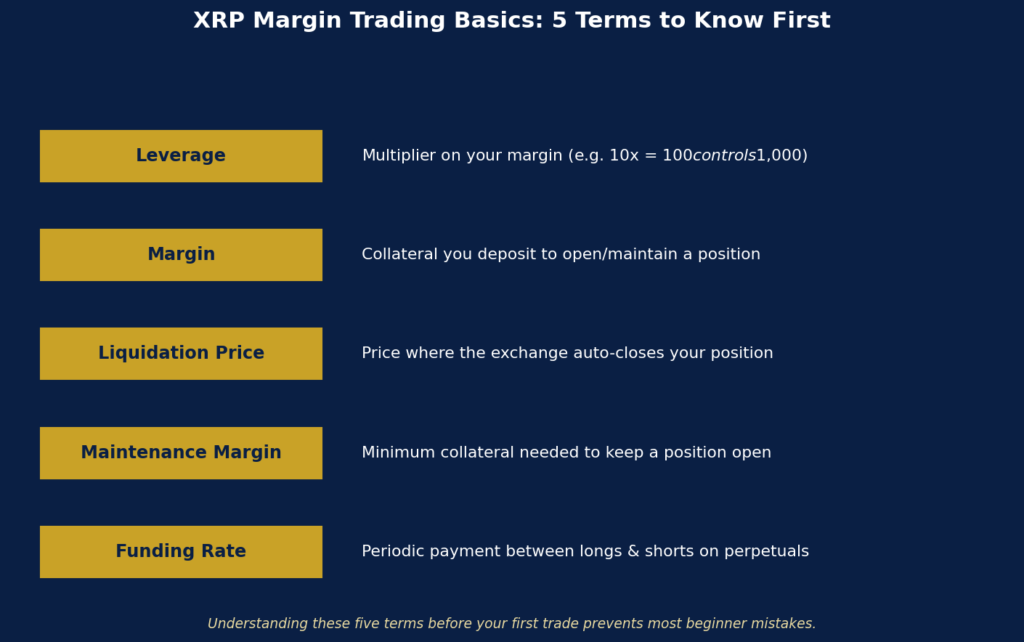
A handful of terms show up constantly once you start exploring XRP margin trading basics, and getting them straight early — before you’re staring at a live order screen under time pressure — saves a lot of confusion later:
Leverage is the multiplier applied to your margin — 10x leverage means a $100 deposit controls a $1,000 position. Margin is the collateral you put up to open and maintain that position in XRP margin trading basics. Liquidation price is the price level at which the exchange automatically closes your position because your losses have eaten through your available margin.
Maintenance margin is the minimum collateral level you must maintain to keep a position open; falling below it triggers liquidation. Funding rate is a periodic payment exchanged between long and short position holders on perpetual futures contracts, keeping the contract price aligned with the actual XRP spot price.
Every one of these terms will show up on the order screen before you open a position, so it’s worth reading them slowly the first time rather than clicking past them to get to the “buy” button.
3. How to Open Your First Position, Step by Step
Once the vocabulary makes sense, opening a position generally follows the same sequence across most exchanges:
- Fund a margin or futures wallet separately from your spot wallet — these are typically kept apart for account safety.
- Select the XRP contract you want to trade and choose isolated margin mode, which limits risk to the funds allocated to that specific trade rather than your entire account balance.
- Choose a conservative leverage setting — many experienced traders suggest beginners start at 2x-5x rather than anywhere near the maximum available, since lower leverage gives you far more room before liquidation.
- Set a stop-loss at the same time you open the position, not afterward.
- Review the estimated liquidation price the exchange displays and confirm it leaves a comfortable buffer from the current market price given XRP’s typical volatility.
Working through these five steps deliberately, rather than rushing to the confirm button, is one of the simplest ways to internalize XRP margin trading basics before real money is on the line — and it’s a sequence worth repeating mentally every single time you open a new position, not just the first one.
4. Common Beginner Mistakes in XRP Margin Trading
A few mistakes show up repeatedly among people new to XRP margin trading basics, and recognizing them ahead of time beats learning from the losses directly. The most common is choosing maximum available leverage on a first trade simply because the exchange offers it — a 100x setting turns even an ordinary price move into an instant liquidation. A close second is trading without a stop-loss, turning every position into an open-ended bet rather than a defined, manageable risk. A third is confusing cross margin with isolated margin and accidentally putting an entire account balance at risk on a single trade.
Each of these is easy to avoid once you know to look for it, which is the entire point of learning XRP margin trading basics before opening a live position rather than after a costly mistake.
A fourth, less obvious mistake is ignoring funding rates on positions held for more than a few hours. Perpetual futures contracts charge or pay funding periodically, and during volatile stretches those payments can meaningfully erode a position’s returns even when the underlying price hasn’t moved much in the trader’s favor.
A fifth mistake worth naming: revenge trading after a liquidation. Losing a position to liquidation is an unpleasant, embarrassing experience, and the instinct to immediately open a larger position to “win back” the loss is common — and dangerous. Every experienced trader has a story about turning one manageable loss into a much larger one by trading emotionally in the minutes after a liquidation rather than stepping away to reassess. Building a personal rule to stop trading for a set period after any liquidation is a small habit that prevents a lot of the worst outcomes in XRP margin trading basics.
5. Practicing Before Committing Real Capital
Most major exchanges offer a demo or testnet trading environment that mirrors live market prices without risking real money. For anyone genuinely new to XRP margin trading basics, spending even a few sessions in a demo account — placing trades, watching how quickly a leveraged position’s value moves, and getting comfortable with where the liquidation price sits — is a low-cost way to build intuition before any real capital is on the line. The lessons learned watching a demo position swing 20% in minutes translate directly to how a real leveraged position will behave.
A demo account is also the right place to deliberately trigger a liquidation on purpose, at least once. It sounds counterintuitive, but watching exactly how fast a position closes once the liquidation price is hit — with no risk since it’s simulated capital — builds a visceral understanding of leverage that reading about XRP margin trading basics never quite achieves on its own. Traders who skip this step often underestimate how quickly things move once a position is actually near its liquidation threshold in live markets.
6. Starting Small and Scaling Up Deliberately
There’s no rule requiring a beginner to trade with any particular amount of capital, and starting with an amount small enough that a full loss wouldn’t be financially painful is a reasonable way to build real experience with XRP margin trading basics without real consequences attached to early mistakes. As comfort and consistency grow — measured over dozens of trades, not just a handful of lucky ones — position sizes and leverage can scale up gradually, informed by an actual track record rather than confidence built on a small early winning streak.
A useful benchmark for anyone applying XRP margin trading basics in practice: many experienced traders suggest keeping a beginner’s total margin trading allocation under 10% of overall crypto holdings for the first several months, regardless of how confident early trades feel. This isn’t a hard rule so much as a guardrail against the common pattern of a few early wins encouraging much larger position sizes before the trader has actually developed the discipline that the wins might have simply been luck rather than skill.
A Few Quick Questions Beginners Often Ask
How much money do I need to start? There’s no fixed minimum built into XRP margin trading basics — most exchanges allow positions with just a few dollars of margin. The more relevant question is whether the amount you’re using is small enough that losing it entirely wouldn’t affect your finances, not whether it meets some arbitrary threshold.
Is margin trading the same as futures trading? Not exactly, though the terms get used interchangeably. Margin trading broadly refers to borrowing capital against collateral, while futures contracts are a specific instrument — often the most common vehicle through which retail traders actually apply XRP margin trading basics in practice. For a beginner, the distinction rarely matters much day to day, since perpetual futures contracts are where most of this activity happens on crypto exchanges.
Can I lose more than I deposit? On most modern exchanges offering isolated margin, no — losses are capped at the margin allocated to that specific position, and the position is automatically liquidated before losses can exceed it. This wasn’t always guaranteed on older platforms, which is one more reason to confirm isolated margin mode specifically rather than assuming it by default.
Where to Go Next
Once these basics feel comfortable, the next layer is genuinely thinking about risk management as its own discipline rather than an afterthought. XRP margin trading basics get you safely to your first few trades; a deeper risk-management framework is what keeps a trading account alive over the following months. Our deeper guide on XRP margin trading leverage and risk management strategies covers tiered leverage limits, isolated versus cross margin in more depth, volatility-based position sizing, and a real liquidation-cascade case study from 2026 — all useful once the fundamentals covered here are second nature.
For readers ready to open a demo or live account to practice these XRP margin trading basics, Bybit’s XRP margin trading platform offers isolated margin, adjustable leverage, and a demo trading mode suited to working through everything covered above before committing real capital.
Disclosure: This post contains an affiliate link. If you choose to open an account through it, this site may earn a commission at no extra cost to you.