XRP margin trading lets you control a position far larger than your account balance by borrowing capital from an exchange, and that single feature is both the appeal and the danger of the entire practice. Leverage doesn’t just multiply your potential profit — it multiplies your potential loss at exactly the same rate, and XRP’s history of sharp, fast price swings makes that math unforgiving for anyone trading on autopilot. These five strategies focus specifically on the risk-management side of XRP margin trading, since that’s the part most beginners skip in favor of chasing leverage multipliers.
It’s also worth noting that the regulatory backdrop for XRP margin trading has shifted meaningfully. Following the GENIUS Act and subsequent CFTC guidance, US-facing platforms and the global exchanges serving US clients have moved toward clearer investor-protection standards and, in some cases, capped leverage tiers for retail accounts compared to the unrestricted multipliers offshore platforms once offered. That’s generally a positive development for anyone new to leveraged trading — lower maximum leverage removes some of the most extreme tail risk, even if it means the eye-catching 500x or 1000x offers advertised elsewhere aren’t available through more compliant venues.
Strategy 1: In XRP Margin Trading, Maximum Leverage Isn’t Fixed
Most traders new to XRP margin trading assume the leverage number advertised by an exchange — say, 75x on Binance or up to 100x on Bybit — is available on every position regardless of size. It isn’t. Exchanges use tiered risk-limit systems where maximum allowable leverage actually decreases as your position value grows. A small position might genuinely access 100x, but a much larger one on the same account will be capped far lower, with margin requirements scaling up accordingly.
This tiered structure exists specifically to prevent oversized, highly leveraged positions from threatening the exchange’s own insurance fund during a sharp move. Before opening a position, check the specific risk-limit tier for the size you intend to trade, rather than assuming the headline leverage figure applies uniformly. Treating the maximum advertised leverage as the default entry point, rather than the tiered reality most positions actually face, is one of the most common early mistakes in XRP margin trading.
This also explains why two traders using the “same” leverage setting can end up with very different actual risk exposure. A $500 position at 50x leverage sits in a completely different risk-limit tier than a $50,000 position at the same nominal setting — the larger trader’s margin requirement, maintenance margin, and liquidation distance will all look different once the exchange applies its tiered schedule. Reading the specific risk-limit table for your exchange and asset before trading, rather than relying on the advertised maximum, is a five-minute step that prevents unpleasant surprises later.
Strategy 2: In XRP Margin Trading, Default to Isolated Margin, Not Cross Margin
Exchanges typically offer two margin modes for XRP margin trading. Cross margin pools your entire account balance as collateral for a position, meaning a single bad trade can draw down funds you intended to keep for other positions or safekeeping. Isolated margin, by contrast, limits your risk on any one trade strictly to the margin you’ve allocated to it — if the position gets liquidated, the loss stops there.
For anyone still building a track record in XRP margin trading, isolated margin is the safer default. It forces you to decide, upfront, exactly how much of your capital you’re willing to lose on a given trade, rather than discovering the answer during a liquidation cascade. Cross margin has legitimate uses for experienced traders managing multiple correlated positions, but it’s a tool to grow into, not one to start with.
There’s a psychological benefit to isolated margin that’s easy to overlook. Knowing the absolute worst-case outcome of a single trade — the isolated margin amount, and nothing more — makes it considerably easier to hold a predetermined plan under pressure. Cross margin’s flexibility can quietly encourage a trader to keep adding margin to a losing position rather than accepting the loss and closing it, since the account balance is always technically available to draw from. Removing that option by defaulting to isolated margin is a simple structural way to enforce discipline in XRP margin trading that doesn’t rely on willpower alone.
Strategy 3: Size Positions Around Volatility, Not Available Leverage
The single most common mistake in XRP margin trading is choosing a leverage multiplier first and a position size second. That’s backward. A sounder approach starts with how much of your total account you’re willing to risk on one trade — a common guideline among disciplined traders is 1-2% of total capital per position — and works backward to a position size and leverage level that keeps a reasonable stop-loss distance from triggering an unwanted liquidation.
XRP’s volatility is not constant. A 5% intraday move is unremarkable during quiet periods but can happen within minutes during news-driven spikes tied to ETF flows, regulatory headlines, or broader crypto market swings. Sizing a position as if volatility were fixed, rather than checking recent realized volatility before setting leverage, is how disciplined traders end up with the same liquidations as undisciplined ones.
A practical way to apply this: before entering a position, check XRP’s average daily range over the past two to three weeks, not just the current price. If that range has widened — say, from a typical 3% to a recent 8-10% — treat that as a signal to reduce leverage and widen your stop-loss distance, even if your usual sizing formula would otherwise call for a larger position. XRP margin trading during a high-volatility stretch requires a different risk approach than during a calm one, and using the same fixed leverage setting across both regimes is a subtle but common error.
Strategy 4: Learn From How XRP Liquidation Cascades Actually Unfold
XRP margin trading carries a specific structural risk that’s easy to underestimate until you’ve seen it happen: liquidation cascades, where one large forced sale triggers the next, compounding a price decline far beyond what spot selling alone would cause. Understanding this dynamic is central to managing XRP margin trading risk responsibly. A useful real-world case study comes from early June 2026, when a sharp XRP price decline triggered sharply divergent outcomes across exchanges — Bybit’s XRP open interest contracted by roughly 36% during the move, while Binance’s open interest held nearly flat through the same decline.
That divergence illustrates an important point: liquidation risk isn’t just about your own leverage choice, it’s also shaped by how concentrated and over-leveraged the broader market is on the exchange you’re using at that moment. When open interest is unusually high heading into a volatile period, the probability of a cascading liquidation event rises regardless of how conservatively any individual trader is positioned.
Checking an exchange’s current open interest relative to its recent range, alongside the broader funding rate environment, gives a rough read on how “crowded” leveraged positioning has become before you add your own. Elevated open interest combined with heavily one-sided funding rates — a strong signal that most leveraged traders in XRP margin trading are positioned the same direction — is historically a precondition for the sharpest cascade events, since a reversal has that much more forced selling or buying to work through on the way down or up.
Strategy 5: Treat Stop-Losses and Funding Rates as Core Tools, Not Extras
A stop-loss order isn’t optional risk management in XRP margin trading — it’s the mechanism that turns a bad trade into a defined, survivable loss instead of an open-ended one. Setting a stop-loss at the same time you open a position, rather than deciding to “watch the trade” and add one later, removes the emotional decision-making that tends to happen exactly when a position is moving against you.
For traders holding leveraged positions longer than a few hours, funding rates also deserve attention. Perpetual futures contracts — the most common vehicle for XRP margin trading — charge or pay a periodic funding rate between long and short position holders to keep the contract price tethered to the spot price. During periods of extreme bullish or bearish sentiment, funding rates can swing sharply, quietly eating into a position’s profitability even if the underlying price hasn’t moved much. Checking the funding rate before entering, not just the leverage and margin terms, rounds out a complete pre-trade checklist.
A concrete example: a position held through three consecutive 8-hour funding intervals at an elevated 0.1% rate loses roughly 0.3% of position value to funding alone, before accounting for any price movement. On a 20x leveraged position, that translates to a 6% drag on the margin actually posted — enough to meaningfully offset a modest favorable price move, and a cost that’s entirely avoidable simply by checking the rate before opening a position meant to be held for more than a few hours.
Putting the Framework Together
None of these five strategies function well in isolation. Tiered leverage awareness, isolated margin, volatility-based position sizing, liquidation-cascade awareness, and disciplined stop-loss use are meant to work as a single system rather than five separate tips to pick and choose from. XRP margin trading rewards traders who treat risk management as the primary skill and leverage as simply a tool within it, not the other way around.
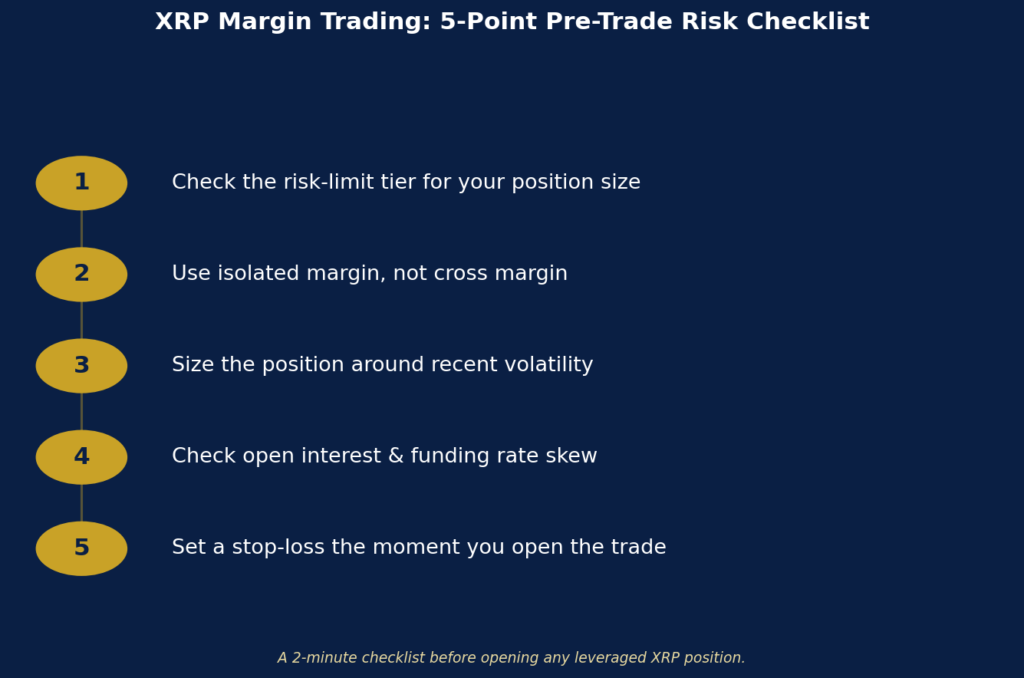
A simple pre-trade checklist pulls all five together: check the risk-limit tier for your intended position size, confirm you’re using isolated rather than cross margin, size the position around current volatility rather than maximum available leverage, glance at open interest and funding rate skew for signs of crowded positioning, and set a stop-loss the moment the position opens rather than after. Running through those five checks takes under two minutes and catches the majority of avoidable mistakes in XRP margin trading before they turn into forced liquidations.
How This Connects to the Broader Picture
This risk-first approach connects to ground we’ve covered elsewhere on the site. Our XRP liquidity and portfolio risk management guide covers position sizing and pool selection from a portfolio-construction angle, which pairs naturally with the trade-level risk controls covered here. And institutions evaluating XRP exposure through regulated channels — as covered in our piece on disclosed XRP ETF holders — are effectively choosing to avoid this entire category of leverage and liquidation risk altogether, which is itself a useful data point on how professional risk tolerance for XRP compares to retail margin trading.
For traders who want to practice these five strategies with a platform that supports isolated margin, tiered risk limits, and clear liquidation data, an XRP margin account on Bybit is one option institutional and active traders use for exactly that purpose.
Disclosure: This post contains an affiliate link. If you choose to open an account through it, this site may earn a commission at no extra cost to you.