Solana XRPL DEX Trading Goes Live: What Axelar’s Wrapped SOL Integration Means for Institutional Liquidity
On August 14, 2026, a new chapter opened for cross-chain liquidity on the XRP Ledger. Solana became directly tradable on the Solana XRPL DEX pathway through Axelar’s Wrapped SOL token, marking one of the most significant interoperability milestones the network has seen this year. For institutional observers who have watched the XRP Ledger evolve from a payments rail into a broader settlement and liquidity venue, the Solana XRPL DEX launch is a signal worth understanding in detail.
What Happened: Solana Arrives on the Solana XRPL DEX
Hussein Zangana, director of community at the XRP Ledger Foundation, confirmed that Solana is now accessible through the Solana XRPL DEX, the ledger’s built-in decentralized exchange. Rather than requiring users to leave the XRPL ecosystem to acquire Solana exposure, the integration lets holders swap directly within XRPL-native infrastructure.
This is a structural change. Previously, gaining SOL exposure from an XRPL-based portfolio meant routing through an external chain or a centralized venue, adding extra steps, extra counterparty exposure, and extra settlement time. Now, the new listing handles that swap natively, using the same order-book and automated market infrastructure that already services XRP, RLUSD, and other XRPL-issued assets. For a network built around fast, low-cost settlement, folding a major external asset into that same infrastructure is a meaningful expansion of what the ledger can offer.
The asset behind this shift is Wrapped SOL, issued exclusively by Axelar. Wrapped SOL represents Solana exposure on the XRP Ledger without requiring users to hold native SOL on the Solana network itself. Every swap executed through the Solana XRPL DEX settles with XRPL’s standard finality guarantees, meaning institutional desks accustomed to the ledger’s settlement speed do not need to adjust their risk models for the new asset class.
How the Axelar Bridge Powers the Solana XRPL DEX Integration
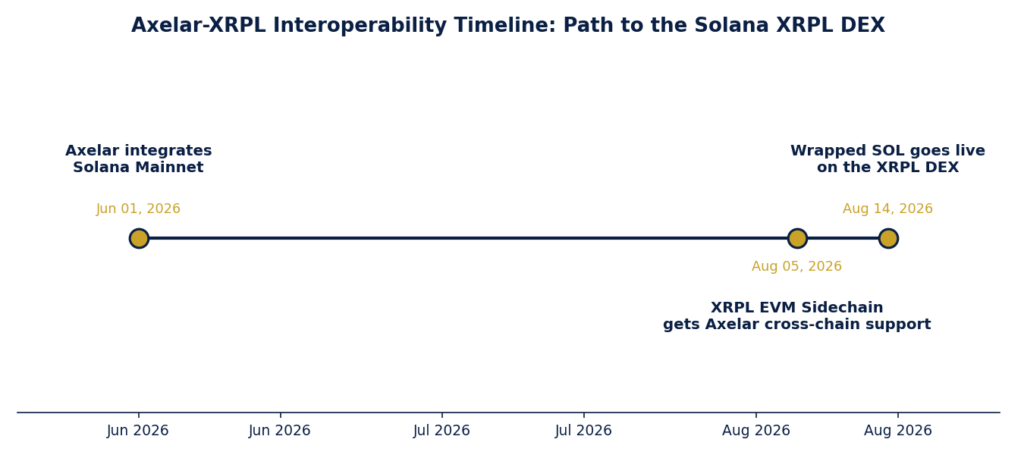
Axelar is an interoperability protocol connecting more than 80 blockchain networks, and it has been steadily deepening its XRPL footprint throughout 2026. The company integrated Solana Mainnet into its network in June, enabling asset and message transfers between Solana and other Axelar-connected chains, including Ethereum, Stellar, and Hedera. The August listing effectively converts that underlying plumbing into something end users can access directly, rather than a capability buried in developer documentation.
Under the hood, Axelar’s gateway account on XRPL — identified on-chain as the Axelar Bridge address — mints Wrapped SOL when genuine SOL is locked on the Solana side, and burns it when users bridge back the other way.
On-chain data from XRPScan confirms transaction activity tied to this gateway. That activity includes an OfferCreate transaction on August 14 that effectively opened Solana XRPL DEX trading to the public for the first time. This design mirrors how wrapped XRP already functions on other chains, giving the Solana XRPL DEX pairing a familiar architecture for anyone who has tracked XRPL’s broader multichain expansion over the past year.
Axelar’s role here is purely infrastructural: it does not custody user funds beyond the standard lock-and-mint bridge mechanism, and the resulting Wrapped SOL trades like any other XRPL-issued currency once it reaches the ledger.
Where Institutional and Retail Users Can Access the Solana XRPL DEX
Several front-end platforms now route into the Solana XRPL DEX, since they all connect to the same underlying native exchange infrastructure rather than operating separate order books. XPMarket, First Ledger, and Magnetic all support SOL trading pairs, and Xaman Wallet added a direct Swap widget so users can access the exchange without leaving their wallet interface.
This multi-front-end approach is consistent with how XRPL has historically distributed liquidity access. Rather than concentrating volume on a single application, the protocol-level DEX lets any compliant front end plug in and draw from the same shared order book.
For institutions evaluating settlement infrastructure, this matters because the Solana XRPL DEX is not a walled garden controlled by one company. It is a shared liquidity layer that any XRPL-compatible platform can tap into, which reduces the counterparty concentration risk that comes with routing volume through a single centralized exchange.
Why the Solana XRPL DEX Launch Matters for XRP Ledger Liquidity
The timing of the Solana XRPL DEX rollout is notable against a backdrop of broader market caution. XRP price support at $1 has faced its toughest test yet through much of August, with ETF inflows cooling from their earlier-year highs and weekly net flows swinging sharply week to week. Against that backdrop, expanding what the XRP Ledger can actually do — rather than relying purely on price momentum — is the kind of fundamentals-driven development that institutional allocators tend to weigh more heavily than short-term volatility.
Bringing Solana liquidity onto the Solana XRPL DEX also complements Ripple’s wider push into tokenized real-world assets. XRPL’s tokenized RWA figures have grown from roughly $73 million in January 2025 to more than $4 billion by August 2026, driven largely by tokenized treasuries and commodities.
A deeper, more diverse asset base on the Solana XRPL DEX gives that RWA ecosystem more collateral and hedging options without forcing participants to leave the ledger for basic cross-chain exposure. In practice, that means a treasury desk holding tokenized assets on XRPL could, in principle, hedge or rebalance exposure to Solana-correlated risk without ever touching an external chain.
Security Considerations: Verifying Legitimate Wrapped SOL
Zangana’s announcement came with an explicit warning: Axelar is currently the only legitimate issuer of Wrapped SOL on the XRP Ledger, and users should verify token authenticity before trading. XRPL’s issued-currency model means anyone can technically create a token with the ticker “SOL,” so the platforms supporting the integration — XPMarket, First Ledger, Magnetic, and Xaman — have added checkmarks to visually distinguish the legitimate Axelar-issued asset from potential imitations.
This caution is not unique to the Solana XRPL DEX rollout. XRPL has dealt with impersonation risk around other bridged and issued assets before, and the pattern is a reminder that institutional desks integrating with this exchange should verify issuer addresses independently rather than relying on token names or tickers alone. The Axelar Bridge account is publicly identifiable on-chain, and cross-referencing it against Axelar’s own documentation remains the most reliable verification method.
It is also worth noting that bridge infrastructure across the wider crypto industry has been a recurring target for exploits, with cross-chain deposit-verification flaws causing billions of dollars in losses since 2021 across multiple unrelated projects. None of those incidents involve Axelar’s Solana XRPL DEX bridge directly, but they underscore why independent verification, rather than trust in a token’s name alone, remains standard practice for any serious market participant.
The Broader Axelar-XRPL Buildout Behind This Launch
The Solana XRPL DEX integration did not appear in isolation. It is the latest step in a longer rollout that began with the XRPL EVM Sidechain, an Ethereum-compatible environment connected to the XRP Ledger via Axelar. That sidechain was designed to let developers use familiar EVM tooling while benefiting from XRPL’s settlement speed and liquidity, with Axelar acting as the connective layer to more than 80 external networks.
Wrapped XRP already moves through that same infrastructure, and the Solana XRPL DEX listing effectively extends the same interoperability model to Solana’s asset base. For traders tracking the space, this also runs in both directions: wrapped XRP has separately expanded onto Solana through other infrastructure providers, meaning liquidity is increasingly flowing both ways between the two ecosystems rather than in a single direction.
The Solana XRPL DEX launch is best understood as one node in that larger multichain liquidity map rather than a standalone event, and it fits a pattern the XRP Ledger Foundation has been reinforcing all year: interoperability first, speculation second.
Market Context Since the Debut
In the days following the debut, activity on the new listing has remained modest relative to XRP’s own trading volume, which is typical for a freshly bridged asset still building liquidity depth. XRPScan data shows steady but measured OfferCreate activity tied to the Axelar gateway account rather than a single burst of volume, suggesting early adoption is coming from active XRPL traders and market makers testing the new pair rather than a wave of retail speculation.
That gradual uptake fits the broader pattern seen with earlier Axelar-XRPL integrations. When wrapped assets first arrive on a new venue, liquidity providers typically wait for a track record of clean settlement before committing meaningful size, and the Solana XRPL DEX appears to be following that same cautious ramp-up rather than an explosive launch. Analysts covering the XRPL ecosystem have noted that this slower build is generally healthier for a new trading pair than a speculative spike that fades once initial interest cools.
For institutional desks in particular, a measured ramp-up is arguably a feature rather than a limitation. It gives risk teams time to observe settlement behavior, confirm issuer verification processes hold up under real trading conditions, and assess whether spreads on XPMarket, First Ledger, and Magnetic tighten as more liquidity providers enter. Those are the kinds of operational questions that typically get answered in the weeks after a listing like this, not on day one.
What This Means for XRP Holders Going Forward
For XRP holders and XRPL-based institutions, the practical takeaway is straightforward. The Solana XRPL DEX gives the ledger another source of cross-chain volume and another reason for liquidity providers to stay active on XRPL-native infrastructure rather than routing exclusively through centralized venues.
It does not directly change XRP’s price mechanics, since the bridge asset is Wrapped SOL rather than XRP itself. But it does reinforce XRPL’s positioning as a settlement and liquidity hub that can host assets well beyond its native token — a positioning that matters more to institutional allocators than any single day’s price move.
Traders who want direct exposure to SOL, XRP, or other assets bridged through this expanding multichain infrastructure can also access spot and margin markets through centralized venues. Bybit lists both XRP and SOL trading pairs with institutional-grade liquidity, which some traders use alongside on-chain venues to manage execution across both centralized and decentralized rails.
(Disclosure: this article contains a referral link; we may earn a commission if you sign up through it, at no extra cost to you.) As with any exchange, this is not financial advice, and traders should confirm current listings, fees, and regional availability directly on the platform before depositing funds.
As Axelar continues expanding its XRPL footprint and more assets follow Solana’s path onto the network’s native exchange, this integration may become a template for how the ledger absorbs liquidity from other major chains going forward. For now, the milestone confirms that the Solana XRPL DEX is maturing into a genuine multichain liquidity venue, not just a venue for XRP-denominated pairs.