Institutional asset managers are no longer testing blockchain rails on the sidelines. They are issuing real products on them. The clearest signal yet came this month, when Aviva Investors confirmed the launch of XRPL tokenized funds through a new share class of its US Dollar Liquidity Fund.
The structure was approved by the Central Bank of Ireland, giving the deal a level of regulatory legitimacy that few tokenization pilots have achieved so far. For an XRP Ledger ecosystem that has spent the past year courting banks and asset managers, XRPL tokenized funds are quickly becoming the proof point institutional observers have been waiting for.
Aviva Investors Brings XRPL Tokenized Funds to Market
The announcement did not come out of nowhere. Aviva Investors and Ripple first disclosed their partnership back in February 2026, framing it as a long-term effort to bring tokenized funds onto the XRP Ledger. What has now shipped is the operational follow-through on that plan. According to reporting from Ledger Insights and Structured Retail Products, the new share class of Aviva’s US Dollar Liquidity Fund is the asset manager’s first venture into fund tokenization, and one of Ripple’s first collaborations with a European investment manager of this scale.
For a fund manager the size of Aviva Investors, moving even a single share class onto public blockchain infrastructure is not a casual decision. It requires sign-off from compliance, custody, legal, and risk teams before a single unit is issued. That XRPL tokenized funds cleared this internal gauntlet at a firm managing hundreds of billions in assets suggests the underlying technology has crossed a credibility threshold that mattered more to institutions than raw transaction speed ever did.
The share class itself tracks the same liquidity fund strategy Aviva already runs through traditional rails, meaning investors are not being asked to accept new investment risk to access XRPL tokenized funds. The innovation sits entirely in the settlement and record-keeping layer, which is precisely the kind of low-drama rollout that risk-averse allocators tend to prefer for a first experiment with tokenization.
Why the Central Bank of Ireland Approval Matters
Ireland has become one of Europe’s preferred domiciles for regulated fund structures, and its central bank’s willingness to approve a tokenized share class carries weight well beyond this single deal. Regulatory approval is the piece that most tokenization projects struggle to secure, and it is often the actual bottleneck rather than the technology itself. Smart contract logic can be audited in weeks. Getting a national regulator comfortable with a novel settlement structure can take years.
By clearing that hurdle, the Central Bank of Ireland has effectively created a template that other UCITS-domiciled funds can point to when they consider their own paths toward tokenization. That precedent is arguably more valuable to the broader XRPL tokenized funds narrative than the size of the Aviva deal itself, because it lowers the perceived regulatory risk for the next asset manager weighing a similar move.
Other European regulators are watching closely. A cleared template in Ireland does not automatically transfer to Luxembourg, France, or Germany, but it does give compliance teams in those jurisdictions a concrete precedent to cite internally when they pitch tokenization projects to their own boards. That kind of soft influence, more than any single technical feature, is how XRPL tokenized funds could realistically scale across the European fund management industry.
A Broader Institutional Stack Behind XRPL Tokenized Funds
Aviva’s launch does not exist in isolation. Ripple has spent the past several months building out a fuller institutional stack around issuance, stablecoins, trading, custody, and credit on the XRP Ledger. Ripple President Monica Long outlined this strategy in early August, days after the company disclosed strategic investments in Zilo and Licuido aimed at expanding institutional capital markets infrastructure connected to the ledger.
Ripple’s Mint platform, which launched in July, lets institutions manage Ripple USD and issue their own stablecoins on the network. Separately, a partnership involving DBS, Franklin Templeton, and Ripple is working toward enabling tokenized fund trading and lending, a structure that overlaps directly with what Aviva has just brought live. Taken together, these moves suggest that XRPL tokenized funds are not a one-off marketing story but a piece of a coordinated push to make the ledger a default settlement layer for regulated financial products.
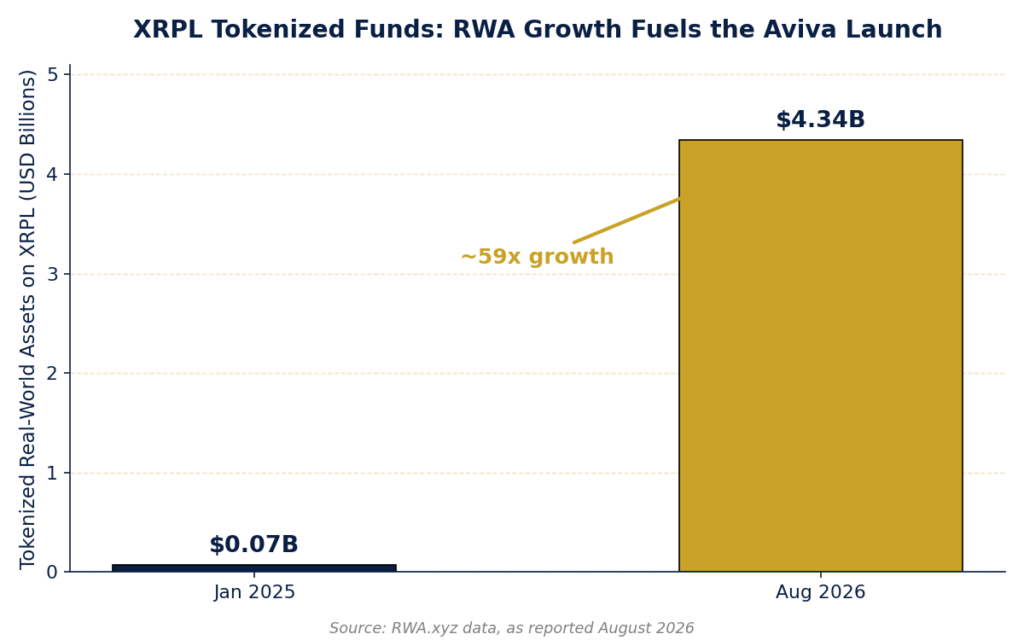
The tokenized real-world asset figures on XRPL support that reading. Data tracked by RWA.xyz shows tokenized real-world assets on the ledger growing from roughly seventy-three million dollars in January 2025 to about four point three four billion dollars by August 2026, an increase of almost fifty-nine times in under two years. Tokenized commodities and money market products have led that growth, and XRPL tokenized funds now sit squarely inside that expanding category.
That growth curve matters because it shows Aviva is entering a market segment that was already accelerating before its own product existed. A single large fund launch can move headlines for a week, but a fifty-nine times increase in tokenized assets over eighteen months reflects an underlying pattern of institutional demand that XRPL tokenized funds are now positioned to capture rather than create from scratch.
🖼️ [ IMAGE PLACEMENT — insert chart here ]
What This Means for Institutional Adoption
For institutions evaluating blockchain rails, the appeal of XRPL tokenized funds is less about novelty and more about operational efficiency. A tokenized share class can, in principle, settle faster than a traditional fund unit, support more granular record-keeping, and integrate more directly with on-chain liquidity and lending markets. The Aviva structure links directly into the broader ecosystem of RLUSD trading and settlement that Ripple has been building, which means investors holding these tokenized shares could eventually plug into on-chain credit and yield products without leaving the XRPL environment.
This is also where XRPL tokenized funds intersect with the ledger’s recent technical upgrades. The XRP Ledger’s version 3.3.0 release, which activated on August 8, introduced a Confidential Transfers amendment designed to encrypt balances and payment amounts for institutional users. That kind of privacy tooling directly addresses a concern that has kept some institutional allocators away from public blockchains: the visibility of position sizes and transaction flows to competitors.
As confidentiality features mature alongside products like Aviva’s fund, the case for XRPL tokenized funds as a genuine institutional settlement option gets stronger. Compliance officers who previously balked at putting fund holdings on a fully transparent public ledger now have a technical path to keep sensitive position data private while still benefiting from on-chain settlement speed.
Not every institutional observer is convinced the momentum will hold. Regulatory clarity in the United States remains unresolved, with a Senate procedural vote on the CLARITY Act pushed into September after lawmakers left for the August recess. That bill would move tokens meeting certain decentralization criteria under CFTC oversight, a lighter regulatory regime that compliance departments generally prefer over the current patchwork.
Until that framework is settled domestically, some U.S.-based asset managers may continue to watch European moves like Aviva’s from the sidelines rather than commit capital of their own. That asymmetry could mean XRPL tokenized funds see faster adoption in Europe and Asia in the near term, with U.S. institutional participation lagging until Congress provides a clearer regulatory runway.
Market Context Around the Launch
The Aviva Investors news landed during a choppy stretch for XRP itself. The token has traded in a narrow band near its multi-month support level in recent sessions, with price action driven more by broader market sentiment and regulatory headlines than by ecosystem-level developments like the fund launch. That disconnect is not unusual. Institutional infrastructure announcements tend to play out over quarters and years, while spot price reacts to short-term liquidity flows and macro conditions.
Still, for a project positioning itself as institutional-grade settlement infrastructure, the divergence between price action and fundamental progress is worth noting. XRPL tokenized funds, the RWA growth trajectory, and the ledger’s expanding stablecoin ecosystem all point toward a network that is accumulating real institutional plumbing, even if that progress has not yet been fully priced in by the market.
Analysts covering the space have noted this pattern before. Custody upgrades, stablecoin issuer additions, and now XRPL tokenized funds each generated a short burst of attention without producing a lasting price move on their own. The cumulative effect of these announcements, rather than any single one, is what tends to shift how institutional allocators view the ledger over a longer horizon.
What Comes Next for XRPL Tokenized Funds
The immediate question is whether other asset managers follow Aviva’s lead. The Central Bank of Ireland precedent gives UCITS-domiciled funds a clearer regulatory path, and Ripple’s parallel work with DBS and Franklin Templeton suggests additional tokenized fund products are already in development. If even a handful of comparable launches materialize over the next several quarters, XRPL tokenized funds could shift from a single notable deal into a recognized category within the broader tokenization market.
For now, the Aviva Investors launch stands as the clearest evidence yet that regulated fund managers are willing to put real assets on the XRP Ledger, not just explore the possibility in pilot programs. Combined with Ripple’s custody, stablecoin, and lending infrastructure, XRPL tokenized funds look increasingly like a durable pillar of the ledger’s institutional strategy rather than a one-time headline.
How This Compares to Other Tokenization Efforts
Aviva is not the first asset manager to experiment with tokenized fund structures, but most prior efforts have run on permissioned or private chains built specifically for a single institution. What sets XRPL tokenized funds apart is that they sit on public, shared infrastructure that other institutions can plug into without negotiating a bespoke technical integration. A tokenized fund on a closed system benefits one issuer. A tokenized fund on a shared public ledger can, over time, benefit an entire network of custodians, exchanges, and counterparties already building on the same rails.
That shared-infrastructure advantage is also why Ripple has been so deliberate about pairing XRPL tokenized funds with parallel investments in custody, stablecoins, and lending. A fund product alone is just one data point. A fund product that can settle in RLUSD, custody through regulated providers, and eventually collateralize on-chain credit is a far more complete institutional pitch, and it is the direction Ripple’s recent moves suggest the ecosystem is heading.
For readers who want to track this space directly, Bybit’s institutional and spot markets remain one of the more accessible ways to follow XRP price action alongside these ecosystem developments, though any trading decision should be weighed independently of the news itself.
Readers tracking the ledger’s institutional custody framework can review how the On-Chain Cosigner multisig model fits into this picture, and those following the stablecoin side of the ecosystem can see how the second RLUSD issuer expansion connects to the same institutional push behind XRPL tokenized funds.