Ripple Buys Its Way Into XRPL Capital Markets Infrastructure
Tokenizing an asset has never been the hard part. Making that tokenized asset actually useful, financeable, and tradeable with the same reliability as a conventional holding is where most institutional pilots have quietly stalled. On August 3, Ripple made a move aimed directly at that gap, announcing strategic equity investments in two UK-based fintech firms, ZILO and Licuido, converting existing commercial partnerships into full ownership stakes as part of a broader push into XRPL capital markets infrastructure.
The timing is not incidental. It comes less than a week after Aviva Investors launched a tokenized share class of its US Dollar Liquidity Fund on the XRP Ledger, the first tokenized fund structure approved by the Central Bank of Ireland on a public blockchain. That deployment already relied on both ZILO and Licuido behind the scenes. Ripple is, in effect, buying equity in infrastructure it had already put into production, a signal that the company sees this specific piece of the XRPL capital markets stack as core rather than experimental.
The “Dead Capital” Problem Facing XRPL Capital Markets
Institutional tokenization has run into a consistent structural failure. Tokenized fund shares get issued, then largely sit idle. The ownership record, the issuance rail, and the settlement mechanism have historically lived on separate, often incompatible legacy systems that were never designed to talk to on-chain collateral markets. An institution holding a tokenized money market fund that suddenly needs cash has typically had one real option: sell the fund outright.
That single-option problem is exactly what Ripple’s SVP of Trading and Markets, Nigel Khakoo, pointed to in the official announcement, describing ZILO and Licuido as supplying the regulated digital transfer agency infrastructure and collateral mobility that XRPL capital markets activity has been missing. Rather than liquidating a position to raise short-term cash, an institution using this stack can pledge the tokenized fund as collateral and borrow against it instead, keeping the underlying position intact.
[[IMAGE]]
What Each Piece of the XRPL Capital Markets Stack Actually Does
ZILO brings transfer agency and fund administration technology, the digital record-keeping layer that tracks who owns what as fund structures move on-chain. That sounds mundane compared to flashier blockchain announcements, but it is the piece regulators and institutional risk teams care about most, since a tokenized share class is only usable in lending and collateral markets if its ownership record meets the same standard as a conventional holding. ZILO already serves major names like Fidelity International and State Street in its non-tokenized business, giving it credibility with exactly the institutions Ripple wants to attract to XRPL capital markets activity.
Licuido supplies the other half: issuance, distribution, and collateral utility, wrapped in an FCA-regulated platform. Its core pitch is unlocking liquidity from assets that would otherwise sit static, letting institutions post tokenized fund shares as collateral to borrow short-term cash rather than selling outright. Licuido’s own framing places this squarely within the nearly $10 trillion money market repo market, a scale that underscores how much idle collateral this kind of infrastructure could theoretically activate if adoption follows the pilot-to-production path Ripple is betting on.
Combined with RLUSD as the settlement asset, the resulting stack, regulated ownership records, compliant issuance, and atomic delivery-versus-payment settlement, is designed to close the full tokenized-asset lifecycle on a single ledger rather than requiring institutions to stitch together multiple vendors and legacy systems.
Why This Matters More Than a Typical Partnership Announcement
Ripple’s approach here differs meaningfully from a standard commercial partnership. By taking equity stakes rather than simply signing distribution deals, Ripple is aligning its own incentives directly with the success of the infrastructure layer underneath XRPL capital markets activity, not just the ledger itself. That distinction matters to institutional counterparties evaluating long-term reliability, since a vendor relationship can be renegotiated or dropped, while an equity stake signals a more durable commitment.
It also reflects lessons from where tokenization pilots across the industry have historically failed. Minting a token is the easy 10 percent of the problem. The other 90 percent, regulated custody, compliant record-keeping, and the ability to actually use the asset as collateral in a crisis, is exactly the plumbing that determines whether institutions treat tokenization as a genuine operational upgrade or an expensive experiment that never leaves the pilot phase. Ripple’s willingness to buy that plumbing outright suggests the company views XRPL capital markets infrastructure as a multi-year bet rather than a one-off product launch.
The Broader Institutional Build-Out Around XRPL Capital Markets
This deal doesn’t exist in isolation. Ripple’s partnership with Aviva Investors, a firm managing roughly $345 billion in net assets, dates back to February 2026, and the July 29 launch of Aviva’s tokenized US Dollar Liquidity Fund marked the first real production use of the combined ZILO-Licuido stack.
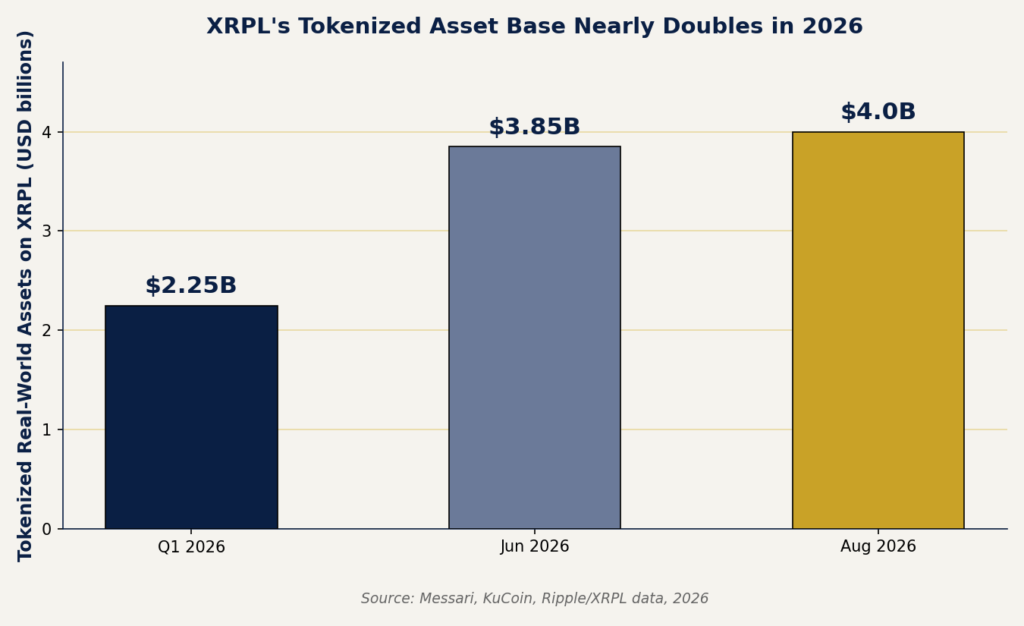
Tokenized real-world assets on XRPL have grown from roughly $2.25 billion in the first quarter of 2026 to nearly $4 billion by August, according to data compiled from Messari and on-chain trackers, a trajectory that suggests this specific corner of XRPL capital markets development has genuine institutional pull behind it rather than speculative hype.
Ripple President Monica Long framed the broader shift bluntly in comments around the announcement, describing a transition from bank pilots to actual production deployments, a distinction that matters because pilots rarely move markets while production volume does. Whether that framing holds up depends on whether more asset managers follow Aviva’s path and whether ZILO and Licuido can scale their infrastructure fast enough to support them.
A separate but related data point reinforces the direction of travel: Ripple has continued deploying capital into XRPL-adjacent infrastructure even as XRP’s own price has struggled through much of the summer. That decoupling between infrastructure investment and token price is common in early-stage institutional blockchain adoption, where the companies building the rails often move faster than the market prices in the eventual payoff. It doesn’t guarantee the payoff arrives, but it does suggest Ripple itself is treating XRPL capital markets development as a priority independent of short-term sentiment around the token.
The Skeptical Read: Does This Actually Help XRP the Token
Not every observer is convinced this translates into direct upside for XRP itself. Some market commentary has noted a pattern in 2026 where announcements framed as bullish for XRPL’s institutional ecosystem have coincided with, rather than reversed, continued price weakness in the token. The core tension is that ZILO and Licuido strengthen the capital markets infrastructure sitting on top of XRPL, but the actual settlement volume moving through that stack currently leans on RLUSD rather than XRP itself for delivery-versus-payment transactions.
That’s a meaningful distinction for anyone evaluating XRPL capital markets news through an investment lens rather than a technology lens. Infrastructure that makes the ledger more useful to institutions doesn’t automatically translate into direct demand for the native token, particularly when stablecoins are doing much of the settlement work. The bull case still requires XRP to capture value indirectly, through network fees, liquidity provisioning, or eventual expanded use cases, rather than through this specific deal alone.
What to Watch Next
The near-term signal worth tracking is adoption breadth: whether additional asset managers beyond Aviva announce tokenized fund launches using the ZILO-Licuido infrastructure, and whether Ripple discloses any usage or volume data from the combined stack. Right now, most of the detail available is qualitative rather than quantitative, with Ripple keeping specific transaction volumes private. A jump in disclosed tokenized asset value, or a second major asset manager following Aviva’s lead, would be the clearest evidence that XRPL capital markets infrastructure is scaling rather than staying confined to a single flagship deployment.
The Bottom Line
Ripple’s investments in ZILO and Licuido address a real, well-documented gap in institutional tokenization: the difference between minting a token and actually being able to use it. By converting commercial partnerships into equity stakes, Ripple is signaling long-term commitment to building out XRPL capital markets infrastructure rather than treating tokenization as a marketing exercise. Whether that translates into direct value for XRP holders remains a separate and genuinely open question, one that likely won’t get resolved by a single announcement but by whether the broader institutional pipeline keeps moving from pilot to production over the next several quarters.
For readers more interested in trading XRP’s price action than tracking its infrastructure roadmap, a platform with reliable liquidity still matters day to day. Bybit is one exchange offering XRP spot and margin markets for those looking to act on shorter-term price moves rather than the multi-quarter institutional story covered here. As always, this is not financial advice, and any trading decision should account for your own risk tolerance.