XRPL’s Stablecoin Ecosystem Just Got a Second Major Player
For most of the past year, talking about dollars on the XRP Ledger meant talking about one token: Ripple’s RLUSD. That is starting to change. The XRPL stablecoin ecosystem now includes a second meaningful issuer, and the shift says more about where XRPL is headed than another price headline ever could.
The trigger is Valtorum’s USDV, a permissioned dollar token that went live on the XRP Ledger earlier this summer. On its own, USDV’s balance is still modest. But its presence changes the structure of the XRPL stablecoin ecosystem from a single-issuer setup into something that starts to resemble a genuine multi-issuer settlement rail, the kind of architecture institutions look for before they commit serious volume to a network.
How Big Is the XRPL Stablecoin Ecosystem Right Now
The numbers tell a growth story even before USDV enters the picture. Total stablecoin supply on the XRP Ledger sat below $100 million for most of 2025. By November of that year, it crossed $200 million and entered a sustained expansion phase. Supply kept climbing through the first half of 2026, reaching roughly $762 million by June, and nearing $890 million by early July, a 30-day increase of more than 20 percent.
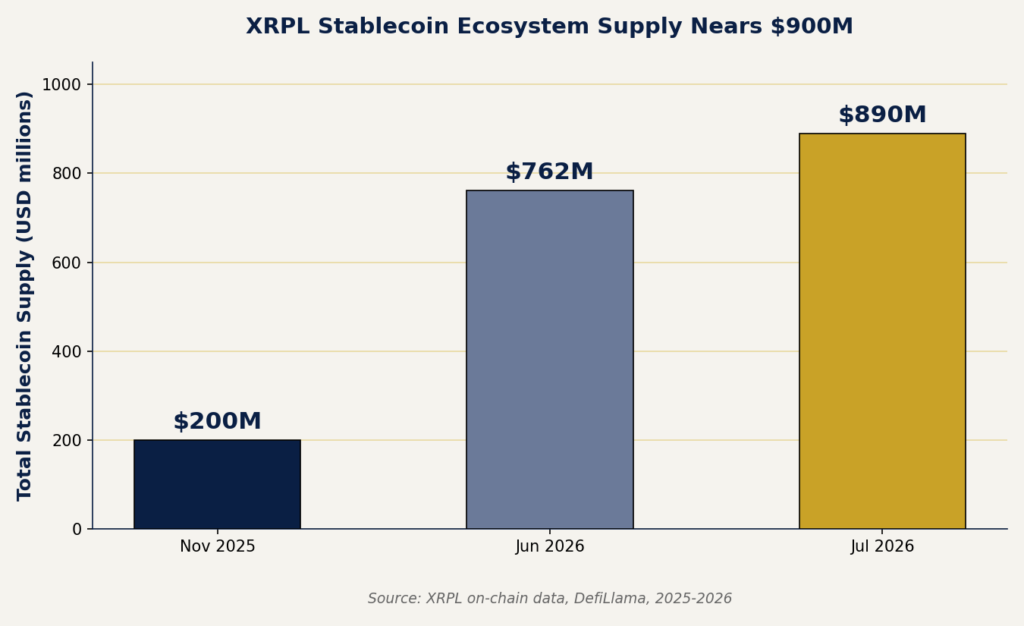
That trajectory has continued into August. On August 6, Ripple minted an additional 811,026 RLUSD directly on the XRP Ledger, using a three-signer multisig configuration to authorize the issuance. The mint pushed RLUSD’s share of the XRPL stablecoin ecosystem past the 50 percent mark of cumulative trading volume, which now exceeds $2.5 billion since launch. RLUSD remains the dominant force by a wide margin, accounting for roughly 95 percent of total XRPL stablecoin supply, with USDV holding a low-single-digit share and USDC trailing further behind.
Why a Second Issuer Changes the Picture for the XRPL Stablecoin Ecosystem
A single-issuer stablecoin ecosystem carries a specific kind of risk that institutions are trained to notice immediately: concentration. If one issuer controls nearly all the dollar liquidity on a network, that issuer’s regulatory status, banking relationships, and operational decisions effectively become the network’s risk profile too. A more diversified XRPL stablecoin ecosystem, even an early-stage one, spreads that dependency across more than one counterparty.
Valtorum’s approach to USDV illustrates why this matters beyond simple diversification. According to the project’s own documentation, USDV is designed as a synthetic dollar built specifically for institutions, payment networks, and on-chain markets, with a reserve model broader than a typical one-to-one fiat peg. The framework can incorporate stablecoins, hard assets, bonds, Treasuries, and crypto collateral rather than relying on a single reserve type. That structure is aimed squarely at the kind of institutional balance sheet management that a pure cash-backed token doesn’t always accommodate.
USDV’s holder trustlines also require issuer authorization before they can transact, a permissioned design that mirrors the compliance-first posture regulated institutions tend to prefer over fully open, permissionless tokens. For a network positioning itself as institution-friendly, having a second issuer that shares that philosophy strengthens the case that the XRPL stablecoin ecosystem is being built around institutional requirements rather than retail convenience alone, and it gives risk teams a genuine second data point when assessing counterparty exposure.
The Transparency Gap Still Standing in the Way
None of this means USDV has already proven itself. Valtorum’s reserve dashboard currently marks coverage as “attestation pending,” meaning the live, verifiable reserve reporting that institutions typically require before extending real trust has not yet gone live. DefiLlama’s own tracking lists USDV’s audit status as unconfirmed. For a token explicitly targeting institutional users, that gap is not a minor detail; it is close to the entire test.
The token is also designed to expand well beyond the XRP Ledger, with native settlement planned across Stellar, Solana, Sui, and Ethereum. Right now, only the XRPL registry is actually live, while the other chains remain pending. That sequencing suggests XRPL is being treated as the proving ground for whether the broader multi-chain model works before Valtorum expands it further, which arguably raises the stakes for how the XRPL stablecoin ecosystem performs as USDV’s flagship deployment and the template other issuers may evaluate before choosing where to launch next.
Dollars Have Arrived in the XRPL Stablecoin Ecosystem, But Activity Hasn’t Caught Up Yet
One of the more sobering data points sits alongside all this growth. Even with XRPL’s stablecoin supply approaching $900 million, daily decentralized exchange volume tied to those tokens has been measured at under $4 million, with daily network fees in the low hundreds of dollars. In plain terms, a large amount of dollar-denominated value has moved onto the ledger, but the payment and trading activity meant to use that liquidity hasn’t caught up yet.
That gap is worth watching closely for anyone evaluating the XRPL stablecoin ecosystem as more than a balance-sheet statistic. Supply sitting in wallets is a necessary first step, but it isn’t the same as proof that a network is being used for real settlement.
Analysts tracking the space have pointed to a handful of concrete signals that would confirm the trend is durable rather than temporary positioning: total supply pushing past roughly $1.1 billion, USDV’s balance scaling from the tens of millions toward $75-100 million, live reserve attestations replacing the current “pending” status, and sustained growth in transfer volume and holder counts rather than concentration among a small number of wallets.
What a Genuine Multi-Issuer Rail Would Mean for XRPL
If those signals materialize, the implications extend beyond stablecoin metrics alone. A functioning multi-issuer XRPL stablecoin ecosystem would give institutions more than one path onto the ledger for dollar liquidity, reducing single-point-of-failure risk and creating competitive pressure that tends to improve terms, transparency, and reliability across issuers. It would also complement the custody and settlement infrastructure XRPL has been building elsewhere, including the recently proposed on-chain multisig coordination standard aimed at institutional custody use cases and the broader XRPL 3.3.0 upgrade bundle focused on tokenized asset usability.
Ripple, for its part, has clear incentives to keep expanding RLUSD’s footprint regardless of how USDV performs. XRPL now holds roughly 52 percent of RLUSD’s total supply, a share that has been rising as corridor partnerships route more liquidity through the ledger rather than Ethereum, where RLUSD’s presence has been shrinking over the same period.
That dynamic alone would keep the XRPL stablecoin ecosystem growing even without a second issuer gaining traction, but a credible alternative issuer changes the qualitative story from “Ripple’s stablecoin runs on Ripple’s ledger” to “XRPL is becoming a settlement venue multiple issuers choose independently.” That distinction matters more to institutional allocators than raw supply figures do, since it speaks to whether the network’s growth depends on one company’s decisions or reflects broader market demand.
How This Compares to Other Chains Chasing Institutional Stablecoin Flow
XRPL is not alone in trying to attract multiple stablecoin issuers to build a credible institutional settlement layer. Ethereum has long hosted a genuinely diverse mix of issuers, though that diversity comes bundled with higher fees and slower finality than XRPL typically offers. Newer entrants like Solana have leaned on speed and low costs to attract stablecoin volume, with mixed results on institutional-grade compliance tooling.
XRPL’s pitch within the XRPL stablecoin ecosystem conversation is narrower and more specific: fast, cheap settlement combined with a regulatory-first posture that has already produced tangible wins, including a Luxembourg Crypto Asset Service Provider license for Ripple and a growing library of real-world asset tokenization pilots involving names like JPMorgan, Mastercard, and Ondo Finance. Whether that combination is enough to pull additional issuers beyond USDV onto the ledger is likely to become clearer over the next two or three quarters, as Valtorum’s attestation timeline plays out and RLUSD’s growth trajectory either continues or plateaus.
The Bottom Line
The XRPL stablecoin ecosystem is at an inflection point that has little to do with XRP’s price and everything to do with the ledger’s long-term positioning as financial infrastructure. RLUSD‘s continued dominance shows Ripple’s own stablecoin strategy is working. USDV’s arrival, however tentative, tests whether other institutions are willing to build on XRPL independently of Ripple’s own product roadmap.
The answer will likely come down to unglamorous details: whether Valtorum publishes real reserve attestations, whether transfer volume starts to reflect the supply already sitting on the ledger, and whether more issuers follow USDV’s lead into the XRPL stablecoin ecosystem. Those are the numbers worth tracking over the next few months, not the headline supply figure alone.
For traders looking to act on stablecoin and liquidity trends directly rather than just read about them, a platform with deep XRP and stablecoin pairs makes execution easier. Bybit is one option offering XRP trading alongside broader market tools for those exploring spot or margin positions. As always, this is not financial advice, and any trading decision should account for your own risk tolerance.