Until recently, a CFO wanting exposure to XRP or RLUSD had to route around the existing treasury stack entirely — a separate wallet, a separate custodian, a separate reconciliation process bolted onto systems never designed for digital assets.
That gap closed in April 2026, and it marks a distinct shift in how XRP corporate treasury adoption is actually happening: not through speculative allocation, but through direct integration into the tools finance teams already use every day.
This guide breaks down what changed, why it matters for institutional treasury strategy, and what the parallel bank-grade settlement pilots running alongside it suggest about where XRP corporate treasury use is headed next.
What Launched: Digital Asset Accounts and Unified Treasury
On April 1, 2026, Ripple introduced two native capabilities inside Ripple Treasury: Digital Asset Accounts and Unified Treasury, as first reported by CoinDesk. Together they represent the first XRP corporate treasury tooling embedded directly inside an enterprise treasury management system, rather than offered as a bolt-on crypto product alongside it.
Digital Asset Accounts let finance teams create a regulated, Ripple-native account holding XRP and RLUSD directly inside the platform. Balances appear alongside traditional cash positions, with real-time fiat valuations calculated from live exchange rates and transactions logged automatically with fiat equivalents and market price at the time of each event.
The precision matters operationally: balances are captured at 15-decimal accuracy to match on-chain records, removing the rounding discrepancies that have historically made crypto reconciliation a manual, error-prone process for corporate accounting teams.
Unified Treasury extends this further by connecting external custodians through the same API layer Ripple already uses for bank integrations, giving treasury teams a single dashboard view across banks, custodians, and asset types rather than assembling that picture manually across disconnected systems.
The GTreasury Acquisition: Why It Matters for XRP Corporate Treasury Adoption
None of this exists in isolation from Ripple’s broader infrastructure strategy. The new capabilities are built on GTreasury, a treasury management platform Ripple acquired for $1 billion in October 2025 — a system that processed $13 trillion in payment volume in 2025 alone for clients ranging from small businesses to Fortune 500 companies.
That distinction is the core reason this launch reads differently than a typical crypto product announcement: Ripple didn’t build XRP corporate treasury functionality from scratch and ask finance teams to adopt new software. It embedded XRP and RLUSD into treasury infrastructure that thousands of corporate finance teams were already running, which meaningfully lowers the operational switching cost that has historically slowed institutional crypto adoption.
Ripple has been explicit that this is a foundation rather than a finished product, with cross-border settlement, intercompany payments, and stablecoin-based yield on idle cash named as the next capabilities planned for the platform.
Beyond Ripple’s Platform: The JPMorgan-Mastercard-Ondo Tokenized Treasury Pilot
A separate but related development strengthens the broader case for XRP corporate treasury infrastructure: a May 2026 pilot connecting the XRP Ledger directly to traditional interbank settlement rails.
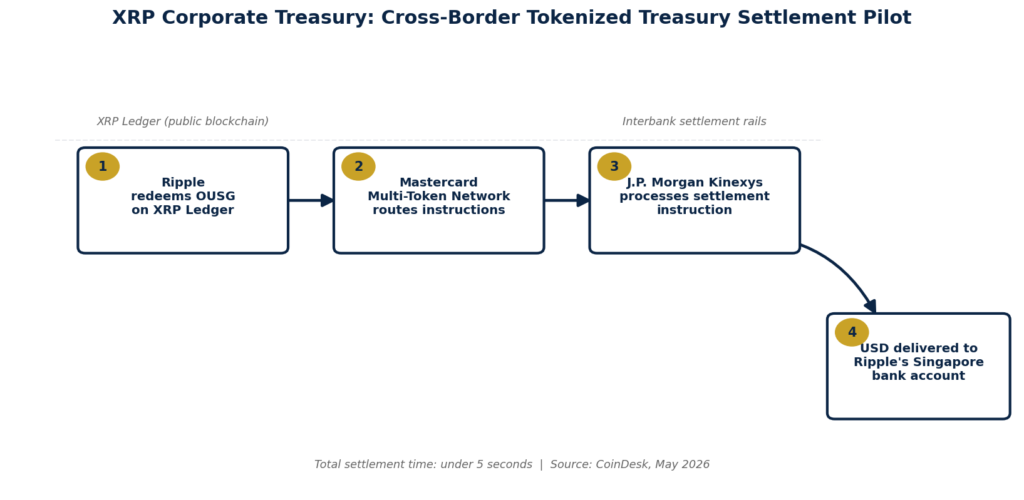
In the test, Ripple redeemed part of its holding in Ondo Finance’s OUSG — a tokenized short-term U.S. government Treasury fund — on the XRP Ledger. Mastercard’s Multi-Token Network routed the settlement instructions to Kinexys, J.P. Morgan’s blockchain settlement unit, which then moved the corresponding U.S. dollars to Ripple’s bank account in Singapore through its correspondent banking network.
The full cross-border settlement completed in under five seconds, according to CoinDesk’s coverage of the pilot. Crucially, the dollar leg moved through the traditional banking system rather than fully on-chain — a hybrid design that let institutions use blockchain rails for the asset leg while keeping fiat settlement inside regulated banking channels.
RippleX’s Markus Infanger noted that the transaction demonstrated institutions running a cross-border tokenized asset movement as a single integrated flow, rather than stitching it together manually across legacy systems — a distinction that speaks directly to what corporate treasury teams evaluating XRP infrastructure actually care about: operational simplicity, not novelty.
For context on how these tokenized settlement rails interact with the ETF-driven institutional capital already flowing into XRP, see our guide to XRP ETF institutional adoption, which covers the investment side of this same institutional shift.
Why CFOs Are Moving Now: The 2026 Finance Leader Survey
The timing isn’t incidental. A Ripple-published survey of more than 1,000 global finance leaders, conducted in March 2026, found that 72% believe their companies must offer a digital asset solution to remain competitive.
That figure signals something more specific than general crypto optimism: a shift from experimentation to integration, where institutions are actively looking to fold digital assets into existing financial systems rather than manage them as a separate, siloed function. For treasury teams, XRP corporate treasury adoption is increasingly framed as an operational competitiveness question, not a speculative allocation decision.
Practical Use Cases for XRP Corporate Treasury Management
Based on what Ripple has already shipped and named as its near-term roadmap, XRP corporate treasury use cases fall into three categories:
- Cross-border settlement. Reducing the multi-day correspondent banking delays that traditional international payments still carry, using XRP or RLUSD as a bridge or settlement asset.
- Intercompany payments. Moving funds between subsidiaries and regional entities faster than traditional wire transfers permit, particularly across time zones where banking hours don’t overlap.
- Yield on idle cash. Using RLUSD or similar stablecoin instruments to generate return on cash balances that would otherwise sit dormant between operational needs — a capability Ripple has named explicitly as a future addition.
Institutional desks already thinking about custody architecture for XRP holdings should treat this treasury-platform model as a distinct track from self-custody: our institutional-grade XRP custody guide covers cold storage and multisig protocols for firms managing XRP outside of a platform like Ripple Treasury, which is the more relevant comparison for treasury teams weighing build-versus-integrate decisions.
Risks and Open Questions for XRP Corporate Treasury Adoption
A few open questions are worth tracking before treating this as a settled institutional standard:
- Jurisdictional availability. Ripple has been explicit that broader rollout depends on regulatory requirements that vary by geography — this is not yet universally available.
- Concentration risk in a single vendor stack. Embedding XRP and RLUSD inside one treasury platform provider creates a dependency that finance teams should weigh against the operational convenience.
- Regulatory framework maturity. The IMF has noted publicly that tokenized finance still needs clearer policy frameworks, safe settlement assets, and stronger legal certainty around settlement finality — a caution worth applying to XRP corporate treasury infrastructure broadly, not just Ripple’s specific implementation.
For treasury teams building a broader XRP allocation and risk framework alongside these operational tools, our XRP liquidity and portfolio risk management guide covers position sizing and liquidity modeling considerations that apply regardless of which custody or treasury platform a firm ultimately selects.
How This Compares to the ETF-Driven Institutional Wave
It’s worth distinguishing this development from the XRP ETF story that dominated institutional headlines through late 2025 and early 2026. Spot ETF inflows represent investment-side institutional adoption — asset managers and RIAs allocating client capital to XRP as a portfolio position, typically without any operational use of the asset itself.
XRP corporate treasury infrastructure represents something structurally different: operational adoption by corporate finance teams who may have no interest in XRP as a speculative holding, but who need faster settlement rails, better cash management tools, or lower-cost cross-border payment infrastructure.
A CFO using Ripple Treasury’s Digital Asset Accounts for intercompany settlement isn’t necessarily making a directional bet on XRP’s price — they’re evaluating it as payment infrastructure.
This distinction matters for how analysts and allocators read XRP adoption data going forward. ETF inflows and treasury-platform adoption are separate demand signals, driven by different institutional buyers with different motivations, and conflating them risks overstating how much of either trend reflects genuine operational usage versus investment positioning.
What This Means for Institutional Due Diligence
For institutions evaluating whether to build internal XRP infrastructure or integrate through a platform like Ripple Treasury, the calculus increasingly resembles a standard build-versus-buy decision rather than a novel crypto-specific evaluation.
Firms with existing GTreasury relationships have the shortest path to XRP corporate treasury adoption, since the digital asset capability extends infrastructure they already operate rather than requiring a new vendor relationship. Firms without that existing relationship face a more conventional vendor evaluation: weighing platform lock-in, jurisdictional availability, and integration cost against the operational benefits of native fiat-and-digital-asset account management.
Either path still requires the same underlying due diligence any institutional digital asset decision demands — custody architecture, counterparty risk assessment, and regulatory status by jurisdiction — regardless of how convenient the front-end integration appears.
Conclusion: XRP Corporate Treasury Infrastructure Is Becoming Operational, Not Speculative
What distinguishes this wave of XRP corporate treasury development from earlier institutional crypto narratives is the shift in framing: this is infrastructure embedded into existing CFO workflows, validated by a real cross-border settlement pilot involving J.P. Morgan and Mastercard, and backed by survey data showing most finance leaders now see digital asset integration as competitively necessary rather than optional.
For institutional treasury teams, the relevant question is no longer whether XRP corporate treasury tooling exists, but how quickly build-versus-integrate decisions need to be made as this infrastructure moves from beta rollout to broader availability across jurisdictions.