Liquidity providers evaluating the XRP Ledger’s native Automated Market Maker (AMM) are often sold on the headline yield — typically 5% to 20% APY from trading fees — without a rigorous accounting of the offsetting risk. That risk has a name and a formula: XRPL AMM impermanent loss.
This guide takes a quantitative approach to XRPL AMM impermanent loss, moving past the marketing framing and into the mechanics institutional liquidity providers actually need to model before allocating capital.
What XRPL AMM Impermanent Loss Actually Measures
Impermanent loss is not a fee or a penalty — it is the mathematical gap between holding two assets in a liquidity pool versus simply holding them in a wallet. It arises whenever the relative price of the pooled asset pair moves away from the price at deposit time.
The constant-product formula underlying most AMMs, including XRPL’s native implementation, automatically rebalances pool composition as prices shift — which is precisely where the divergence originates.
The shape of this XRPL AMM impermanent loss function is well documented in academic literature: it follows an inversely U-shaped curve relative to the price ratio change between the pooled assets. Small price movements produce proportionally small losses, but the loss accelerates sharply as the price ratio departs further from parity.
For an LP posting an XRP/stablecoin pair, this means a 2x move in XRP’s price produces a meaningfully larger — not just double — divergence loss relative to simply holding XRP outright.
The practical takeaway for quantitative allocators: fee income needs to be modeled against a convex loss function, not a linear one. A pool that looks profitable at low volatility can flip unprofitable quickly once price swings exceed a threshold specific to the fee tier and pool depth.
XRPL’s Structural Edge: The Continuous Auction Mechanism
Where XRPL’s AMM design differs meaningfully from Ethereum-based implementations like Uniswap is in how it handles the arbitrage that drives impermanent loss in the first place. XRPL’s native AMM includes a Continuous Auction Mechanism (CAM), which lets participants bid for time-limited discounted trading slots when a pool’s price has drifted from the external market.
Rather than letting all of that arbitrage value leak out to external bots, the auction design is built to redirect a portion of it back to liquidity providers — a direct structural response to XRPL AMM impermanent loss.
Academic simulation work comparing the XRPL AMM-DEX against a generic Ethereum-style AMM found that XRPL’s shorter block times and lower fees improved price synchronization and reduced slippage. The CAM further mitigates impermanent loss by redistributing arbitrage value to liquidity providers rather than losing it entirely to external arbitrageurs.
The effect was most pronounced during periods of elevated volatility — precisely the conditions where impermanent loss is otherwise most damaging.
This is a structural advantage worth quantifying rather than taking on faith. LPs comparing XRPL pools against equivalent pairs on other chains should treat the CAM as a partial offset to modeled XRPL AMM impermanent loss, not a full hedge — the underlying research is explicit that no fee function can eliminate impermanent loss entirely across all starting conditions.
Modeling the Arbitrage Window
Every arbitrage opportunity against an AMM pool has a size threshold below which it isn’t worth executing, once network fees and slippage are accounted for. On XRPL, that threshold is unusually low: sub-second settlement and negligible transaction costs mean smaller price divergences get arbitraged away faster than on higher-fee chains.
For a liquidity provider, this cuts both ways. Faster arbitrage means tighter price tracking and more frequent, smaller rebalancing events rather than large, infrequent corrections.
It also means reduced “toxic flow” risk compared to venues where mispricings accumulate before correction, concentrating losses into fewer, larger events that are harder to hedge.
Quantitatively, this means the same nominal fee tier can produce different realized IL outcomes depending on the venue’s settlement speed and arbitrage-capture design — a variable that is easy to overlook when comparing headline APY figures across platforms.
Fee Economics: Where the XRPL AMM Impermanent Loss Breakeven Line Sits
XRPL AMM pools typically run a 0.3% trading fee, in line with common Uniswap-style defaults, meaning a $10,000 trade generates roughly $30 in fees split proportionally among LPs.
Whether that fee income offsets impermanent loss over a given holding period depends on three variables an institutional LP should model explicitly:
- Realized volatility of the pooled pair. Higher volatility increases both fee-generating trading volume and the convex IL exposure — the net effect isn’t automatically positive.
- Pool depth relative to trade size. Deeper pools experience less price impact per trade, which reduces both fee capture per trade and the LP’s individual share of that fee income.
- Holding period. IL is only realized on withdrawal — a pair showing unrealized loss mid-period can fully recover if prices revert before the position closes.
For pairs involving RLUSD or other stablecoin legs, expected volatility is materially lower, which shifts the breakeven math meaningfully in the LP’s favor compared to volatile XRP/altcoin pairs. Institutional desks sizing positions across the XRP liquidity and portfolio risk management framework we’ve outlined previously should treat pool selection — not just position size — as a primary risk lever.
A Worked Example: Quantifying XRPL AMM Impermanent Loss at Different Price Moves
Numbers make the convexity argument concrete. Consider an LP depositing an XRP/RLUSD pair into a standard constant-product pool, with no fee income yet factored in. The figures below use the standard constant-product impermanent loss formula, isolated from fee income and CAM arbitrage-value recapture so the underlying convexity is visible on its own.
| XRP Price Change | Impermanent Loss (vs. holding) |
|---|---|
| +25% | ≈ 0.6% |
| +50% | ≈ 2.0% |
| +100% (2x) | ≈ 5.7% |
| +300% (4x) | ≈ 20.0% |
| -50% | ≈ 2.0% |
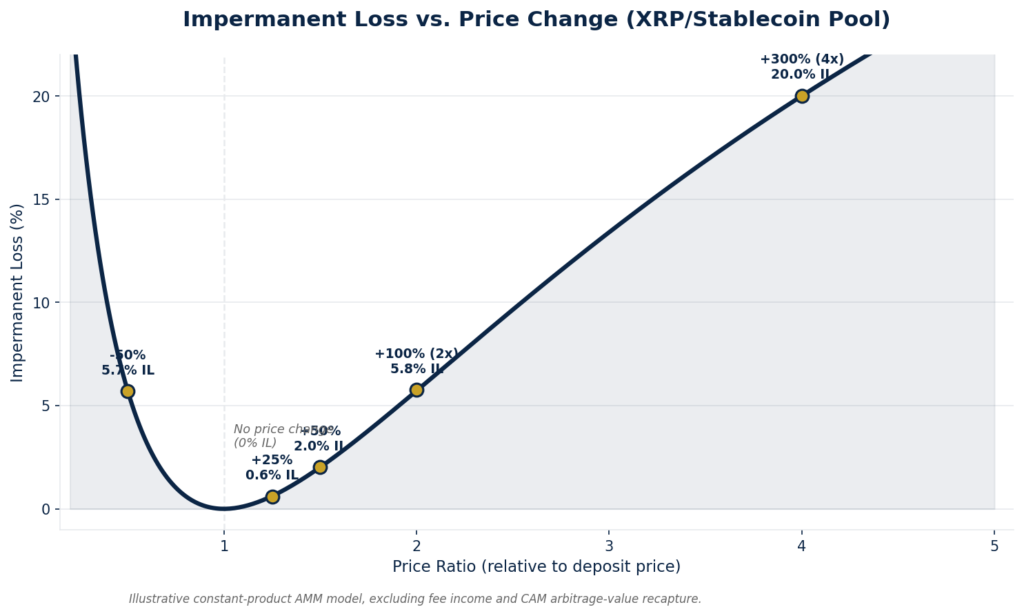
The pattern is symmetric around price direction but sharply convex around magnitude — doubling the price move roughly quadruples the loss rather than doubling it.
This is the mathematical reason a pool that comfortably breaks even during a quiet, range-bound quarter can post a materially negative net return in a quarter where XRP moves sharply in either direction, even with fee income included.
Layering fee income onto this table changes the picture but doesn’t erase the convexity. At a 0.3% fee tier with healthy trading volume, a pool might generate an annualized 8–12% in fee income under normal conditions — comfortably covering IL at the ±25% end, but potentially falling short at the 2x-or-greater end unless CAM recapture is also factored in.
This is precisely why position sizing and holding-period assumptions matter more for AMM liquidity provision than for simply holding the underlying asset: the risk profile is not linear.
Building a Risk Management Framework Around XRPL AMM Impermanent Loss
A disciplined approach to XRPL AMM liquidity provision, informed by the above, generally includes:
- Position sizing tied to realized, not implied, volatility of the pooled pair over a trailing window relevant to the expected holding period.
- Explicit IL breakeven modeling before entry, using the convex loss function rather than a linear approximation.
- Preference for CAM-eligible native pools over synthetic wrapped equivalents, given the partial arbitrage-value recapture built into the protocol.
- Active monitoring of trust-line and issuer exposure, since XRPL AMM pairs often involve IOU issuers whose counterparty risk is separate from — and additive to — pool-level impermanent loss.
- Scenario testing across multiple price paths, not just a single expected-value estimate.
None of these steps require exotic tooling — most can be modeled in a standard spreadsheet using the constant-product formula, historical volatility for the pair, and the pool’s published fee tier.
Larger allocators sometimes extend this into a lightweight Monte Carlo simulation across a range of plausible price paths, but the spreadsheet version captures the bulk of the decision-relevant insight for most position sizes.
For allocators who want direct exposure to XRP price movement without liquidity-provision risk — for example, to hedge an existing LP position using margin — a dedicated trading account is the more direct tool.
Opening an XRP margin account on Bybit is one route institutional and active traders use for that purpose. Our margin trading strategies guide covers position sizing and leverage considerations in more depth.
Disclosure: This post contains an affiliate link. If you sign up through it, we may earn a commission at no additional cost to you.
Conclusion: Treat Yield as Net of XRPL AMM Impermanent Loss, Not a Standalone Number
The core error in most retail-facing AMM content is presenting fee APY as if it were the return. For any liquidity provider sizing a real allocation, the relevant number is fee income net of a properly modeled XRPL AMM impermanent loss function — adjusted for XRPL’s structural advantages around settlement speed and arbitrage-value recapture via the Continuous Auction Mechanism.
Institutions that build this into their pool selection and position-sizing process are better positioned to treat XRPL AMM participation as a genuine yield strategy rather than an unmodeled directional bet dressed up as one.