Ripple just gave institutions a much easier way to move its stablecoin — and the timing says a lot about where the company’s ambitions actually sit. The centerpiece of that push is Ripple Mint RLUSD, a new institutional platform paired with a strategic compliance investment.
On July 23, 2026, Ripple launched Ripple Mint, a unified platform that lets institutional clients issue, redeem, bridge, and monitor RLUSD, its dollar-backed stablecoin, through either a web console or a full API. On the same day, Ripple announced a strategic investment in Notabene, a compliance network used by more than 2,300 institutions across over 100 jurisdictions to move roughly $2 trillion a year.
Together, the two moves target the two biggest obstacles that have kept large financial institutions from treating RLUSD as a serious operational tool: clunky issuance and thin compliance infrastructure.
For a blog that tracks institutional XRP and crypto developments, Ripple Mint RLUSD’s rollout is the story worth sitting with today— not because it moves the XRP price chart directly, but because of what it reveals about how Ripple is building its business around XRP rather than strictly through it.
What Ripple Mint RLUSD Actually Does
Before Ripple Mint RLUSD, institutions that wanted to create or redeem RLUSD had to work directly with Ripple through a manual, largely relationship-driven process. Ripple Mint replaces that with a self-service platform built for scale. Institutions can now:
- Mint and redeem RLUSD directly through a dashboard or API
- Bridge tokens across every network RLUSD supports
- Track transactions in real time, from fiat receipt through on-chain settlement
- Receive webhook alerts at each stage of a transaction
- Use consistent reference IDs that simplify reconciliation for exchanges and market makers
Ripple built the platform for repeat users — exchanges, market makers, and fintech firms — that need to move stablecoin volume routinely rather than as one-off transactions.
RLUSD is issued by Standard Custody & Trust Company, a New York-chartered trust company regulated by the New York State Department of Financial Services — institutions weighing how that custody model compares to self-custody options may find our XRP custody and cold storage guide useful context — and Ripple already runs a parallel stablecoin operation in Japan through SBI Group. Ripple Mint RLUSD effectively standardizes that institutional approach.
RLUSD is also no longer confined to the XRP Ledger and Ethereum. It has expanded onto the XRPL EVM sidechain, Base, Optimism, Ink, and Unichain, giving institutional users more venues to hold and move the token without disrupting existing customers.
The Notabene Investment: Solving the Compliance Gap
Building an easy way to mint a stablecoin solves only half the adoption problem. The other half is convincing regulated institutions that the token can move safely through their existing compliance workflows — which is where Notabene comes in.
Ripple made an undisclosed strategic investment in Notabene and will integrate RLUSD into Notabene Flow, its platform for compliant business-to-business stablecoin payments. Notabene works with banks and virtual asset service providers to share identity and compliance data before a transaction settles, addressing counterparty verification, one of the most persistent regulatory friction points in stablecoin payments. The two companies also plan to explore how Notabene’s payment-authorization tools might work alongside Ripple Payments more broadly.
A Standard Custody & Trust Company executive framed the Notabene deal as a step toward globally compliant stablecoin transfers, tying RLUSD, Ripple Payments, and Notabene’s institutional network together under a single compliance umbrella. That framing matters: it signals that Ripple is positioning RLUSD less as a crypto-native asset and more as regulated payments infrastructure that happens to run on blockchain rails.
The Numbers Are Mixed — and That’s the Interesting Part
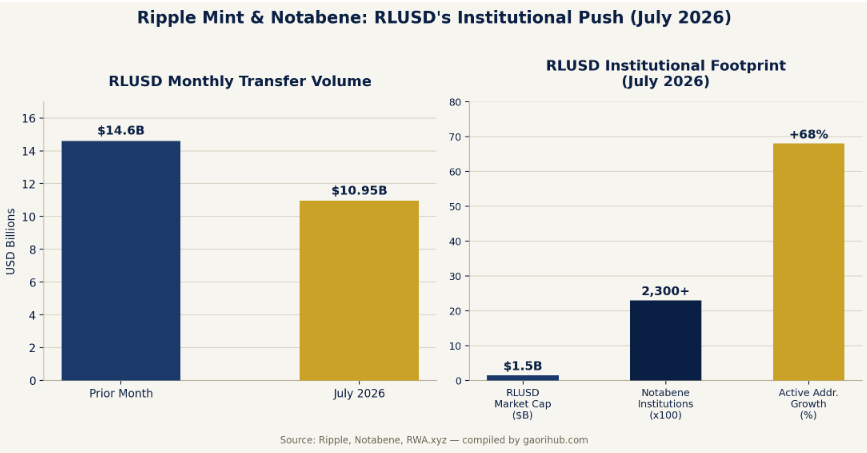
The rollout arrives at an odd moment for RLUSD’s underlying metrics. Holder counts and active addresses both grew through July, with active addresses reportedly surging as much as 68% in some measurements. At the same time, monthly transfer volume fell by roughly a quarter, from about $14.6 billion to $10.95 billion. RLUSD’s market capitalization currently sits near $1.5 billion, which puts it well behind Tether and USDC but keeps it in the second tier of regulated dollar stablecoins.
Read together, the data suggests broader but shallower usage: more distinct participants are touching RLUSD, even as aggregate volume has cooled. That’s a plausible pattern for infrastructure that’s mid-rollout — Ripple Mint RLUSD and the Notabene integration are both aimed squarely at reversing the volume side of that equation by making RLUSD easier to move at scale.
How RLUSD Fits Into the Institutional Stablecoin Race
RLUSD’s roughly $1.5 billion market capitalization is small next to Tether’s tens of billions and USDC’s own multi-billion-dollar footprint, and no single product launch is going to close that gap overnight. But market cap alone understates what Ripple is actually competing on. Tether has never prioritized the kind of granular, real-time institutional tooling Ripple Mint RLUSD offers, and USDC’s issuer, Circle, has focused more on developer-facing infrastructure than on white-glove institutional onboarding through a compliance partner network like Notabene’s.
Ripple’s pitch, in other words, isn’t “the biggest stablecoin.” It’s “the stablecoin built specifically for regulated institutions that need audit trails, webhook-level transaction tracking, and a compliance layer baked in from day one.” That’s a narrower but potentially stickier niche — banks, market makers, and payment processors tend to weigh operational risk and regulatory exposure more heavily than raw liquidity depth when choosing a settlement asset.
If Ripple Mint RLUSD and the Notabene integration succeed in that niche, RLUSD’s growth curve is more likely to look like steady institutional onboarding than the retail-driven volume spikes that move Tether and USDC.
Why This Matters for XRP, Specifically
Here’s the part institutional XRP watchers should pay closest attention to: RLUSD’s growth and XRP’s price have become increasingly separate stories. Ripple has spent the past several years assembling what amounts to a full-stack financial institution — payments infrastructure, custody, a stablecoin, and a growing acquisition portfolio (see our related coverage of XRP and corporate treasury strategy in 2026) — and recent analysis of that build-out concludes its success is currently independent of XRP’s own price performance.
RLUSD transactions on the XRP Ledger do burn a small amount of XRP as a network fee, but that burn has removed only about 0.014% of XRP’s total supply over fourteen years, a negligible figure against XRP’s roughly $68 billion market capitalization.
That decoupling is worth sitting with for anyone evaluating XRP as an institutional-adoption thesis rather than a pure trading instrument. Ripple’s stablecoin and payments business can succeed — and clearly is scaling — without that success translating mechanically into XRP demand. The bull case for XRP still rests more on the XRP Ledger’s broader utility, its ongoing protocol upgrades, and spot ETF flows than on RLUSD volume alone.
On the price side, XRP has been consolidating near the $1.08 support level through late July, trading in a tight band between roughly $1.08 and $1.12. Traders are watching that level closely: a break below $1.08 could expose $1.05 and then $1.02, while spot and futures market pricing suggests a fairly balanced, range-bound market in the near term.
The ETF picture adds another layer worth tracking alongside the RLUSD news — see our deeper look at XRP ETF institutional adoption for the full flow breakdown. XRP spot ETFs strung together eight consecutive weeks of net inflows earlier in the summer, pushing cumulative net inflows to roughly $1.5 billion and net assets close to $1 billion.
That streak has cooled more recently, with several days of zero net activity and weekly inflows now described as among the weakest since April, even as some analysts note capital rotating back toward Bitcoin and Ethereum ETFs in the same window. None of that is a verdict on XRP’s medium-term prospects on its own, but it does suggest institutional appetite for spot XRP exposure is currently more cautious than it was in June — a useful counterweight to the otherwise upbeat RLUSD infrastructure news.
What to Watch Next
Two upcoming developments are likely to matter more for XRP’s medium-term trajectory than the RLUSD news itself:
- The Batch Amendment Package — a bundle of six protocol amendments, including batch transactions, confidential transfers, sponsored fees, and permission delegation, currently moving through validator voting as one of the most significant XRP Ledger upgrades in years.
- The Native Lending Protocol — a proposed feature that would enable fixed-term, uncollateralized loans using Single Asset Vaults directly on the XRP Ledger, pending a validator vote.
Both would expand what the XRP Ledger can actually do for institutional users, which is arguably a more direct lever on long-term XRP demand than stablecoin issuance volume.
The Bottom Line
Ripple Mint RLUSD and the Notabene investment are genuinely significant steps for RLUSD’s institutional credibility — they address issuance friction and compliance risk, the two things large institutions consistently cite as blockers to stablecoin adoption. But the more important takeaway for XRP-focused readers is structural: Ripple’s stablecoin ambitions and XRP’s price are running on increasingly separate tracks.
Institutional investors and long-term holders should treat RLUSD’s growth as evidence of Ripple’s business execution, not as a direct catalyst for XRP itself — and keep their attention on the XRP Ledger’s own upgrade pipeline for the developments that will actually move the token’s institutional-adoption story forward.
For readers who prefer to track this range-bound price action directly rather than just the institutional headlines, monitoring XRP’s live order book on an exchange like Bybit can offer a more real-time read on how the $1.08 support level is holding.
Disclosure: This post contains an affiliate link. If you choose to open an account through it, this site may earn a commission at no extra cost to you.