Managing digital assets in a institutional or high-net-worth portfolio requires far more than simple capital allocation; it demands an uncompromising framework for asset protection. As market dynamics mature in 2026, securing digital holdings through institutional-grade XRP Custody has transitioned from a best practice to an absolute necessity. Investors and asset managers face a complex risk environment where cybersecurity threats, counterparty failures, and evolving regulatory expectations intersect.
To safeguard significant holdings on the XRP Ledger (XRPL), market participants must implement robust security protocols that eliminate single points of failure. This comprehensive guide examines the technical mechanisms, operational workflows, and regulatory frameworks required to establish a high-security XRP Custody infrastructure using offline cold storage, multi-signature protocols, and institutional sub-account management.
The Evolution of Asset Security: Why XRP Custody Demands Precision
Digital assets built on ledger technologies require a fundamentally different custody approach compared to traditional equities or real estate. Because blockchain transactions are immutable and irreversible, the loss or compromise of a private key results in permanent asset loss. Consequently, professional management of XRP Custody focuses entirely on key governance and secure cryptographic execution.
Key Risks in Modern Crypto Asset Storage
- Counterparty & Exchange Risk: Storing assets on centralized exchanges exposes investors to platform insolvency, regulatory freezes, and operational downtime.
- Key Compromise: Single-key hot wallets connected to the internet remain vulnerable to sophisticated phishing, malware, and social engineering attacks.
- Operational Errors: Mismanaged internal controls, lack of authorization hierarchy, and missing backup protocols contribute significantly to private key loss.
To mitigate these systemic vulnerabilities, institutional investors rely on multi-layered architecture that segregates transaction initiation, authorization, and cryptographic signature execution.
Understanding Cold Storage Mechanisms on the XRP Ledger
At the core of any resilient XRP Custody strategy is cold storage—the practice of keeping private keys entirely isolated from internet-connected environments. Cold storage ensures that even if an investor’s primary computing infrastructure is compromised, the cryptographic keys authorized to sign transactions remain unassailable.
+-----------------------------------------------------------------------+
|                       COLD STORAGE ARCHITECTURE                       |
+-----------------------------------------------------------------------+
|                                                                       |
|   +-----------------------+               +-----------------------+   |
|   |   Online Interface    |               |  Air-Gapped Hardware  |   |
|   |  (Unsigned Tx Creation)               |   (Offline Signing)   |   |
|   +-----------+-----------+               +-----------+-----------+   |
|               |                                       |               |
|               v                                       v               |
|   [Unsigned Transaction]  ---> QR / USB --->   [Cryptographic Signature]
|                                                       |               |
|                                                       v               |
|   [XRPL Network Broadcast] <--- QR / USB <---  [Signed Transaction]   |
|                                                                       |
+-----------------------------------------------------------------------+
Hardware Security Modules (HSMs) vs. Air-Gapped Hardware Wallets
- Hardware Security Modules (HSMs): FIPS 140-2 Level 3 (or higher) certified physical appliances used by institutional custodians to generate, store, and manage cryptographic keys within secure tamper-evident hardware.
- Air-Gapped Hardware Wallets: Devices that do not feature wireless interfaces (Bluetooth, Wi-Fi, Cellular). Transactions are signed entirely offline via QR code scans or USB data transfers, ensuring the key never touches an online device.
By leveraging air-gapped signing protocols, an investor ensures that raw private keys are generated offline and never exposed to memory leaks or network sniffing attacks during transaction processing.
Multi-Signature (Multisig) Governance for XRP Holdings
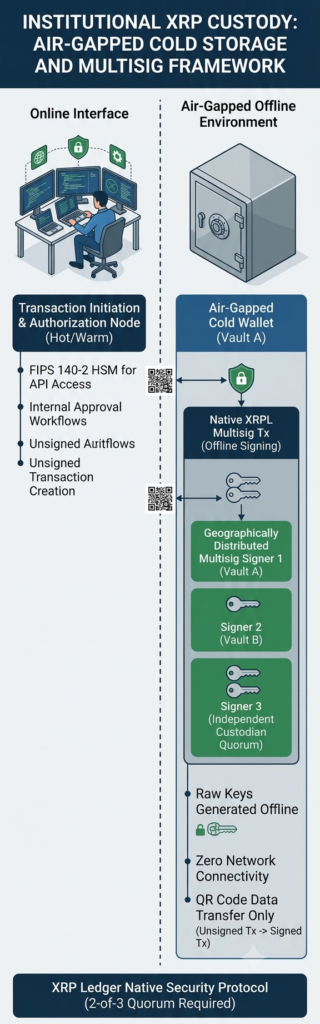
While cold storage isolates private keys from network attacks, reliance on a single key still presents a single point of failure (e.g., physical theft, extortion, or hardware failure). The XRP Ledger natively supports multi-signature protocols without requiring complex smart contracts, providing a robust built-in mechanism for governance and institutional XRP Custody.
(Alt Text: Secure institutional XRP Custody architecture featuring air-gapped cold storage and multi-signature protocol workflow)
Native XRPL Multisig Mechanism
Unlike platforms that rely on external layer-2 smart contracts for multisig functionality, the XRPL natively integrates SignerLists at the ledger layer. This drastically reduces attack surfaces and eliminates smart contract vulnerability risk.
- SignerListSet Format: An XRP Ledger account can configure a list of up to 32 authorized signer addresses.
- Quorum Threshold: A specific quorum weight is assigned to the account. For a transaction to be valid, the total weight of the attached signatures must meet or exceed the predefined threshold.
- Key Distribution: Keys can be geographically distributed across distinct physical vaults, independent corporate executives, and third-party escrow agents.
Sample Governance Configuration Table
| Role / Key Holder | Assigned Weight | Location / Storage Type | Governance Rule |
| Chief Financial Officer | 1 | Offline Cold Wallet (Vault A) | Required for daily operations |
| Managing Director | 1 | Offline Cold Wallet (Vault B) | Secondary signing authority |
| Institutional Custodian | 1 | HSM via API / Air-Gap | Independent approval node |
| Quorum Required | 2 of 3 | Multi-Vault Approval | Transaction Executed |
This 2-of-3 threshold structure ensures that no single individual can unilaterally execute a transaction, nor can the loss of a single key result in permanent lock-out of funds.
Regulatory Compliance, Insurance, and Custodial Models
For a deeper analysis of balancing risk exposures across broader asset portfolios, read our previously published guide on XRP Liquidity and Portfolio Risk Management.
Qualified Custody vs. Self-Custody
For institutional funds, wealth managers, and corporate treasuries, regulatory mandates often dictate the use of a Qualified Custodian under local financial regulations (such as SEC rules in the United States).
- Self-Custody: The investor retains complete control of private keys and multisig weights. This eliminates counterparty risk but shifts 100% of the operational security responsibility onto the internal team.
- Qualified Custody: A licensed trust company or bank holds keys on behalf of the client, offering institutional insurance coverage, regular audit reports (SOC 1 / SOC 2 Type II), and legal isolation of bankruptcy assets.
- Hybrid Custody: Combining self-custody cold wallets with an independent third-party custodian key in a 2-of-3 multisig scheme, balancing full control with institutional oversight.
Investors seeking technical specifications on native consensus and ledger mechanisms can review the official technical documentation at XRPL.org Documentation for detailed developer guidelines.
Furthermore, for a deeper analysis of balancing risk exposures across broader asset portfolios, read our previously published guide on XRP Liquidity and Portfolio Risk Management.
Step-by-Step Implementation Framework for Institutional Setup
Implementing a resilient cold storage and multisig setup requires a structured, multi-phase rollout to verify operational readiness before migrating capital.
+--------------------------------------------------------------------+
|                CUSTODY IMPLEMENTATION ROADMAP                      |
+--------------------------------------------------------------------+
|                                                                    |
|  [PHASE 1] Hardware Procurement & Clean Environment Prep           |
|       |                                                            |
|       v                                                            |
|  [PHASE 2] Key Generation & Offline Seed Backup Verification       |
|       |                                                            |
|       v                                                            |
|  [PHASE 3] XRPL SignerList Configuration & Quorum Testing           |
|       |                                                            |
|       v                                                            |
|  [PHASE 4] Low-Value Test Transactions (Send & Receive)            |
|       |                                                            |
|       v                                                            |
|  [PHASE 5] Capital Vault Transfer & Operational Auditing           |
|                                                                    |
+--------------------------------------------------------------------+
Phase 1: Clean Environment & Key Generation
- Procure enterprise hardware wallets directly from original manufacturers in tamper-evident packaging.
- Initialize devices on air-gapped workstations running verified operating systems.
- Record cryptographic recovery seeds on non-corrosive metal storage plates (e.g., titanium or stainless steel) rather than paper.
Phase 2: Configuring Multisig Quorum on XRPL
- Establish master accounts and secondary authorization accounts on the ledger.
- Issue a
SignerListSettransaction defining the weight of each public key and the required quorum threshold. - Verify account state using offline ledger explorers or local validation nodes.
Phase 3: Operational Dry-Run
- Execute low-value test transfers to confirm signing workflows across all distributed signers.
- Simulate a disaster recovery scenario (e.g., intentional loss of Key 1) to verify that remaining keys can successfully execute recovery and signer list modification transactions.
- Finalize operational runbooks and assign clear administrative responsibilities.
Best Practices for Physical Security and Disaster Recovery
Cryptographic controls are only as strong as the physical security protecting the underlying seed phrases and hardware devices. High-net-worth individuals and corporate entities must enforce strict physical access protocols.
Institutional Security Rule: Private key recovery seeds must never be photographed, stored in cloud text files, typed on a keyboard connected to the internet, or spoken aloud near smart devices.
Physical Vault Infrastructure
- Geographic Redundancy: Store backup components across multiple geographic zones to protect against natural disasters (floods, fires, earthquakes) or localized physical security breaches.
- Tamper-Evident Envelopes: Seal hardware devices and seed plates in serialized, tamper-evident bags. Audit seals on a mandatory quarterly schedule.
- Dual-Control Access: Access to physical safe deposit boxes or enterprise vaults should require two authorized personnel to be present simultaneously.
Strategic Summary: Establishing Complete Control Over Digital Holdings
Building an uncompromising digital asset strategy requires aligning technological capability with disciplined operational procedures. By combining air-gapped hardware cold storage, native XRPL multi-signature governance, and clear administrative workflows, investors can effectively eliminate single points of failure.
Whether managing a personal long-term position or overseeing corporate treasury allocation, prioritizing institutional XRP Custody guarantees that your assets remain secure, compliant, and ready to navigate the evolving global market landscape.
Implementing enterprise-grade XRP Custody protocols is the ultimate foundation for protecting long-term digital treasury allocations.
Strategic Implementation Roadmap for Institutions
Deploying an enterprise-grade XRP Custody infrastructure requires a structured, multi-tiered security operational workflow. Institutions should not rely solely on technical architecture; operational governance and continuous auditing are equally critical. Below are three essential operational mandates for institutional asset managers:
- Routine Key Ceremony Audits: Multi-signature configurations must undergo bi-annual operational dry-runs to verify that keyholders can execute disaster recovery protocols without compromising cold storage integrity.
- Granular Access Control Policies: Implement strict Role-Based Access Control (RBAC) and time-lock mechanisms on XRPL accounts. This ensures that high-value outgoing transfers require multi-party quorum approvals spanning distinct geographic jurisdictions.
- Cryptographic Redundancy: Store backup key shares (Shamir’s Secret Sharing or physical seed phrases) in tamper-evident, fireproof, and EMP-shielded physical vaults managed by independent third-party custodians.
By combining native XRPL multi-signature smart logic with air-gapped hardware execution, institutional treasuries can establish an unwavering XRP Custody framework built to withstand both external cyber threats and internal operational risks.
Institutional On-Ramp & Trading Infrastructure
Executing liquidity strategies within the XRPL DeFi ecosystem requires institutional-grade security, deep order book depth, and seamless fiat-to-crypto gateways.
Asset managers and corporate treasuries looking to deploy balance sheet capital can utilize our vetted liquidity partner portals featuring institutional KYC/AML compliance, reduced taker fees, and dedicated API endpoints:
- Institutional Exchange Gateway: Access deep XRP/USD and XRP/RLUSD trading pairs with tier-one fee discounts via our Institutional Partner Desk*.
- Custody & Liquidity Solutions: Secure institutional-grade storage and seamless native AMM deposits through XRPL Enterprise Liquidity Hub*.
*Disclosures: Gaori Hub maintains strategic affiliate relationships with compliance-first digital asset venues. Executing institutional onboarding via partner links provides accredited entities with fee-tier discounts while supporting our independent research operations.
Key Takeaways for 2026 Investors
Verify Recovery Protocols: Conduct bi-annual disaster recovery simulations to ensure operational readiness under all conditions.
Eliminate Single Points of Failure: Transition from single-key setups to native 2-of-3 or 3-of-5 XRPL multisig structures.
Maintain True Air-Gap: Ensure transaction signing keys never connect to online interfaces or non-secured local networks.