Meta Description:
An in-depth analysis of XRP Liquidity, institutional adoption, and strategic risk management practices for digital asset investors in 2026.
Introduction
The digital asset landscape in 2026 presents a mature market characterized by sophisticated financial infrastructure, heightened regulatory clarity, and increasing participation from institutional entities. Among major cryptocurrencies, XRP maintains a distinct value proposition centered on institutional liquidity, payment settling speed, and cross-border payment efficiency. As capital markets become increasingly integrated with distributed ledger technology, understanding the mechanics of digital asset liquidity is essential for managing portfolio volatility and optimizing risk-adjusted returns.
This article provides an educational overview of XRP’s liquidity mechanics, evaluating cross-border payment efficiencies, key metrics driving institutional adoption, order book depth, and actionable risk management strategies for contemporary digital asset portfolios.
1. The Financial Architecture of XRP Liquidity and Cross-Border Efficiency
“Understanding XRP Liquidity is fundamental for managing digital asset allocation.”
Liquidity in financial markets refers to the ease with which an asset can be converted into fiat currency or another asset without causing a significant shift in price. In the context of digital assets, liquidity is the foundation for low slippage, efficient market making, and swift settlement execution.
+------------------+     XRP On-Demand     +------------------+
| Sender Currency  | --------------------> | Target Currency  |
|  (e.g., USD/EUR) |    Liquidity (ODL)    |  (e.g., JPY/MXN) |
+------------------+                       +------------------+
         |                                           ^
         v                                           |
+-------------------------------------------------------------+
|                     XRPL Ledger Engine                      |
|            - Finality: 3–5 Seconds                          |
|            - Minimal Transaction Costs                      |
|            - Automated Market Maker (AMM) Depth             |
+-------------------------------------------------------------+
Mechanics of Cross-Border Payment Efficiency
Traditional cross-border payments rely on the correspondent banking framework, which requires pre-funded accounts (Nostro and Vostro accounts) across multiple jurisdictions. This system inherently ties up substantial capital, exposes transactions to multi-day settlement delays, and incurs high operational costs.
XRP and the XRP Ledger (XRPL) address these inefficiencies by serving as a bridge asset:
- Pre-funding Reduction: Financial institutions can source liquidity on-demand rather than maintaining dormant fiat reserves in foreign bank accounts.
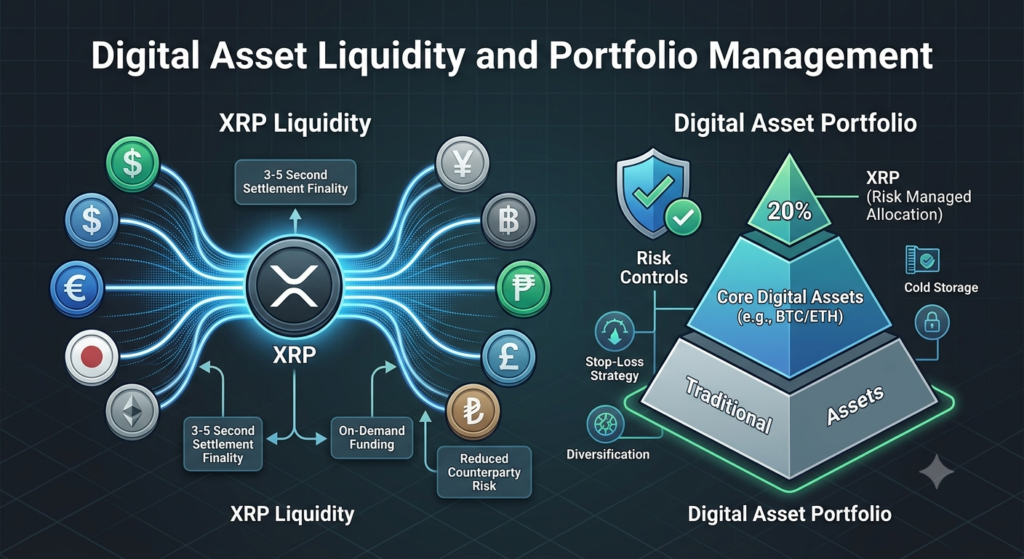
- Settlement Finality: The XRP Ledger achieves transaction consensus in 3 to 5 seconds, reducing counterparty risk and operational exposure during cross-border transfers.
- Transaction Cost Optimization: Settlement costs on the ledger remain nominal, preserving value across large-scale institutional volume transfers.
Order Book Depth and Arbitrage Mechanics
Deep liquidity across primary global digital asset exchanges ensures that large orders can be executed with minimal market impact. XRP’s liquidity architecture benefits from continuous arbitrage across fiat-to-crypto and crypto-to-crypto trading pairs. High market depth across international order books ensures that institutional payment flows—such as converting USD to XRP, transferring on-chain, and converting XRP to JPY—can occur almost instantaneously without causing price dislocation.
2. Metrics of Institutional Adoption and Market Depth
“Institutional investors prioritize XRP Liquidity to reduce slippage during high-volume trading.”
To evaluate the strength of XRP liquidity, investors must examine key structural metrics rather than relying solely on short-term price movements. Market participants look to network activity, order book resiliency, and institutional usage patterns to gauge long-term asset stability.
Key Institutional Indicators
| Metric | Significance to Portfolio Analysis | Impact on Liquidity |
| On-Chain Volume | Measures actual transactional utility on the ledger rather than speculative exchange trading. | Higher sustainable liquidity. |
| Bid-Ask Spread | Reflects market efficiency and market maker participation. | Tighter spreads lower execution costs. |
| Institutional ODL Volume | Tracks commercial payment flows routed via digital liquidity pools. | Reduces dependence on speculative retail capital. |
| Liquidity Hub Integration | Indicates integration into enterprise financial systems and treasury platforms. | Stabilizes order book depth across fiat pairs. |
Institutional On-Demand Liquidity (ODL) Utility
Institutional liquidity is primarily sustained through financial institutions utilizing enterprise liquidity management solutions. By routing cross-border remittances through XRP pools, payment providers replace traditional clearinghouses.
Furthermore, the integration of Native Automated Market Makers (AMMs) within the XRP Ledger allows protocol-level liquidity provision. This mechanism encourages long-term capital retention within liquidity pools, supplementing centralized order book depth with decentralized liquidity reserves.
3. Practical Portfolio Risk Management Strategies for XRP Investors
“Analyzing XRP Liquidity provides critical insights into cross-border settlement stability.”
While digital assets offer unique growth opportunities, market volatility requires a disciplined risk management framework. Incorporating XRP into a balanced financial portfolio demands rigorous asset allocation, strategic trade execution, and secure storage protocols.
Strategic Asset Allocation and Correlation Analysis
XRP often exhibits varying correlation coefficients relative to broader financial benchmarks, including equities, commodities, and major cryptocurrencies like Bitcoin and Ethereum.
Portfolio Allocation Framework (Illustrative)
+-------------------------------------------------------------+
| [80-90%] Core Traditional & Defensive Assets                 |
| (Equities, Fixed Income, Cash Equivalents, Real Estate)     |
+-------------------------------------------------------------+
| [10-20%] Digital Asset Allocation                           |
|   |-- Major Assets (BTC / ETH): 60-70%                      |
|   |-- High-Utility Protocols (XRP): 20-30%                  |
|   `-- Emerging Protocols / Cash Reserves: 10%               |
+-------------------------------------------------------------+
- Position Sizing: Depending on an investor’s risk tolerance, digital assets typically occupy between 1% to 10% of a total diversified portfolio. Within the digital asset allocation, utility-driven assets like XRP are structured based on an investor’s specific exposure goals.
- Rebalancing Protocols: Establishing systematic quarterly or semi-annual rebalancing schedules prevents asset price spikes from over-exposing the total portfolio to single-asset volatility.
Trade Execution and Stop-Loss Mechanics
To protect capital against unexpected market downturns, systematic order placement strategies should be utilized:
- Stop-Loss Orders: Trailing or fixed stop-loss orders help limit downside exposure. A predetermined loss threshold (e.g., 8% to 15% below entry price) preserves liquid capital during systemic market corrections.
- Dollar-Cost Averaging (DCA): Rather than executing lump-sum transactions, allocating fixed dollar amounts over time smooths out entry prices and mitigates the impact of short-term volatility.
- Limit Orders vs. Market Orders: Executing trades via limit orders ensures that transactions occur at specified prices, avoiding unexpected slippage in low-liquidity market environments.
Secure Custody: Cold Storage and Multisig Solutions
Risk management extends beyond market position sizing to encompass security practices. Institutional-grade custody protocols are vital for safeguarding digital holdings.
                          Digital Asset Custody Hierarchy
                                         |
                +------------------------+------------------------+
                |                                                 |
     [Cold Storage Protocol]                            [Institutional Custody]
     - Offline Private Keys                             - Multi-Signature (Multisig)
     - Hardware Wallets (Ledger/Trezor)                 - Institutional Custodians
     - Air-Gapped Key Generation                        - Insurance Coverage & Audits
- Cold Storage Protocols: Long-term holdings should be stored in hardware wallets or air-gapped devices that keep private keys completely offline, isolated from internet-connected vulnerabilities.
- Multi-Signature (Multisig) Governance: For larger holdings, multisig wallet architectures require multiple key approvals (e.g., 2-of-3 signature requirement) to authorize transactions, reducing single-point-of-failure risks.
- Exchange Exposure Limits: Digital asset exchanges should be viewed primarily as execution venues rather than long-term custodians. Retaining minimal working capital on centralized exchanges limits counterparty risk.
Advanced Liquidity Assessment and On-Chain Analytics
To properly evaluate XRP Liquidity, institutional research desks look closely at on-chain telemetry rather than short-term price movements on centralized exchanges. The total volume of transactions settled over the XRP Ledger provides an accurate signal of actual network utility. High transaction velocity combined with consistent volume indicates a healthy, functioning liquidity bridge capable of handling large-scale foreign exchange operations.
Furthermore, analyzing order book depth across key fiat corridors—such as USD/XRP, EUR/XRP, and JPY/XRP—reveals how resilient the asset is during sudden market shocks. When market depth remains robust across multiple geographic order books, large institutional transactions can settle seamlessly without experiencing substantial execution slippage. Integrating these structural liquidity metrics into a standardized evaluation checklist enables digital asset managers to optimize trade execution and maintain capital security.
Managing Counterparty Risk in Liquidity Provision
When participating in digital asset liquidity pools or automated market making (AMM) protocols, institutional investors must systematically evaluate counterparty and Smart Contract risk. While on-chain liquidity solutions offer competitive yield generation and efficient capital routing, protocol vulnerabilities can lead to unexpected capital loss. Evaluating auditor credentials, checking code immutability, and verifying total value locked (TVL) metrics are essential prerequisites before allocating capital to decentralized liquidity pools.
Additionally, understanding market volatility dynamics across different global trading sessions ensures that stop-loss thresholds remain responsive during low-liquidity hours. Liquidity depth often fluctuates between the Asian, European, and American market closes. By adjusting order parameters according to session liquidity levels, digital asset managers minimize execution slippage and maintain steady portfolio protection across volatile market cycles.
Integrating Automated Risk Monitoring Tools
In addition to structural liquidity assessments, institutional investors increasingly rely on automated risk monitoring tools to safeguard digital assets. Algorithmic alerts triggered by anomalous volume spikes, sudden depth collapse in key fiat order books, or rapid shifts in funding rates can provide critical early-warning signals.
By setting up dynamic volatility notifications, portfolio managers can execute predefined hedging strategies before systemic liquidation cascades occur. Incorporating real-time liquidity analytics alongside disciplined position sizing ensures a fully integrated risk control layer for digital asset portfolios in 2026.
Future Institutional Outlook for XRP Liquidity
As global regulatory frameworks clarify, institutional participation in cross-border crypto settlement will continue to scale. Strategic asset managers who continuously audit order book depth and maintain tight risk controls will be best positioned to capitalize on growing network adoption throughout 2026 and beyond.
For more market insights, check our previous crypto analysis guides
Institutional On-Ramp & Trading Infrastructure
Executing liquidity strategies within the XRPL DeFi ecosystem requires institutional-grade security, deep order book depth, and seamless fiat-to-crypto gateways.
Asset managers and corporate treasuries looking to deploy balance sheet capital can utilize our vetted liquidity partner portals featuring institutional KYC/AML compliance, reduced taker fees, and dedicated API endpoints:
- Institutional Exchange Gateway: Access deep XRP/USD and XRP/RLUSD trading pairs with tier-one fee discounts via our Institutional Partner Desk*.
- Custody & Liquidity Solutions: Secure institutional-grade storage and seamless native AMM deposits through XRPL Enterprise Liquidity Hub*.
*Disclosures: Gaori Hub maintains strategic affiliate relationships with compliance-first digital asset venues. Executing institutional onboarding via partner links provides accredited entities with fee-tier discounts while supporting our independent research operations.
Conclusion
XRP Liquidity serves as a foundational component of modern cross-border financial engineering, bridging traditional institutional banking with decentralized ledger technology. By providing rapid settlement finality and operational efficiency, the asset fulfills a specific utilitarian function within global payments infrastructure.
For investors navigating the digital asset market in 2026, capital preservation relies on balancing exposure to utility-based protocols with rigorous risk management principles. Through disciplined asset allocation, structured stop-loss mechanisms, and robust offline custody solutions, portfolio managers can effectively participate in the evolution of digital liquidity while insulating their capital against market volatility.